

Runway earned its reputation on raw generation quality, its Gen-4 model family, motion brushes, and inpainting tools sit alongside a real editing timeline, which is more than most single-model generators offer.
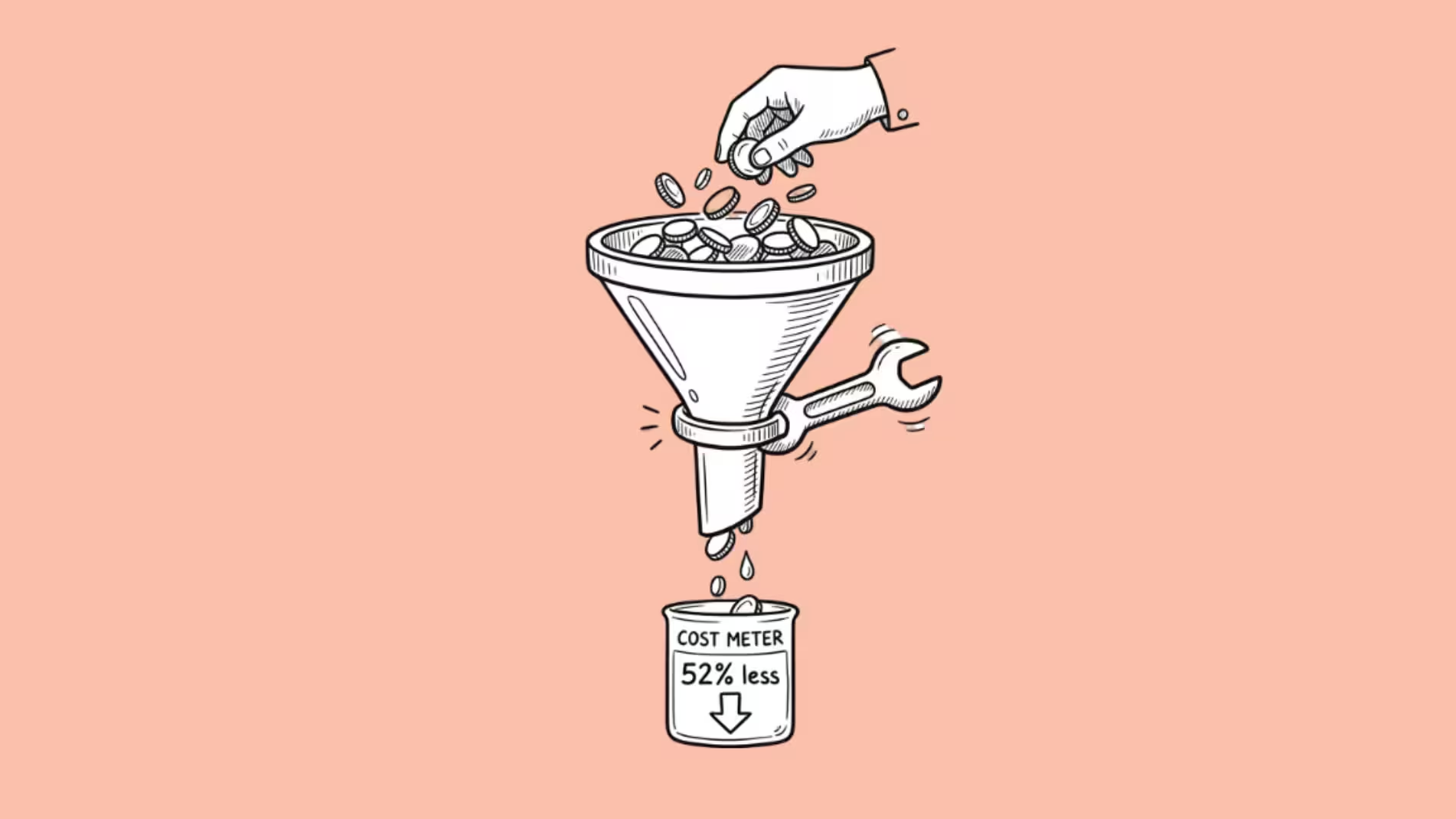
That quality has a price, though, and it’s charged by the second.
This guide walks through five Runway alternatives for AI filmmaking, from a full agentic production platform to budget-friendly social tools, so you can match the right one to the work in front of you.
Why creators look for Runway alternatives
Most of the complaints trace back to how Runway prices generation, since that shapes almost everything else people run into.
Credits are spent per second of generated footage, and rates vary by model and mode, Gen-4.5 alone runs a specific credits-per-second rate that’s changed as the model line has evolved. So the same monthly plan can produce very different amounts of finished footage depending on which model and resolution you’re using.
A few specifics worth knowing before you commit to a plan:
- Credits don’t roll over. Unused Standard, Pro, or Max credits expire close to your next billing date, so a slow month doesn’t bank anything for a busy one.
- Unlimited is gone. Runway retired its old Unlimited plan for new subscribers and replaced it with Max, a purely credit-based tier, heavy iterators no longer get an uncapped safety net.
- Pricing is per editor, not per workspace. Every paid tier is priced per seat, and paid editors on a team share one pooled credit balance instead of getting individual allowances.
- The iteration tax. AI video rarely lands on the first try. Several attempts per keeper is normal, which pushes your real cost per usable clip well past the plan’s sticker price.
To judge the five alternatives below fairly, we looked at pipeline depth (a full script-to-edit workflow vs. isolated clips), character and scene consistency, pricing predictability, model breadth, and commercial usage rights at the entry paid tier. None of these five wins on all five counts, the right one depends on what you’re actually producing.
The 5 best Runway alternatives at a glance
| Tool | Best at | Starts at | Free option |
|---|---|---|---|
| invideo Agent | Full agentic AI filmmaking, script to finished edit | $17/mo (annual) | No Free Trial |
| Krea AI | Cleaner model aggregator with a real time canvas | $9/mo | Yes (100 units/day) |
| Pika | Fast, playful clips for social | $8/mo (annual) | Yes (80 credits/mo) |
| Luma Dream Machine | Natural camera motion and physics | ~$30/mo | Yes (limited) |
| LTX Studio | Script to storyboard narrative planning | ~$15/mo (annual) | Yes (800 credits) |
Invideo Agent

Invideo Agent works less like a single generation model and more like a production crew. Instead of one tool handling every task, specialized Expert Agents, a DOP, a casting director, a storyboard artist, coordinate automatically on the same project, and a new agent added mid-shoot gets briefed on everything that’s already been decided without anyone re-explaining the project from scratch.
When it’s time to generate, the AI filmmaking engine turns the agreed script and shot list into finished scenes directly, and Slate, the agent’s built-in timeline editor, assembles approved takes into a rough cut from plain-language instructions instead of manual trims and drag-and-drop edits.
For shots that need hands-on control rather than full agent autonomy, Notebooks opens the same 200+ models for manual, one-off generation, and any work done there carries over automatically when you switch back to agent mode, so nothing has to be re-uploaded or re-explained.
Best for: Film productions that need script, style, generation, and editing in one place, with consistency held across an entire project rather than one clip.
Where it falls short: The full-project, context-heavy approach introduces more structure than a creator needs for one quick, disposable clip.
Pricing: Plus $17/mo, Max $85/mo, Generative $170/mo, Elite $900/mo, all billed annually with a built-in discount.
Krea AI
Best for: Creators who want a cleaner model aggregator with real-time, sketch-to-render tools built in.
Krea bundles 60+ image and video models, Flux, Veo, Kling, and Runway itself among them, behind one interface, so switching models doesn’t mean switching accounts and billing. Its Realtime Canvas is the standout: sketch or upload an image on one side and watch a photorealistic render generate on the other in under a second.
That breadth is aimed more at image and quick concept work than long-form filmmaking, video generation draws down its unit-based credits fast, and heavier video use pushes you toward the Pro or Max tiers quickly.
Where it falls short: It’s a strong aggregator for stills and short concept clips, but it doesn’t offer a script-to-edit production pipeline the way invideo Agent or LTX Studio do.
Pricing: Free (100 units/day), Basic $9/mo, Pro $35/mo, Max ~$70/mo, Business $200/mo.
Pika
Best for: Social media creators and marketers who want fast, visually distinct clips without a learning curve.
Pika trades cinematic depth for speed and personality. Its Pikaffects (melt, explode, inflate), Pikaframes keyframe tool, and Pikaformance lip-sync are built for short, punchy clips rather than long narrative sequences.
Clips cap out around 10 seconds and photorealism trails Runway and the bigger cinematic models, but for TikTok, Reels, and Shorts output, that trade-off rarely matters to the audience watching.
Where it falls short: Continuity across many shots isn’t the point here, it’s a tool for standalone clips, not multi-scene productions.
Pricing: Free (80 credits/mo), Standard $8/mo, Pro $28/mo, Fancy $76/mo, all billed annually.
Luma Dream Machine
Best for: Creators who care most about how convincingly the camera and physics behave.
Luma’s Dream Machine, built on the Ray model family, earns its reputation through smooth, natural camera movement, a byproduct of Luma’s roots in 3D capture technology. It’s a strong pick for product shots or anything that needs to feel grounded in real space.
Luma has also grown a bundling layer of its own, called Luma Agents, which pulls in outside models like Veo, Kling, and Seedance alongside Luma’s own Ray models under one credit pool.
Where it falls short: There’s no script-to-edit production pipeline here, so assembling a full film still means exporting into another editor.
Pricing: Free tier available; Plus ~$30/mo, Pro ~$90/mo, Ultra ~$300/mo (roughly 20% cheaper billed annually).
LTX Studio
Best for: Filmmakers who want to plan and adjust an entire multi-scene story before committing to final renders.
LTX Studio, built by Lightricks, starts from a script instead of a single prompt. It auto-generates a multi-scene storyboard, then lets you adjust lighting, swap actors, or reposition the camera in 3D space shot by shot before anything renders.
That script-in, storyboard-out structure makes it feel closer to a directing tool than a clip generator, which suits creators planning a full short rather than chasing one hero shot.
Where it falls short: It has no native AI music generation, and commercial usage rights only kick in at the Standard tier or above.
Pricing: Free tier available; Lite ~$15/mo, Standard ~$35/mo, Pro ~$125/mo, billed annually.
Which Runway alternative should you use?
There’s no single best pick, because the right one depends on the job in front of you.
- Want a full AI filmmaking crew that handles a whole project, not just clips? invideo Agent.
- Want a wide menu of models with real-time sketch-to-render tools? Krea AI.
- Making fast, stylized clips for social? Pika.
- Chasing the most natural camera motion and physics? Luma Dream Machine.
- Planning a multi-scene narrative before you render anything? LTX Studio.
The bottom line
Most of the alternatives above offer a free tier or trial, so the smartest move is testing two or three on the same brief and comparing what actually comes out. Pay attention to the real cost per usable clip, not the headline price, iteration is where AI video budgets quietly disappear.
If the job is a real production, a short film, an episodic series, or a campaign that needs a character or brand to hold together across dozens of shots, invideo Agent is the one on this list built specifically to do that as an AI filmmaking collaborator rather than a single-prompt tool.
Common questions about Runway alternatives
Is there a free alternative to Runway for making AI video? Pika, Luma Dream Machine, LTX Studio, and Krea AI all have free tiers, and invideo Agent offers a free trial, though each one restricts resolution, watermarks output, or caps generations until you upgrade. None of them support a full paid production on the free tier alone.
Which Runway alternative is best for keeping a character consistent across many shots? Invideo Agent is built around this specifically, using a persistent context engine that holds character, product, and location references across an entire project. Pika and Krea AI are built more around strong individual clips than long-run continuity.
Do any of these tools handle a full production pipeline, not just clip generation? Invideo Agent and LTX Studio both go beyond single-clip generation. Invideo Agent covers scripting through editing inside one agent-driven workflow, while LTX Studio focuses on script-to-storyboard planning before rendering.
Are these tools cheaper than Runway? It depends on the tier. Pika’s entry plan and the Plus tier of invideo Agent both start below Runway’s Standard plan, while Luma Dream Machine’s higher tiers and the Elite tier of invideo Agent run well above Runway’s published range. Pricing across all of these platforms, including Runway’s, has shifted more than once in 2026, so it’s worth checking each provider’s live pricing page before you commit.
