


CodeRabbit has done something genuinely impressive. It helped bring AI-powered code review to the mainstream.
Over two million repos connected, more than thirteen million PRs reviewed, and a $550 million valuation backed by some serious investors.
But here’s the thing about developer tools: what works for a 5-person startup building a React app doesn’t always work for a 200-person engineering org running microservices across three languages.
Teams have different stacks, different budgets, different tolerance for “helpful” AI comments that aren’t all that helpful.
So this article isn’t a hit piece on CodeRabbit. It’s a guide for developers and engineering leads who’ve tried it (or looked at it) and want to know what else is out there.
Whatever brought you here, by the end you’ll have a clear picture of which tool matches your team’s size, workflow, and biggest pain points.
Let’s dig in.
The 7 Best CodeRabbit Alternatives
1. Qodo Merge (Formerly CodiumAI)
If privacy and platform flexibility are at the top of your list, Qodo Merge deserves a hard look. It started as an AI test generation tool and has evolved into one of the most full-featured code review platforms available.
The big differentiator is that it is open-source, and you can self-host the whole thing.
That means your code never has to leave your infrastructure. It works with GitHub, GitLab, Bitbucket, and even Gitea making it one of the most platform-flexible options on this list of CodeRabbit alternative.
Qodo also goes beyond surface-level style feedback. It focuses on test generation, logic bugs, and catching the kind of mistakes that actually break things in production. One recent evaluation ranked it as the strongest overall AI code review tool for depth and detail.
Watch out for: The broader feature set comes with a steeper learning curve. Self-hosting requires DevOps resources, and the credit-based pricing model can get restrictive if your team reviews a lot of code.
Best for: Teams in regulated industries that need on-prem deployment and multi-platform support.
2. Sourcery
Sourcery has been around since the early wave of AI coding tools, and it’s matured into a surprisingly polished product.
It reviews PRs on GitHub and GitLab, runs inside VS Code and JetBrains IDEs, and supports over 30 programming languages.
What makes Sourcery different from CodeRabbit is its approach to noise.
Sourcery learns from your feedback. If you dismiss a certain type of comment as unhelpful, it adapts and stops repeating it. Over time, your reviews get quieter and more relevant. It also generates visual diagrams to explain code changes, which is genuinely useful for onboarding new team members.
The Pro plan starts at $12 per month per developer, roughly half of CodeRabbit’s price. There’s also a free tier for open-source projects.
Watch out for: Some evaluations have noted that Sourcery reviews one file at a time, so it can miss cross-file dependencies. It’s also been flagged as slower than some competitors.
Best for: Small to mid-size teams that want clean, quiet reviews without spending a fortune.
3. GitHub Copilot Code
If your team already lives inside GitHub and pays for Copilot, this one’s a no-brainer to at least try.
GitHub Copilot’s code review feature hit general availability in April 2025, and within a month, it had over a million users.
You assign Copilot as a reviewer on your PR and it leaves inline comments with suggested fixes.
The October 2025 update gave it more teeth: it now reads source files, explores directory structures, and integrates CodeQL and ESLint for security scanning. For zero-friction AI review inside a workflow you already use, nothing beats it.
Watch out for: It’s diff-based, meaning it only sees what changed in the PR, not the broader codebase. That makes it weak on architectural issues and cross-file bugs.
There’s also no real analytics or enforcement layer. You can’t set quality gates or track review impact over time.
Best for: GitHub-native teams who want to add AI review without touching their workflow.
4. Greptile
Greptile takes a fundamentally different approach: it indexes your entire codebase before it reviews a single line.
That gives it deep context awareness that most competitors simply don’t have.
When Greptile flags an issue, it shows you evidence from across your repo, not just a vague suggestion based on the diff.
Version 3 (launched late 2025) uses the Anthropic Claude Agent SDK for autonomous investigation, meaning it can dig into your codebase to find the root cause of a problem, not just flag the symptom.
At $30 per developer per month, it’s pricier than some alternatives, but for teams where one missed cross-file bug costs thousands in production incidents, the math works out.
Watch out for: Independent evaluations show Greptile has the highest catch rate among AI reviewers but also the highest false positive rate. You’ll get more real bugs and more noise. That’s a trade-off you’ll need to be comfortable with.
Best for: Teams with complex, multi-service codebases where cross-file context matters more than anything.
5. Codacy
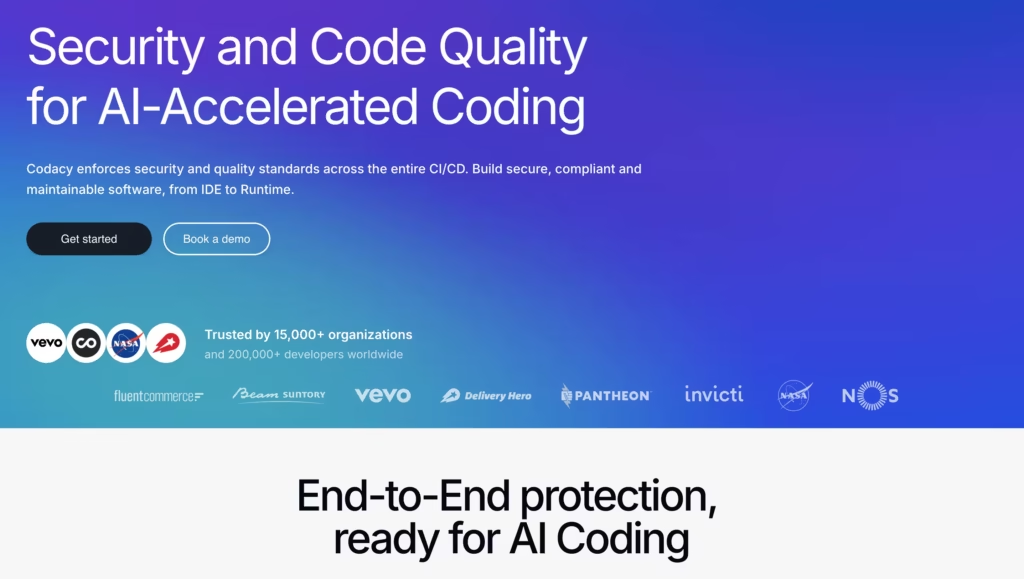
Codacy isn’t the newest tool on this list, and it doesn’t have the flashiest marketing.
But it’s been in the automated code review space since 2012, and it has something most AI-first tools don’t: breadth.
With support for over 40 programming languages and built-in quality gates that can actually block a merge, Codacy is built for teams that want guardrails, not suggestions, making it one of the best CodeRabbit alternative to check out.
The platform combines traditional static analysis (SAST, secret detection, dependency scanning) with an AI layer that adds context to PR comments and offers one-click fixes.
It also integrates with Jira and Slack, which makes it easy to slot into existing engineering workflows.
Pricing starts at $15 per user per month, and there’s a free tier for open-source projects.
Watch out for: The AI features aren’t as advanced as newer tools like CodeRabbit or Qodo. If cutting-edge AI review is your top priority, Codacy might feel a step behind. But if you want comprehensive code health tracking alongside review, it’s hard to beat.
Best for: Mid-size to large teams that want code review, security scanning, and quality dashboards all in one place.
6. DeepSource
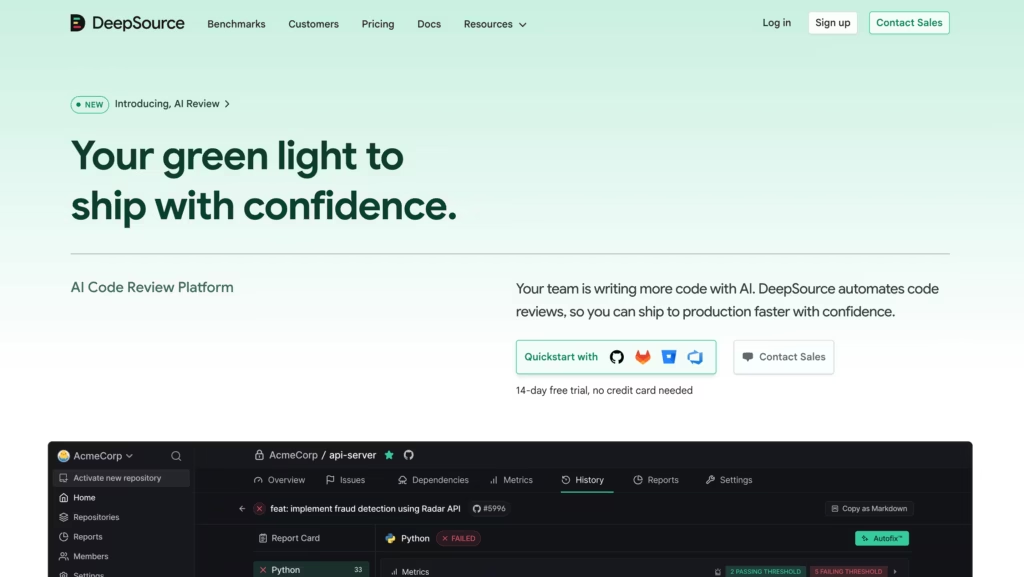
DeepSource focuses on something a lot of AI review tools talk about but few actually deliver: auto-fixing issues, not just flagging them.
Its Autofix feature can detect problems and generate patches automatically, which means less time going back and forth between the reviewer and the developer.
The platform supports 20+ programming languages and integrates with GitHub, GitLab, and Bitbucket.
It also comes with enterprise-grade security compliance (HIPAA, SOC 2 Type II), which makes it a solid pick for teams with strict regulatory requirements.
One thing to note: DeepSource recently restructured its pricing.
The old free plan is being replaced with an Open Source plan limited to public repos.
The Team plan starts at $12 per developer per month (billed annually), but AI Review features carry additional usage-based costs on top of that, $8 per 100,000 lines of input code analyzed.
Watch out for: That usage-based pricing can get expensive for large, active codebases. Teams with high code volume have reported bills significantly higher than the base subscription would suggest. Do the math before you commit.
Best for: Teams that want auto-fixes, strong static analysis, and compliance certifications but keep an eye on usage costs.
7. Graphite
Graphite is a different animal. It’s not primarily an AI code review tool, it’s a developer workflow platform built around stacked pull requests and fast merge cycles.
Think of it as “what if GitHub’s PR experience was rebuilt from scratch for speed?”
The AI review component is a layer on top of that workflow.
Graphite Agent understands your full codebase and reviews changes in the context of stacked PRs, which means it can catch issues that tools reviewing one PR in isolation would miss.
For teams that ship dozens of PRs a day and care deeply about merge velocity, that’s a compelling combo.
Watch out for: Graphite’s user base is smaller than the other tools on this list of CodeRabbit alternative, and the AI review features are newer. If you’re not already bought into the stacked-PR workflow, there might not be enough here to justify switching.
Best for: Fast-moving teams that already use (or want to use) stacked PRs and need an AI reviewer that understands that workflow.
How to Actually Decide (Without Overthinking It)
Still not sure which tool fits? Here’s a quick decision guide:
If privacy is non-negotiable → Qodo Merge. Self-host everything. Your code stays on your servers.
If you want the cheapest option that still works → Sourcery. At $12/dev/month with adaptive noise control, it’s solid value.
If you’re already paying for GitHub Copilot → Try Copilot Review first. It’s included in your subscription and takes zero setup.
If cross-file bugs keep biting you → Greptile. The full-codebase indexing catches things other tools miss.
If you need code health dashboards and security scanning → Codacy. It’s the Swiss Army knife of this list.
If you want auto-fixes, not just flags → DeepSource. But watch the usage-based pricing.
If you ship tons of PRs and live for speed → Graphite. Especially if you’re already into stacked PRs.
Here’s my real advice, though: pick two tools from this list.
Run them in parallel on the same repo for two weeks. Most offer free tiers or trials. Then ask your team one question: “Which one made your review process feel lighter?”
The best AI code review tool isn’t the one with the most features. It’s the one your team actually keeps turned on.
