

Information needs to be digitized first before AI can create substantial value. That’s why high-quality archival scanners are still important: they can accurately record everything from handwritten ledgers and big maps to artwork, newspapers, and bound volumes for long-term storage.
As libraries, museums, archives, and government agencies keep digitizing their collections, many are turning to a powerful new tool called Artificial Intelligence (AI) that speeds up the process and reveals more information.
Here’s how AI is changing digital archiving and why it becomes even more important once your items have been fully scanned.

How has digitization changed from scanning to understanding?
Scanners that are still in use only turn paper into image files like JPEGs and PDFs. The process is quick, but the result is limited: you just get a photograph. You can’t search the text, break it down, or do anything useful with it.
For a long time, “digitization” meant putting papers into a machine and getting static PDFs. It was helpful, but it didn’t change anything. The plot changed because of AI.
What started as simple OCR has become a complex system that not only reads text but also understands it, sorts it, and makes it into valuable, organized data. Tasks that used to take hours of human sorting—something everyone who works in law, finance, or compliance is familiar with—can now be done automatically with amazing accuracy.
AI OCR: Making Scans into Data That Is Smart, Searchable, and Useful
AI-powered document scanning is a lot more than regular OCR. It doesn’t only recognize characters; it also pulls out meaning, context, and structure.
1. AI OCR: More accurate and works with more things
More accurate as time goes on. Machine learning models get better at recognizing things all the time, which means fewer mistakes and misreads with each scan.
Works with a lot of languages and formats. AI OCR makes it easy to work with documents in many languages and formats, which makes it perfect for international companies.
2. NLP: Knowing what words mean, not just what they seem like
OCR finds letters, and NLP (Natural Language Processing) figures out what they mean.
AI can do things on its own:
- Get the date, sum, and invoice number from receipts.
- Find important terms in contracts
- Tag themes, types of documents, and groups of content
- Based on the criteria set by the government, flag sensitive information
This comprehension of the context makes static files into useful data assets for legal, compliance, and financial teams.

3. AI image enhancement for scans that are cleaner and more accurate
AI vision algorithms are currently used by modern scanners to complete jobs that used to be done by hand:
- Taking away shadows
- Making curved book pages flat
- Getting rid of wrinkles or fold lines
- Automatically trimming and fixing pages that are crooked
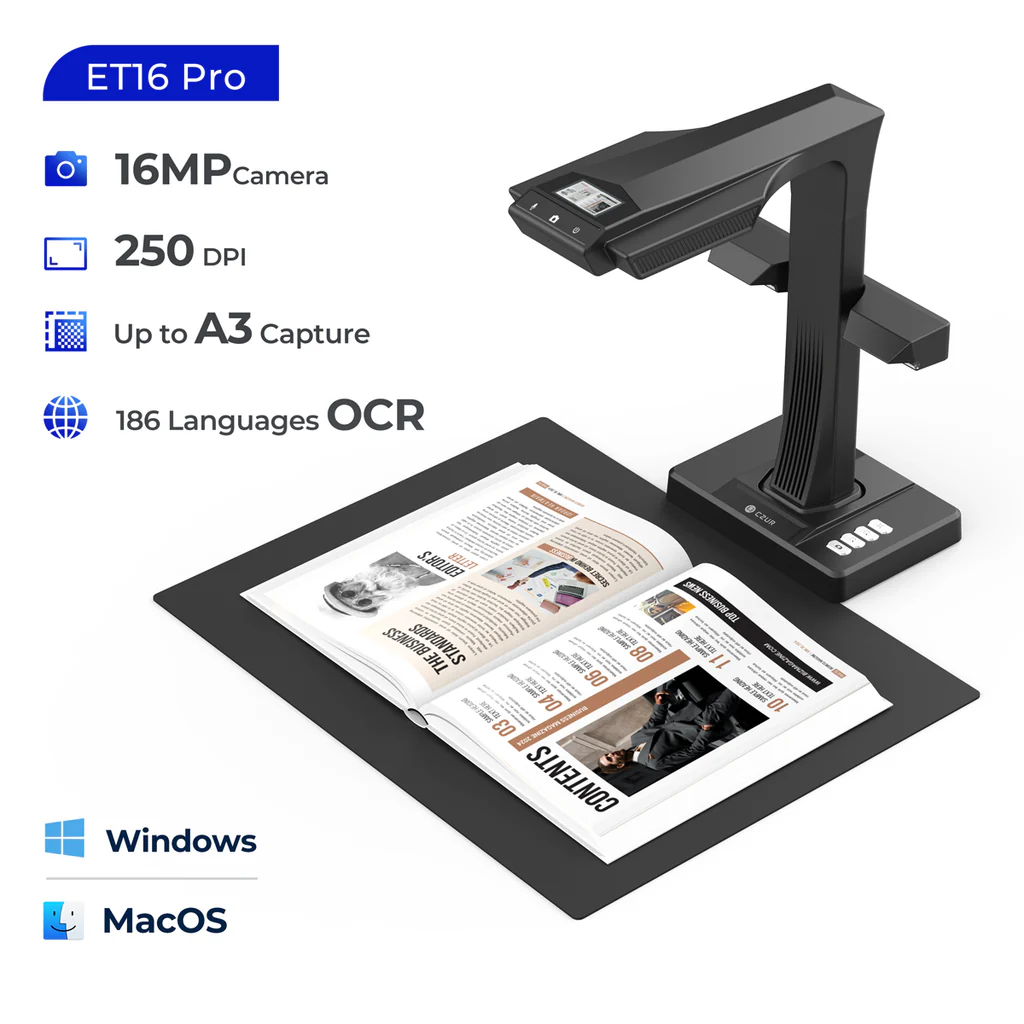
The scanner can automatically flatten pages and find spine curvature in heavy volumes. This gives you near-flatbed quality and speeds up batch scanning by a lot.
CZUR Smart Scanner: A Smart Way to Digitize Things
CZUR smart scanners use AI to process images and provide a full end-to-end digitization workflow.
- OCR is built in with ABBYY as the engine
- searched PDFs, Word files, Excel spreadsheets
- Each scan takes as fast as 1.5 seconds
- Technology for Flattening Curves™
The scanner uses a laser sensor array to trace the curvature of the page in real time and automatically flattens the image, getting rid of distortions and cutting down on the need for manual adjustments.
- Tools for automated, smart workflows.
Auto-scanning when a page turn is detected.Auto Finger Removal to get rid of hands that are in the way
- Book scanning with Auto Page Splitting
These features speed up the whole process and make digitalization on a big scale much more efficient.
Where AI-Powered Digitization Makes the Biggest Difference
- Money and Business
AI can pull important information from bills, such as amounts, dates, and account numbers, and send it straight to accounting systems. Research shows that AI-based invoice recognition can cut down on mistakes when entering data by more than 90% and cut the time it takes to process by half.
- Learning and Research
Schools and research institutes can turn textbooks, manuscripts, and notes into digital files, which makes it easier to find content and search for keywords quickly.
- The government and healthcare
AI helps automate electronic medical records (EMR), safely handling patient data, smartly storing public records, and getting old documents back faster.
- For use at home and for personal reasons
Families can scan and put things in order:
- Tax papers
- Proofs
- Receipts
- Records about you
All of them can be readily stored, backed up, and searched.
The Core Value of AI-Powered Document Digitization
- Streamlined Workflows and Enhanced Productivity
AI-powered document scanning technology can now automate processes that once required significant time and manual effort. The time savings are substantial.
Imagine compliance officers who previously spent hours manually reviewing documents—now, with AI, the same work can be completed in minutes. More importantly, AI’s accuracy significantly reduces the risk of compliance violations caused by human error.
In addition, AI-driven document scanning can integrate with various platforms to enable seamless workflow automation. This integration facilitates rapid sharing and collaboration, which is essential in today’s remote work environments and distributed teams.
- Ensuring Security and Regulatory Compliance
Security can never be overlooked, especially when handling sensitive information. AI-powered OCR offers multiple layers of protection, from data encryption to role-based access control.
For organizations bound by regulations such as GDPR, HIPAA, and SOX, AI-enabled compliance automation ensures adherence to these standards—helping avoid costly penalties and maintaining trust with clients and stakeholders.
- Seamless Integration
Digitized documents can be directly imported into ERP, CRM, and other enterprise systems, creating a highly efficient closed-loop workflow that connects data with decision-making processes.
Together, these advantages make AI-driven document digitization a critical pillar of modern enterprise information management and digital transformation.
The Future of Document Processing: IDP (Intelligent Document Processing)
Document processing is shifting from traditional OCR to the more advanced IDP (Intelligent Document Processing). IDP combines AI, NLP (Natural Language Processing), and machine learning to automatically extract structured data from large volumes of unstructured documents. Today, more and more businesses are adopting real-time, API-driven IDP platforms to achieve higher accuracy, greater scalability, and smarter end-to-end automation across their entire document workflow.
When Documents Start to “Think”: The Main Goal of Digital Transformation
The key purpose of using AI to digitize documents is not to get rid of people. The goal is to make them more productive. AI turns stacks of paper into smart, organized data assets that can be searched, shared, analyzed, and acted on. Choosing the right smart scanner is more than simply a tech choice; it’s a step toward a digital workplace that is smarter, more productive, and more creative.
