
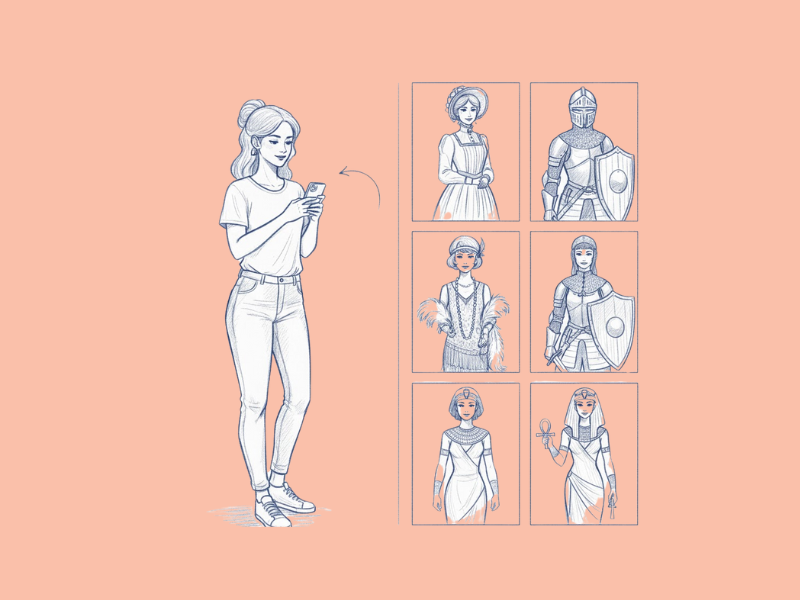

Remember those AI-generated historical photos that flooded social media in late 2022 and 2023? Your college roommate as a 1920s flapper.
Your dad dressed like a medieval knight. Your neighbor looking absolutely regal in Renaissance garb. Most of those viral images came from one place: MyHeritage’s AI Time Machine.
The tool was a massive hit. Millions of people uploaded their photos and transformed themselves into Vikings, Egyptian pharaohs, and Victorian ladies. But then, quietly, it disappeared.
So what happened to MyHeritage’s AI Time Machine? Was it actually worth the hype when it was available? And more importantly, what can you use instead now that it’s gone?
I’m going to break down everything you need to know about this viral AI tool, what made it special, and where you can get similar results today.
What Was MyHeritage’s AI Time Machine?
MyHeritage is a genealogy company that’s been around since 2003. They’re legit, they help people build family trees, search historical records, and do DNA testing.
The AI Time Machine wasn’t their main business. It was a fun side project that launched in November 2022 and quickly went viral.
The Time Machine used AI models (similar to the tech behind Gemini and ChatGPT) to generate photorealistic images of you in different historical periods.
You’d upload a few photos of yourself, and within minutes, you’d get images of yourself as a Viking warrior, Victorian gentleman, ancient Greek philosopher, or dozens of other time periods and cultures.
Here’s what made it different from just slapping a filter on your photo: The AI didn’t just change your clothes or add a sepia tone.
It actually reconstructed your face and entire appearance to match the photography style, clothing, lighting, and cultural aesthetics of specific time periods.
The results looked like someone actually photographed you in 1850 using the camera technology available back then.
The tool offered over 100 different themes spanning ancient civilizations to the modern era. Options included:
- Ancient Egypt, Rome, and Greece
- Medieval Europe
- Renaissance and Baroque periods
- Victorian and Edwardian eras
- Roaring 1920s
- Various cultural aesthetics from around the world
- Even futuristic and fantasy themes
Each theme generated multiple variations, so you weren’t just getting one image per time period. You typically got 8-10 different poses and styles per theme.
How Did It Actually Work?
The process was pretty straightforward, which was one of its biggest selling points. You didn’t need to be tech-savvy or spend hours figuring out complicated settings.
First, you uploaded 10-25 photos of yourself. MyHeritage recommended using clear, well-lit photos where your face was visible and you were looking at the camera.
The AI needed to understand what you actually looked like from different angles. Selfies worked. Professional headshots worked. That blurry photo from your cousin’s wedding? Not so much.
Once you uploaded your photos, the AI trained a model specifically on your face. This took about 30 minutes to a few hours, depending on how busy their servers were. Users reported that weekday mornings were faster than weekend evenings.
After the training finished, you could select which themes you wanted.
Each theme generated a batch of images, usually 8-10 photos per theme. The generation process took another 10-20 minutes per theme.
Then boom. You had your historical portraits ready to download, share, or print on canvas.
The technology behind this was actually fascinating. The AI didn’t just paste your face onto a template. It used something called “stable diffusion” combined with facial recognition to genuinely reimagine how you’d look in different contexts.
The AI considered lighting conditions from those eras, typical photography techniques, clothing styles, hair trends, and even the facial expressions that were common in historical photos.
MyHeritage licensed this technology from Astria, a company specializing in AI-generated imagery.
Why Was It So Popular?
AI Time Machine went absolutely viral within hours of launching. Here’s why it captured everyone’s attention:
The quality was legitimately stunning. These weren’t obviously fake or cartoonish images. They looked like authentic historical photographs. The lighting, the texture, the grain of “old photographs” – everything felt real. People genuinely thought they were looking at century-old portraits.
It was fast and easy. Unlike planning an actual themed photoshoot (with costume rentals, photographers, and locations), you could generate dozens of historical portraits in an evening while sitting on your couch.
The variety kept things interesting. With over 100 themes, you could explore different eras and cultures. The tool included diverse representation beyond just European history, Asian, African, Middle Eastern, and indigenous cultures were all featured.
The social media engagement was incredible. Posts featuring AI Time Machine photos got way more comments and shares than typical content. There was something universally appealing about seeing familiar faces in unfamiliar historical contexts.
It made great gifts. People printed these portraits as personalized gifts for family members. A portrait of your mom as a 1950s Hollywood starlet or your dad as a Wild West cowboy? That’s way more interesting than another gift card.
It introduced people to AI technology. For many users, this was their first hands-on experience with AI image generation. It showed what modern AI could do in a fun, accessible way.
The Not-So-Good Stuff: Limitations It Had
It required a subscription for full access. The free trial was extremely limited – you got one theme and that was it. To really use the tool, you had to pay. Pricing ranged from $12 for 20 themes to $39 for complete access to all themes.
It struggled with certain faces. If you had very distinctive features – a thick beard, very curly hair, prominent birthmarks – the AI sometimes got confused. Beards could look painted on. Glasses either disappeared entirely or created weird glare effects.
Skin tone accuracy was hit or miss. While MyHeritage improved this over time, the AI sometimes lightened or darkened skin tones in ways that felt off. This was particularly noticeable in themes depicting specific cultures.
Group photos didn’t work. The tool was designed for individual portraits only. If you uploaded photos with multiple people, it might grab the wrong face or create weird composite results.
Historical accuracy wasn’t guaranteed. Sure, the images looked old, but they weren’t always accurate to the actual time period. The tool sometimes mixed elements from different decades or regions. Historians definitely noticed the anachronisms.
The uncanny valley was real. About 30-40% of generated images had something slightly…off. Maybe the eyes didn’t quite match. Maybe the lighting on the face didn’t match the lighting on the clothes. Once you saw it, you couldn’t unsee it.
Privacy concerns existed. You were uploading multiple photos of your face to a company’s servers where they trained an AI model specifically on your appearance. While MyHeritage had security measures in place, privacy-conscious users had legitimate concerns.
What Happened to AI Time Machine?
This is the big question. MyHeritage hasn’t made an official announcement about discontinuing AI Time Machine, but the evidence is clear:
- The original URL now redirects to LiveMemory, a different AI tool
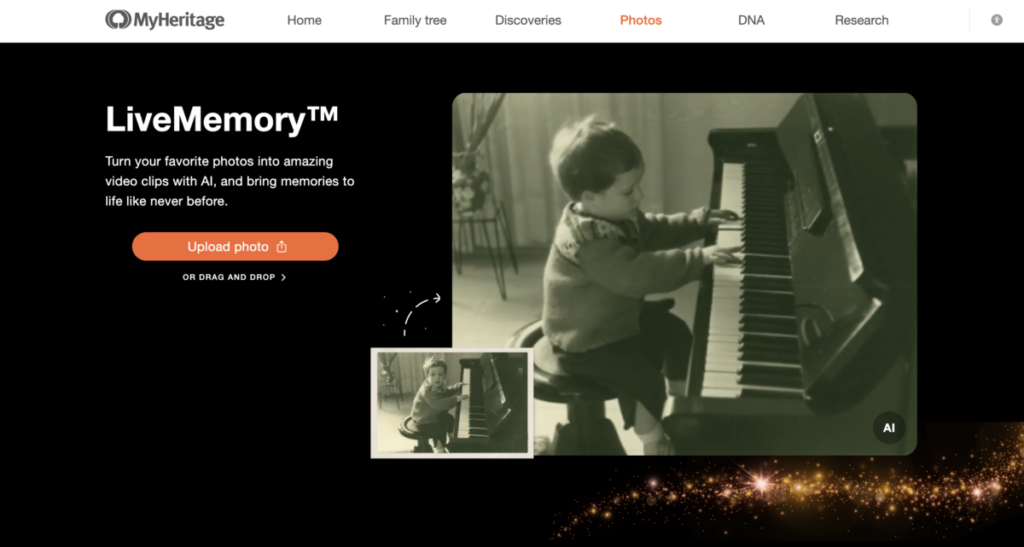
- AI Time Machine no longer appears in MyHeritage’s main Photos menu
- The feature isn’t listed among their current AI offerings
Why did it likely disappear?
Several factors probably contributed:
The AI trend moved on. By late 2023 and 2024, the novelty of AI-generated historical portraits wore off. New AI tools emerged. People moved on to the next thing.
Technology licensing costs. MyHeritage licensed the underlying technology from Astria. Maintaining those licenses for a side feature that wasn’t their core business probably became expensive, especially if usage dropped.
Competition intensified. When AI Time Machine launched, it was relatively unique. By 2024, dozens of similar tools existed, many of them free or cheaper.
Focus on core business. MyHeritage is fundamentally a genealogy company. They likely decided to focus resources on their main offerings rather than maintaining a viral novelty feature.
Technical challenges. As AI models evolved, maintaining compatibility and quality may have become more complex than it was worth for a secondary feature.
Whatever the reason, the tool that millions of people used to transform themselves into historical figures is no longer accessible through MyHeritage.
Best Alternatives to MyHeritage’s AI Time Machine
The good news? Plenty of alternatives exist that can create similar (or even better) historical AI portraits. Here are your best options:
| Tool | Best For | Pricing | Key Features |
|---|---|---|---|
| Lensa AI Magic Avatars | Artistic historical portraits | $7.99 for 50 avatars | Multiple art styles, quick generation, very popular |
| Remini AI | Photo enhancement + AI portraits | Free trial, then $9.99/week | Also restores old photos, good quality |
| VOGE | Realistic AI avatars | $4.99 for 100+ avatars | Very realistic results, multiple styles |
| Midjourney | Professional-quality results | $10/month basic plan | Requires Discord, steep learning curve, best quality |
1. Lensa AI Magic Avatars
This became the spiritual successor to AI Time Machine. It creates artistic avatars in various styles, including historical themes.
The app is user-friendly, generates results in about 20 minutes, and offers excellent variety. The quality is consistently good, though the style leans more artistic than photorealistic.
Download: Available on iOS and Android app stores
2. Remini AI
Originally known for photo enhancement, Remini added AI avatar generation. It creates both historical and modern styled portraits.
The advantage? You can also use it to enhance old family photos. Two tools in one. The quality is solid, though it offers fewer theme options than AI Time Machine did.
Download: Available on iOS and Android, also web-based
3. Midjourney
For those willing to invest time learning, Midjourney produces the highest quality results. You can create custom prompts to generate exactly the historical look you want.
The downside? It requires using Discord and learning prompt engineering. Not as plug-and-play as AI Time Machine was.
Access: Through Discord at midjourney.com
4. VOGE
This creates incredibly realistic AI avatars, including historical themes. The results often look more like actual photographs than artistic renderings.
It’s affordable and generates a large number of images per purchase. Good option if you want that photorealistic quality AI Time Machine was known for.
Download: Available on iOS and Android
Should You Use These Alternatives?
Here’s my honest take:
You should definitely try them if:
You loved AI Time Machine and want similar results. These tools can absolutely recreate that experience.
You need content for social media. Historical AI portraits still get good engagement, even if they’re not as viral as they were in 2022.
You’re looking for unique gift ideas. Printed AI portraits remain thoughtful, personalized gifts.
You want to experiment with AI technology. These tools are fun ways to explore what modern AI can do.
You should probably skip them if:
You’re on a tight budget. Even affordable options add up. This is entertainment, not essential.
You’re uncomfortable with privacy concerns. You’re still uploading your face to corporate servers.
The novelty has worn off for you. If you already did this with AI Time Machine, you might not get much new value.
You prefer authentic photos. No AI generation will ever replace real photography.
The Bottom Line
MyHeritage’s AI Time Machine was a cultural moment. It introduced millions of people to AI image generation in a fun, accessible way. It showed what was possible when you combined cutting-edge technology with user-friendly design.
Was it perfect? No. Did it have limitations? Absolutely. But for a brief period in late 2022 and 2023, it captured the internet’s imagination and gave people a playful way to see themselves through history’s lens.
The fact that it’s gone now doesn’t diminish what it accomplished. It paved the way for dozens of similar tools. It proved there was massive demand for personalized AI-generated imagery. It demonstrated that AI didn’t have to be complicated to be impressive.
If you’re looking for that same experience today, you have plenty of excellent alternatives. Lensa AI, Remini, and VOGE all offer similar functionality. Some are even better in certain ways – more styles, better quality, lower prices.
If you’re nostalgic for AI Time Machine specifically, I get it. There was something special about that particular tool during that particular moment in time. But technology moves forward. New tools emerge. Better options appear.
