

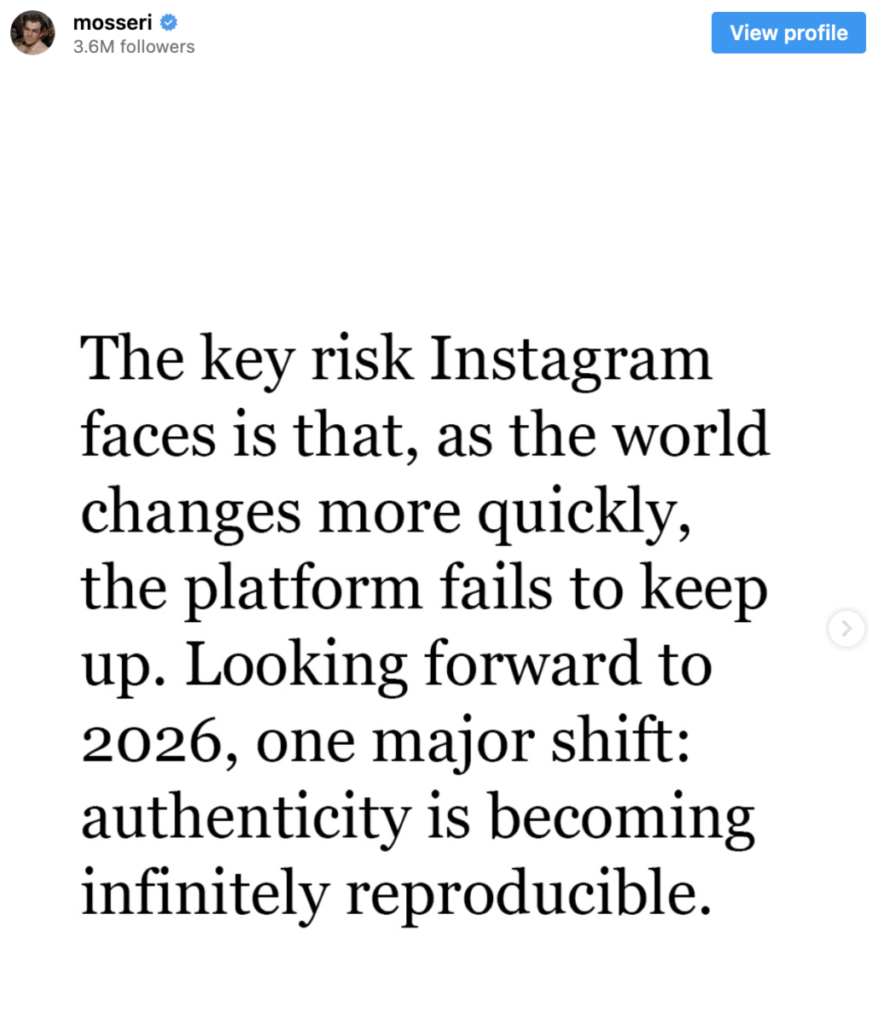
Instagram’s boss, Adam Mosseri, is ending 2025 with a clear warning: the internet is entering an age where authenticity can be copied endlessly.
In a long Instagram slideshow, Mosseri laid out what he sees coming next. AI-generated photos and videos are getting so good that even experts struggle to tell what’s real anymore. The old habit of trusting our eyes is fading fast.
And Instagram, he says, must change quickly, or risk falling behind.
Why Seeing Is No Longer Believing Online
For decades, photos meant proof. If you saw it, it likely happened.
That assumption no longer holds.
AI tools can now create lifelike images and videos in minutes. Skin texture, lighting, motion, almost perfect. Hence, we’re shifting from trust by default to doubt by default.
Mosseri put it plainly: humans are wired to believe what they see. Undoing that instinct will take time, and discomfort.
What’s changing right now
- AI can create realistic people who never existed
- Videos can show events that never happened
- Editing tools blur the line between enhancement and fabrication
The Instagram Feed You Remember? It’s Been Gone for Years
If you still picture Instagram as a grid of polished photos, you’re behind.
Mosseri says that version of Instagram died quietly years ago.
Where real sharing happens now
- Private DMs
- Blurry photos
- Shaky videos
- Random shoe pics
- Unplanned, unflattering moments
That’s where people feel safe being real.
Public posts followed the same path. The raw look crept in. Filters faded. Perfection started to feel fake.
Why “Perfect” Content Now Feels Suspicious
Here’s the irony: the more flawless content becomes, the less people trust it.
AI made beauty cheap. Perfect lighting is boring now.
Creators who stand out today do the opposite.
They post:
- Awkward angles
- Messy rooms
- Uneven lighting
- Real-time moments
Imperfection has become a signal.
Why imperfection works
- It feels human
- It feels harder to fake (for now)
- It builds trust
In a world full of polish, rough edges feel honest.
Camera Companies May Be Chasing the Wrong Goal
Mosseri took a subtle jab at camera makers.
Many still aim to make everyone look like a professional photographer from 2015. Smooth skin. Cinematic lighting. Flawless output.
But AI already does that better, and faster.
When perfection is easy, it loses value.
Raw images now carry more weight because they don’t look optimized.
The Catch: AI Will Copy Imperfection Too
This raw phase won’t last forever.
AI will soon recreate:
- Grain
- Blur
- Lighting mistakes
- “Accidental” framing
When that happens, appearance won’t help us decide what’s real.
So what will?
Trust Will Shift From Content to People
Mosseri believes the next big shift is simple but profound:
who says something will matter more than what is shown.
When visuals lie, credibility becomes the anchor.
Signals that may matter more
- Posting history
- Transparency
- Consistency over time
- Identity verification
Trust won’t come from pixels. It will come from patterns.
How Platforms Plan to Spot Real Content
Labeling AI content helps, but it’s not enough.
As AI improves, detecting fake media gets harder. Mosseri argues it’s more practical to verify real content instead.
Possible solutions on the table
- Cryptographic signatures from cameras
- Fingerprints added at image capture
- Chain-of-custody records for photos and videos
This shifts proof from edits to origins.
What Instagram Says It Needs to Do Next
Mosseri outlined several priorities as Instagram moves into 2026.
Instagram’s stated focus areas
- Build better creative tools
- Clearly label AI-generated content
- Verify authentic media
- Show credibility signals about accounts
- Reward originality in ranking systems
It’s a tall order, and time is tight.
Other Tech Leaders Share the Same Concern
Mosseri isn’t alone.
Tech leaders across the industry are openly worried.
| Executive | Company | Concern |
|---|---|---|
| Craig Federighi | Apple | Impact of AI photo manipulation |
| Patrick Chomet | Samsung | Whether “real photos” even exist |
| Platform leaders | Multiple | Trust erosion in visual media |
The message is consistent: this problem won’t stay inside Instagram.
Why Creators Still Matter More Than Ever
Despite all the fear, Mosseri made one optimistic point.
Authenticity is becoming scarce, and scarcity creates value.
AI can copy style. It can copy faces. It can copy aesthetics.
But it can’t copy:
- Lived experience
- Long-term consistency
- Earned trust
The bar is shifting from “Can you create?” to “Can only you create this?”
The New Internet Reality We’re Walking Into
We’re heading into a strange place.
There’s infinite content. Infinite doubt. Infinite creativity.
In that world, creators who win won’t be the loudest or the most polished. They’ll be the ones who stay real, stay visible, and stay consistent over time.
Instagram knows it must evolve, fast.
Whether it can keep up? That part is still unfolding.
