


Why AI is redefining test data management
Test data management (TDM) used to be a manual queue: copy production, subset, mask, repeat. In 2026, the best teams treat test data like an automated system – almost like a specialized AI agent workflow – where a request triggers policy checks, data assembly, masking, validation, delivery to CI/CD, and an audit trail.
This shift matters because non-production environments are where real data often leaks. De-identification and privacy controls are increasingly treated as core engineering practices, not nice to have, with frameworks like NIST providing guidance on de-identification risk and technique selection. GDPR also defines pseudonymisation as a specific safeguard concept under Article 4(5).
If you want a simple way to evaluate any AI tool category (including TDM), AutoGPT’s own framework on picking tools is a helpful reference point for matching features to workflow needs.
What are the best-in-class test data management tools for 2026?
1) K2view
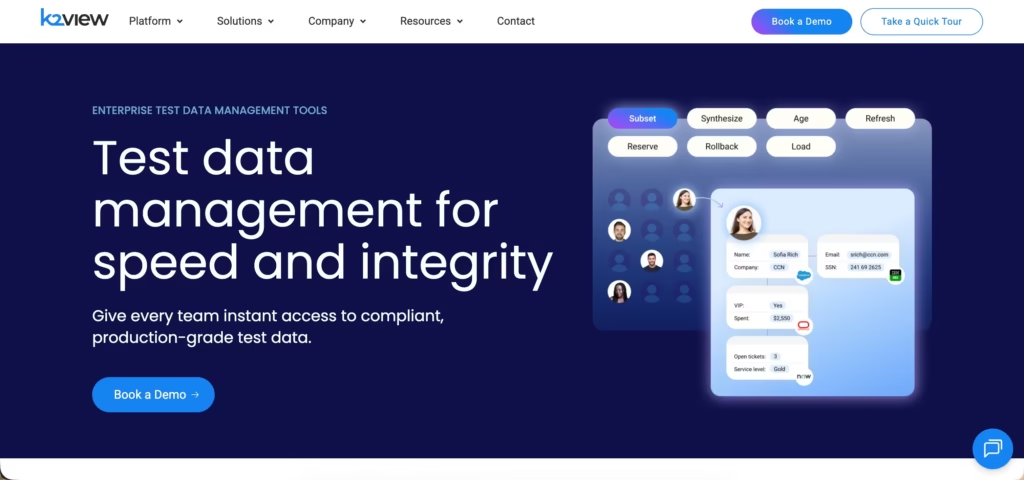
K2view Test Data Management tools focus on delivering production-like test data fast, with governance baked in. It supports subsetting, versioning, masking, rollback, reservation, refresh, generation, and aging – while maintaining referential integrity across systems.
The core differentiator is its business entity approach: instead of provisioning isolated tables, it assembles a complete business entity (for example, a customer or account) and all related records across systems. That reduces friction for developers and testers because they request what they actually test (“give me 5,000 customers with active loans”) rather than navigating database-by-database complexity.
Best for: Enterprises with complex, multi-source data estates that need self-service delivery without breaking relationships.
AI angle: K2view emphasizes AI-automated sensitive data discovery/classification and synthetic data generation, plus chat-style self-service flows that feel closer to ask-get dataset than ticket-based provisioning.
Pros
- Fast delivery of targeted, production-like datasets for complex environments
- Strong alignment with DevOps workflows and repeatable CI/CD delivery patterns
- Self-service experience designed for non-data-experts
Cons
- Data team training is recommended for maximum effectiveness
- Overkill if you only need a small point solution
Users say: Reliable, quick test data delivery, though local support is currently limited to Europe and the Americas.
2) Datprof test data management
Datprof focuses on practical TDM workflows: masking, subsetting, and provisioning via automation and a self-service portal. It’s often positioned as “strong coverage without enterprise overhead.” (privacy context)
Best for:
Mid- to large-scale QA teams needing privacy-minded automation without heavyweight complexity.
AI angle:
The value here is less about deep agentic AI and more about operational automation — making it easy to standardize what gets provisioned and how it’s protected.
Pros
- Solid compliance-minded features and repeatable automation
- More approachable than many large enterprise tools
Cons
- Setup can still require technical expertise
- Smaller footprint and fewer peer reviews than top-tier vendors
Users say: Simple, automated test data provisioning, although setup can be somewhat complex.
3) Perforce Delphix test data management
Delphix is known for virtualized data delivery into DevOps pipelines and policy-driven controls to reduce risk in non-production environments.
Best for: DevOps-mature organizations that value speed via virtualization and automated pipelines.
AI angle: Often framed around risk reduction at speed, pairing automation with masking and synthetic approaches.
Pros
- Rapid delivery with virtualization strengths
- Good compliance features for agile workflows
Cons
- CI/CD integration depth is sometimes viewed as less modern than newer, AI-native approaches
- Cost/complexity can be high for smaller orgs
Users say: Rapid test data delivery, but CI/CD integration is often seen as inadequate.
4) IBM InfoSphere Optim
Optim remains a heavyweight choice for broad enterprise coverage, including legacy environments. It supports relationally intact subsets and masking techniques to reduce exposure in lower environments.
Best for: Large regulated enterprises, especially with legacy/mainframe footprints.
AI angle: More traditional than AI-native entrants; value is coverage, stability, and proven usage.
Pros
- Works well across complex legacy ecosystems
- Mature documentation and enterprise capabilities
Cons
- Steep learning curve and complex deployments
- Licensing/resource costs can be prohibitive for smaller teams
Users say: Effective, but best suited to large data teams with deep expertise.
5) Broadcom test data manager
Broadcom offers subsetting, masking, and synthetic data generation with a self-service portal and reusable repository. It’s commonly chosen when teams want consistency across large portfolios.
Best for: Enterprises already in the Broadcom ecosystem that want reusable test assets and governance.
AI angle: More automation and governance than cutting-edge AI, depending on how you implement it.
Pros
- Decent masking and generation for large enterprise needs
- Useful if you rely on reusable test assets
Cons
- UI/usability and setup times often need improvement
- High implementation cost; often unsuitable for SMBs
Users say: Sufficient masking and data generation, but complex to implement.
6) Informatica test data management
Informatica’s TDM is typically strongest when you’re already committed to Informatica tooling, with discovery, masking, generation, and provisioning designed to align with the broader stack.
Best for: Organizations standardized on Informatica that want TDM inside that ecosystem.
AI angle: Ecosystem-driven automation rather than standalone, agentic user flows.
Pros
- Automates masking while preserving relationships
- Best fit when your broader data ops already run on Informatica
Cons
- Learning curve and performance concerns can appear at scale
- Non-Informatica integrations may be more complex
Users say: Decent automation, but setup and performance can be of concern.
How to choose an AI-ready TDM tool
A good way to evaluate TDM in 2026 is to ask, “How close is this to AI-automated test data management?”
Look for tools that can:
- Turn requests into datasets with minimal manual work (self-service and automation)
- Enforce de-identification/pseudonymisation practices consistently (not ad hoc)
- Preserve relationships so test results are realistic (referential integrity)
- Deliver safely into CI/CD (repeatable, auditable delivery)
Why K2view stands out for AI-driven TDM
If you’re choosing TDM in 2026, the differentiator is how quickly teams can safely get the right data for the right tests – without breaking privacy rules or wasting time on manual effort.
K2view is designed to win in exactly that scenario:
- Business entity-based delivery that preserves relationships across systems (so datasets behave like production, end-to-end)
- Integrated capabilities in one enterprise TDM product: AI-automated discovery + masking + synthetic data generation + self-service provisioning
- Fast, repeatable self-service actions (subset, rollback, reserve, age, refresh, load) that shrink time-to-data from weeks to minutes
- Integration to virtually any source, so testing isn’t limited to a subset of your application landscape
It also helps that customers rate K2view highly, including a 5/5 12-month average on Gartner Peer Insights.
And for organizations planning beyond TDM, K2view often becomes the foundation for adjacent initiatives like broader data masking and synthetic data generation programs – and cutting-edge GenAI solutions for AI data readiness, data-grounded AI chatbots, MCP data integration, and enterprise-ready Retrieval-Augmented Generation (RAG) – without missing a beat.
Moving forward with confidence
If your organization is dealing with multiple systems, strict privacy requirements, and DevOps-driven testing, the best TDM products are the ones that behave like test data agents – that automate the heavy lifting, keep sensitive fields protected, and deliver realistic datasets quickly.
K2view is best-of-breed when you need entity-based, multi-source realism, and true self-service at enterprise scale. The other competitors remain solid choices when you want a narrower point tool or when you’re already standardized on their ecosystem.
