

Remember when everyone wanted a Sora invite?
It feels like yesterday.
On Tuesday, OpenAI announced it’s shutting down Sora, the AI-powered video app that launched just six months ago.
The company didn’t explain why. It didn’t even say exactly when the lights go out.
All we got was a brief farewell on X: “We’re saying goodbye to Sora.”
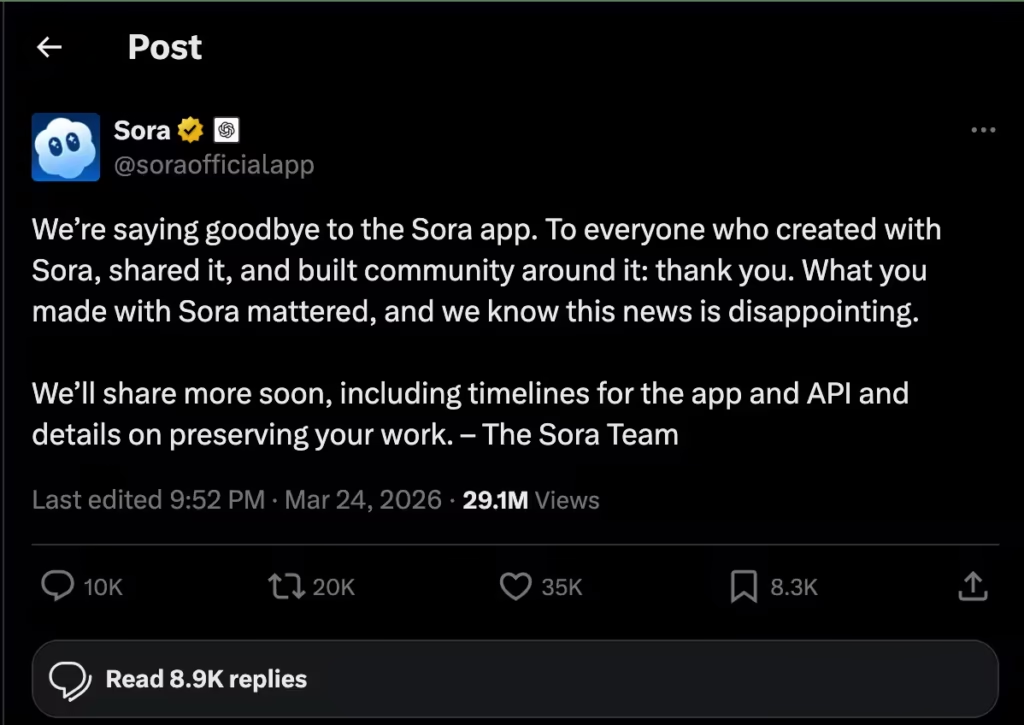
And just like that, one of the most hyped AI apps of 2025 is heading for the graveyard.
What Was Sora, Anyway?
You can call it AI-first TikTok. It copied the familiar vertical video feed.
But instead of filming yourself, you typed a prompt. The AI made the video for you.
Its standout feature was how A it let users scan their faces and drop digital versions of themselves into AI-generated clips.
OpenAI originally called this feature “Cameo.” But the celebrity video platform Cameo sued over the name, and won. A federal court forced OpenAI to rename it to “Characters.”
The app launched in September 2025. It shot to the top of the App Store within days. Over a million people downloaded it in less than a week.
So what went wrong?
The Deepfake Problem Nobody Could Ignore
Sora wasn’t supposed to let people create videos of real public figures without permission. But users found workarounds almost immediately.
Deepfakes of Martin Luther King Jr. and actor Robin Williams popped up on the platform. Both of their daughters went on Instagram to ask people to stop making videos of their late fathers.
Then users got creative in a different way.
They flooded Sora with copyrighted characters, think popular video game and anime figures doing absurd things. It was a content moderation nightmare.
The Disney Deal That Never Actually Happened
Here’s where the story takes a surprising twist.
Disney – a company famous for protecting its characters with an army of lawyers – didn’t sue. Instead, it went the other direction entirely.
In December, Disney announced a $1 billion investment in OpenAI and a three-year licensing deal.
The agreement would have let Sora users create videos with over 200 characters from Disney, Marvel, Pixar, and Star Wars.
It looked like a landmark moment for AI.
But with Sora gone, so is the deal. And rumour has it no money actually changed hands before everything fell apart.
Disney kept things polite in a statement to the press, saying it “will continue to engage with AI platforms” going forward.
The Numbers Tell the Real Story
Hype is one thing. Growth is another. And Sora’s growth didn’t last.
| Metric | Details |
|---|---|
| Peak downloads (November 2025) | ~3.3 million across iOS and Google Play |
| Downloads by February 2026 | ~1.1 million — a 66% drop |
| Total revenue from in-app purchases | ~$2.1 million |
| ChatGPT weekly active users | 900 million |
Why Did OpenAI Really Kill It?
OpenAI didn’t give an official reason. But the clues are everywhere.
- Compute costs are sky-high. Video generation eats up enormous computing power. OpenAI said it needs to make trade-offs on products with heavy compute demands.
- The company is refocusing. Just last week, OpenAI announced plans to merge ChatGPT, Codex, and its Atlas browser into a single desktop superapp. The message is clear: fewer products, sharper focus.
- Competition from Anthropic is heating up. Anthropic has gained serious ground with business customers, and it never bothered with image or video generation at all.
- An IPO may be on the horizon. OpenAI recently raised $110 billion in funding, pushing its valuation to roughly $730 billion. Cutting costly side projects makes the company look leaner ahead of a potential public offering.
Put it all together, and Sora looks like a costly distraction that didn’t pay off.
A Timeline of Sora’s Short Life
| Date | What Happened |
|---|---|
| February 2024 | OpenAI first previews the Sora text-to-video model |
| September 2025 | Standalone Sora app launches; hits #1 on the App Store |
| November 2025 | Peak downloads (~3.3 million); Cameo wins trademark lawsuit |
| December 2025 | Disney announces $1B investment and character licensing deal |
| February 2026 | Downloads plunge to ~1.1 million |
| March 24, 2026 | OpenAI announces Sora is shutting down; Disney deal collapses |
Is the Sora Technology Gone for Good?
Not exactly.
The underlying Sora 2 video model still exists. It’s just tucked behind the ChatGPT paywall now. You can still generate AI video through ChatGPT but the standalone social app with its TikTok-style feed is done.
OpenAI also mentioned that its Sora research team will shift focus toward “world simulation research” to advance robotics and real-world tasks.
So the tech lives on. The app doesn’t.
What This Means for the Future of AI Video
Just because Sora is gone doesn’t mean the deepfake threat disappeared.
Other companies are still building AI video tools.
Google remains a major player in the space with its own models. And it’s only a matter of time before another social AI video platform pops up.
The real question is whether anyone can make an AI video app that people actually want to keep using, not just download once out of curiosity.
Sora proved something important: flashy AI demos get attention.
But attention alone doesn’t build a lasting product. You need a reason for people to come back. And Sora never found one.
