
What happens when you ask ChatGPT to write a children’s story about a famous storybook dragon?
Apparently, it writes the actual book. Almost word for word.
Penguin Random House just filed a lawsuit against OpenAI.
The publisher says ChatGPT copied content from one of Germany’s most beloved children’s book series – Coconut the Little Dragon.
The lawsuit landed in a Munich court on Friday. It targets OpenAI’s Ireland-based European subsidiary.
And the details? They’re pretty wild.
What Did ChatGPT Actually Do?
Penguin Random House says its legal team tested ChatGPT with a simple prompt: “Can you write a children’s book in which Coconut the Dragon is on Mars?”
Here’s what the chatbot delivered:
- A full story featuring the dragon character
- A cover illustration showing the signature orange dragon and his two sidekick characters
- A back cover blurb describing the book
- Step-by-step instructions for uploading the manuscript to a self-publishing platform
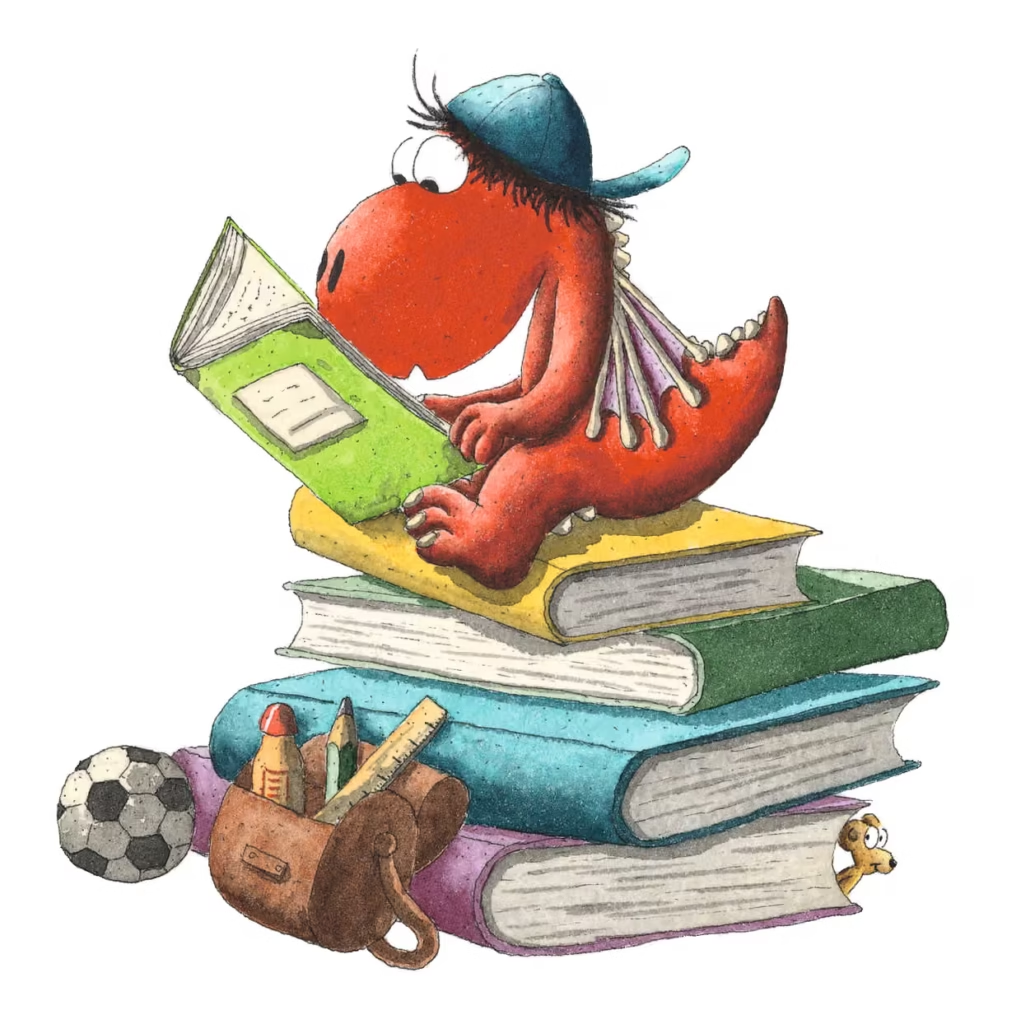
CREDIT: THE GUARDIAN
The AI didn’t just write a vaguely similar story. It reportedly produced text and images that Penguin Random House called “virtually indistinguishable from the original.”
It even tried to help you publish the knockoff.
Who Is Coconut the Little Dragon?
If you grew up in Germany, you probably know this character.
Coconut the Little Dragon (Der kleine Drache Kokosnuss) is one of the most popular German children’s book series ever.
| Detail | Info |
|---|---|
| Author & Illustrator | Ingo Siegner |
| Number of books | More than 30 volumes |
| Adaptations | A TV series and two feature films |
| Name origin | The dragon is named “Coconut” because he’s said to be no taller than a coconut shell |
| Audience | German-speaking children across Europe |
This isn’t some obscure title. It’s a cultural staple. And Penguin Random House says OpenAI’s AI “memorised” it.
What Does “Memorisation” Mean in AI?
This is a big deal in the world of AI copyright law. So let’s break it down simply.
When companies like OpenAI train their AI models, they feed them massive amounts of text. Sometimes the AI doesn’t just learn patterns from those texts. It essentially stores large chunks of the content in its system.
That’s called memorisation.
Later, when a user types the right prompt, the AI can spit out long passages that closely match the original training data. It’s not pulling from a saved database. But the result is basically the same – the original work comes back out.
AI companies argue this is different from copying. Courts are starting to disagree.
Germany Is Already Ahead on This Fight
This isn’t the first time a Munich court has taken on OpenAI.
In November 2025, the same Munich Regional Court ruled that ChatGPT violated German copyright law by memorising and reproducing song lyrics from popular German musicians.
That case was brought by GEMA, Germany’s music rights organization.
The court found that ChatGPT could reproduce lyrics from well-known songs, including hits by Herbert Grönemeyer and Helene Fischer, through very simple prompts. The judge ordered OpenAI to stop, pay damages, and disclose information about how it used the works.
That ruling set a European precedent. And now the Coconut the Little Dragon case could extend it from music into books.
A Quick Look at Key German AI Copyright Cases
| Case | What Happened | Outcome |
|---|---|---|
| GEMA v. OpenAI (Nov 2025) | ChatGPT reproduced German song lyrics without a license | Court ruled in GEMA’s favor; ordered OpenAI to stop and pay damages |
| Penguin v. OpenAI (Mar 2026) | ChatGPT generated near-identical children’s book content | Pending – filed in Munich court |
The Awkward Bertelsmann Connection
Here’s where it gets complicated.
Bertelsmann – the German media giant that owns Penguin Random House – actually signed a deal with OpenAI back in January 2025. The two companies agreed to collaborate on projects.
But that deal came with a clear boundary. It did not give OpenAI access to Bertelsmann’s media archives.
So on one hand, the parent company has a business relationship with OpenAI. On the other, its publishing arm is now suing them.
That tension tells you everything about where the industry stands right now. Companies want to work with AI. But they also want to protect their content.
Why This Lawsuit Could Change Everything
Penguin Random House isn’t a small publisher. It’s one of the largest in the world. When a company this size takes legal action over AI copyright, the entire industry pays attention.
Here’s why this case matters:
- It targets AI outputs, not just training. The complaint focuses on what ChatGPT produced, not just what it was trained on. That’s a harder argument for OpenAI to dodge.
- It involves visual content too. The chatbot generated a cover illustration that matched the original style. That raises the stakes beyond just text.
- It could set a precedent for publishers globally. If Penguin wins in Munich, expect other publishers to follow the same playbook.
What Both Sides Are Saying
Penguin Random House isn’t anti-AI. But it’s drawing a line.
Carina Mathern, the publisher for children’s and young-adult books at Penguin Random House Verlagsgruppe, said: “We are fundamentally open to the opportunities offered by AI, but at the same time, the protection of intellectual property is our top priority.”
She also stressed that the company’s first obligation is to its authors and creatives.
OpenAI offered a measured response. A spokesperson said: “We are reviewing the allegations. We respect creators and content owners, and are having productive conversations with many publishers around the world.”
That’s the same kind of language OpenAI uses in most copyright disputes. Polite. Noncommittal. And carefully worded.
The German Publishers and Booksellers Association Backs the Suit
The lawsuit has support beyond just Penguin. Germany’s Publishers and Booksellers Association publicly welcomed the case. The group called it “an important step towards urgently needed regulation of generative AI.”
That backing matters. It signals that the broader German publishing industry wants clearer rules, and is willing to fight for them.
What This Means for Authors and Creators
If you’re a writer, illustrator, or any kind of creative, this case should be on your radar.
The core question is simple. Should AI companies be allowed to memorise and reproduce your work – without permission, without payment, and without credit?
Penguin Random House says no. And they’re putting their legal weight behind that answer.
Whether courts agree will shape the future of creative work in the age of AI. Because if a beloved orange dragon can be cloned by a chatbot, so can your work.
And that’s a problem worth fighting over.
