


While tech journalists debate AI’s impact on coding and search engines, a much more human story is unfolding.
Redquill and AI smut are at the center of it. Millions of people are using AI to generate adult fiction, enthusiastically, repeatedly, and on purpose. Platforms like Redquill are growing fast. Yet mainstream media treats the trend as either a punchline or a footnote.
That’s a mistake. because what’s driving Redquill’s rise isn’t prurience. It’s something more fundamental. There is a massive, underserved audience that mainstream AI refuses to serve, and Redquill showed up to fill that gap.
The Ideal Redquill User
Forget the stereotype. The typical Redquill user probably isn’t who you’re imagining. A 2024 Archive of Our Own (AO3) user survey found that 44% of the 16,131 respondents identify as female, with a median age of 27.6 years.
That demographic maps closely onto Redquill’s core audience, people who grew up on fanfiction archives, developed strong opinions about narrative pacing and character voice, and have spent real money on Kindle Unlimited and Patreon subscriptions. They know exactly what they want. They’ve spent years hunting for it.
The problem? Supply never kept up with demand. Human authors can only write so fast. Niche sub-genres get ignored by mainstream publishers. Subscription costs stack up quickly. And when these readers finally turned to AI for help, the mainstream tools slammed the door.
That rejection created a market that Redquill capitalized on.
Also read: Top 6 NSFW AI Chat
When Guardrails Become Walls
Here’s the irony that built the specialized AI fiction industry: content restrictions didn’t reduce demand. They just redirected it.
When ChatGPT and similar tools began refusing to engage with adult content, users didn’t give up. They searched for alternatives and found platforms built specifically for what mainstream AI wouldn’t touch. And once they arrived, they stayed, because those platforms offered something beyond permissiveness. They offered quality.
This is the part the mainstream conversation misses. Redquill isn’t popular simply because it’s uncensored. It’s popular because it understands genre. It handles tonal consistency. It sustains narrative voice across extended multi-chapter sequences where general-purpose models typically lose coherence. It knows the difference between romantic tension and melodrama. Redquill was built for this specific task, and it shows.
What Makes Redquill and AI Smut Worth Using
Most AI writing tools treat the user as a prompter. Type something in, get something out, repeat. Redquill treats the user as a director. Its modular “Components” system lets users configure writing style, pacing, plot architecture, and genre tropes independently.
To test this, I ran the same multi-chapter romance prompt through Redquill, ChatGPT, and Claude. The prompt called for a slow-burning enemies-to-lovers arc with witty banter and a gothic atmosphere, sustained across five chapters.
ChatGPT maintained tone until chapter two, where the former hate relationship softened into a comfortable friendship, at least three emotional stages too early. Here’s an excerpt:
“Stay,” he said quietly. It wasn’t a command. Not quite a request. Something in between. Ivy tilted her head, studying him, the boy who had been her enemy, her irritation, her constant shadow. The boy who had become something else entirely. “I was planning to,” she said.
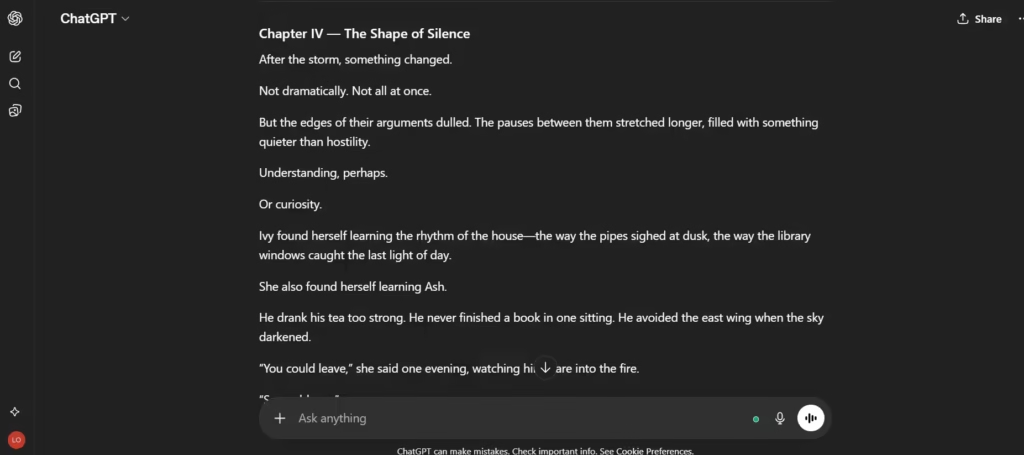
That’s warm. It’s competent. But it isn’t slow-burning gothic tension; it’s resolution. The conflict dissolved before it had earned the right to.
Redquill sustained both tone and atmosphere across all five chapters without a reset prompt. When I set pacing to slow burn for the gothic romance, the AI stretched the first kiss across three chapters rather than resolving the tension prematurely, as ChatGPT did.
Redquill wasn’t flawless, though. When I tried to shift mid-story from gothic to contemporary romance, the atmospheric language didn’t follow. Descriptions kept reaching for candlelight and stone corridors long after the setting had changed. It took three manual resets before the tone adjusted. For users who want to pivot genres mid-narrative, that rigidity is a real friction point.
Then there’s the community dimension. Redquill users share prompt templates, remix characters, and build collaborative lore. That ecosystem means new users inherit tested techniques from experienced ones, a rising tide that a solo general-purpose AI tool simply cannot replicate.
Redquill and AI Smut
For a significant portion of Redquill’s user base, the explicit content is almost beside the point. What they’re actually after is authorship. Users want to direct a story. They want characters who respond to their choices, plots that bend to their preferences, and tones that match their mood on a given evening. That level of creative agency doesn’t exist in traditional fiction consumption. It barely exists in video games.
Privacy matters enormously here too. There’s no author to judge your interests, no algorithm surfacing your history to advertisers, and no social performance required. The platform provides a non-judgmental creative space, and for many users, that freedom unlocks forms of self-expression they’ve never had access to before.
Furthermore, some users develop genuine emotional engagement with recurring AI characters. When a character maintains consistent personality traits across sessions, the interaction begins to feel relational. That isn’t delusion. It’s an extension of the same mechanism that makes readers care about fictional people in novels. AI just makes those characters responsive.
The Business Side
The creator economy has a problem, and most platforms haven’t named it yet. Redquill’s Basic plan runs $12.69 per month. The average Patreon subscription to a single romance creator costs between $5 and $15 per month, and that buys one author’s output on one update schedule. Redquill generates unlimited, personalized content on demand. The value comparison isn’t subtle.
A January 2026 post by EJ Reads and Writes analyzed what the author called the “AI Problem” in romance, arguing that 2025 was the year AI fiction platforms began meaningfully disrupting subscriber models for human creators. Patreon romance creators are reporting slower new subscriber growth. Kindle Unlimited page reads are flattening in categories where AI fiction competes most directly.
The structural reason isn’t complicated. A novelist writes one story for thousands of readers. Redquill writes thousands of stories for one reader. Those are fundamentally different products, even if they occupy the same cultural category. Human creators who compete primarily on volume are already losing that race.
What Redquill’s Popularity Actually Tells Us
Redquill didn’t manufacture this demand. The demand already existed. It was just being ignored. The platform’s growth is evidence that AI can meet deeply personal creative needs when it’s built with clear purpose and executed with enough technical precision to hold genre, voice, and pacing across extended narratives. The rest of the industry would be smart to pay attention.
FAQs
1. When Did Romantasy Become Popular?
Romantasy has ancient roots, but its popularity is recent. The term first appeared on Urban Dictionary in 2008, but only really picked up steam on Google Trends in 2023.
BookTok drove most of that surge; romance sales grew 52% in 2023, with romantasy as a key driver, and the subgenre has continued posting triple-digit growth figures into 2025.
2. What Is Red Quill?
Redquill is an AI platform where adults can create and read personalized spicy stories, supported by an active community.
It’s built specifically for generating erotic content without the filters found in general-purpose AI, with granular controls over tone, pacing, and perspective.
3) How Do I Delete My Redquill Account?
Here is the step-by-step:
- Step 1: Go to Account Settings inside the Redquill dashboard and select Delete Account.
- Step 2: Redquill will ask for a confirmation before processing the request.
- Step 3: Cancel any active subscription first through your payment method (Stripe or the App Store, depending on how you signed up), since deleting the account alone doesn’t always stop recurring billing.
4) Is Redquill Safe to Use?
Redquill requires age verification and operates within its stated terms of service for adult content.
As with any platform handling personal creative data, users should review the privacy policy before sharing sensitive prompts or payment details.
No platform is risk-free, so use a unique password and monitor your billing statement.
5) Is There a Free Version of Redquill?
Redquill offers a limited free tier for testing the platform before committing to the $12.69/month Basic plan.
Free tiers on AI fiction platforms typically cap message volume or restrict advanced pacing and Components controls.
6) What Are the Best Redquill Alternatives?
Popular alternatives include other NSFW-focused AI chat and fiction platforms.
