


A Sudowrite alternative is any AI writing tool that helps fiction writers brainstorm, draft, expand, and edit narrative prose.
Sudowrite set the standard for fiction-specific AI with its proprietary Muse model, Story Bible, and prose editing tools (Rewrite, Describe, Expand).
But at $19/month with a credit system that confuses even experienced users, plenty of writers are looking for tools that fit their workflow and budget better.
After testing eight alternatives against Sudowrite on real fiction projects, here is what I found: Sudowrite still produces the best sentence-level prose of any dedicated fiction tool.
But it is not the best tool for every type of fiction writer. Several alternatives beat it on worldbuilding, affordability, workflow flexibility, and full-pipeline publishing.
Why Are Writers Looking for Sudowrite Alternatives?
Four reasons keep surfacing in writing communities:
The credit system is confusing. Sudowrite uses AI credits that deplete at different rates depending on which feature you use and which underlying model you select (Muse, Claude, or GPT-4o). Multiple writers on Reddit have reported running out of credits mid-chapter without understanding why.
$19/month adds up for hobbyist writers. Not every fiction writer is a professional. Many are hobbyists, students, or early-career authors who cannot justify $228/year for a writing tool, especially when free options like ChatGPT and Claude handle brainstorming and dialogue competently.
No export beyond DOCX. Sudowrite exports to DOCX only. No EPUB, no PDF formatting, no KDP-ready output. Writers who self-publish need a separate tool for formatting and cover design, which adds cost and friction to the pipeline.
Some writers want more control over the AI model. Sudowrite chooses which model powers each feature. Writers who prefer specific models (Claude for character voice, GPT-4o for plot structure, local models for privacy) cannot make that choice inside Sudowrite. Alternatives like NovelCrafter let you bring your own API key and pick your model per task.
The 8 Best Sudowrite Alternatives in 2026
1. NovelCrafter: Best for Worldbuilding-Heavy Fiction (Fantasy, Sci-Fi, LitRPG)
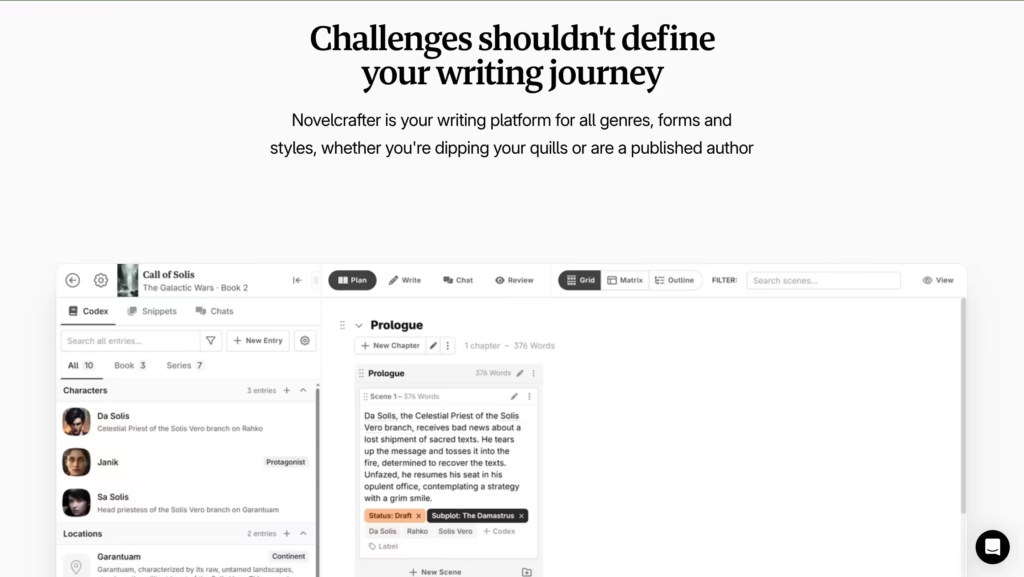
NovelCrafter is what Laterpress calls “the Photoshop of AI-assisted fiction.”
Its Codex system lets you define characters, locations, factions, magic systems, and lore. When you generate or edit a scene, NovelCrafter automatically injects relevant Codex entries into the AI prompt so the model stays consistent with your world.
The key differentiator: you bring your own API key. Connect OpenRouter, OpenAI, Anthropic, or any compatible endpoint. Pick Claude for character dialogue, GPT-4o for plot structure, a local model for privacy. You control which AI powers each task and how much you spend.
In my testing on a fantasy novel with 40+ named characters and 3 interconnected magic systems, NovelCrafter maintained consistency more reliably than Sudowrite because the Codex fed the AI exactly the right context for each scene.
Sudowrite’s Story Bible is good but does not inject context as precisely.
Best for: Fantasy, sci-fi, and LitRPG writers with complex worlds.
Starting Price: $4.30/month.
2. Type.ai: Best for Prose Quality and Simplicity
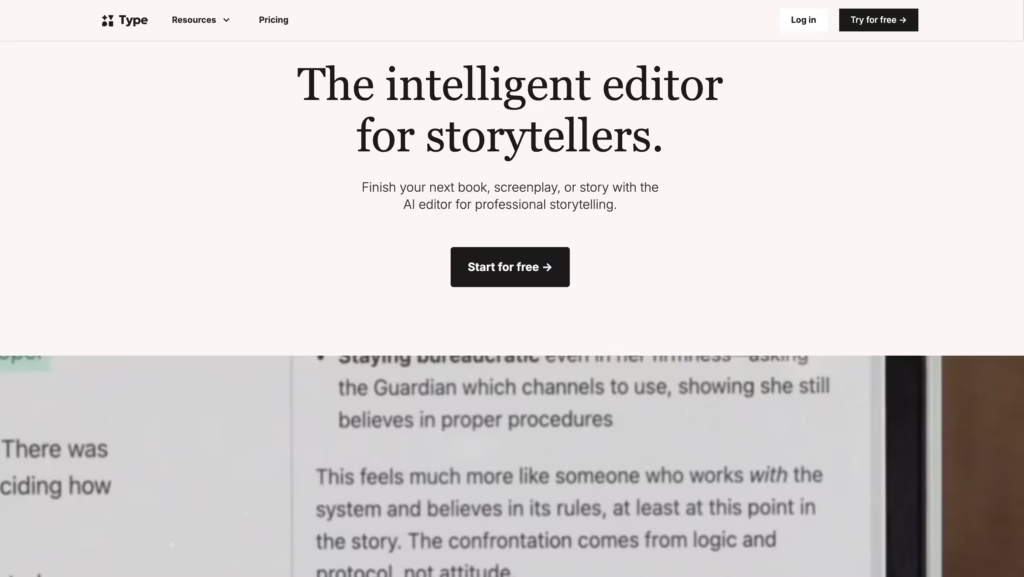
Type.ai positions itself as the primary Sudowrite alternative for writers who care about prose quality above everything else.
The AI generates and rewrites directly inside the document, not in a separate panel. You write, highlight a weak passage, and Type rewrites it inline.
Type supports documents up to 150,000 words, which covers most novels. The AI emphasizes drafting and revision quality rather than planning features.
If your bottleneck is prose output (getting words on the page that do not sound robotic), Type produces more usable words per hour than Sudowrite’s more modular approach.
The trade-off: Type lacks Sudowrite’s planning tools (Story Bible, Canvas, brainstorming modules). It is a writing tool, not a story architecture tool. If you already know what you want to write and just need help writing it well, Type fits.
If you need the AI to help you figure out what to write, Sudowrite or NovelCrafter are better picks.
In a direct comparison, I gave both Type.ai and Sudowrite the same scene outline (a confrontation between two characters in a fantasy tavern). Type.ai generated 2,400 words of usable prose in 15 minutes. Sudowrite produced 1,800 words in the same timeframe, but the sentence-level quality was noticeably higher.
Type gets you to a working draft faster. Sudowrite gets you to a polished draft slower.
Best for: Writers who already have an outline and want fast, clean prose.
Starting Price: $12/month or $8/month annual
3. NovelAI: Best for Uncensored Story Generation

NovelAI is that Sudowrite alternative that runs its own fiction-trained Kayra-XL model with a 128K token context window. No content filters on the Opus tier.
The AI produces narrative prose with varied sentence structure, sensory detail, and tonal consistency that reads closer to published fiction than chatbot output.
The Lorebook system (NovelAI’s equivalent of a story bible) lets you define characters, settings, and rules that the AI references dynamically. In my testing, a character’s backstory surfaced naturally 30 turns later when the narrative called for it. That long-term memory is something Sudowrite cannot match on extended sessions.
NovelAI also includes anime image generation and text-to-speech, so you can visualize characters and hear your story from the same platform.
When I tested NovelAI’s Lorebook on my fantasy novel, I noticed that entries with more than 5 or 6 linked characters started to dilute each other.
The AI would reference the right names but occasionally blend personality traits between characters when too many Lorebook entries activated in the same scene. Keeping entries concise and limiting cross-references per scene produced much better results.
Best for: Writers who want full creative freedom with zero content restrictions.
Starting Price: $10/month
4. Laterpress: Best for Structured Workflow (Beats to Scenes to Drafts)
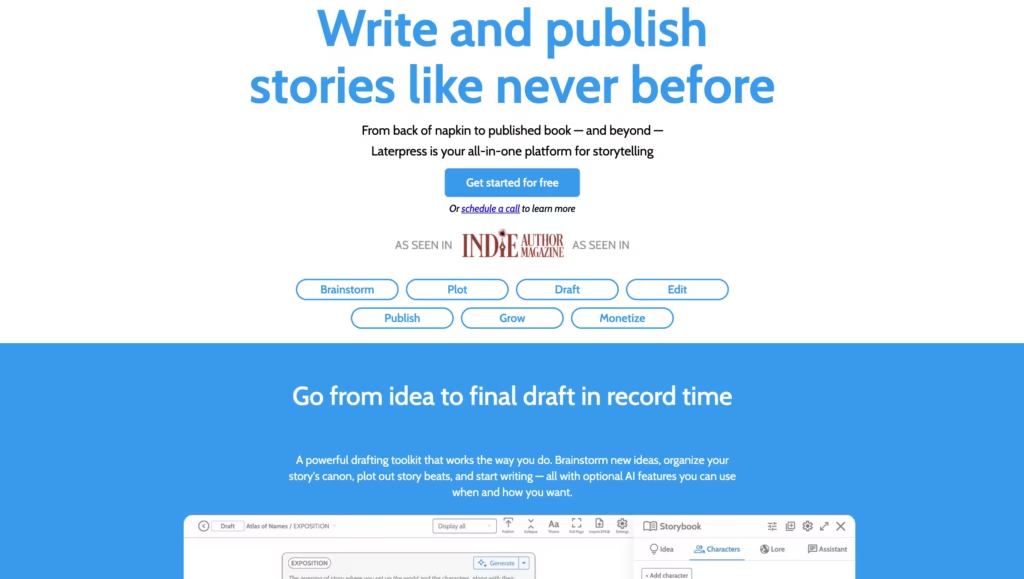
Laterpress is a fiction editor where story structure lives inside the writing environment.
You seed a concept, build your world in the wiki, generate a scene-by-scene outline, and expand beats into full drafts. The AI knows your world because it is built into the same tool where you write.
Where Sudowrite focuses on prose quality and NovelCrafter on configurability, Laterpress focuses on the workflow from idea to drafted scene. For writers who think in beats and outlines before they write prose, that structural approach matches how their brain already works.
I tested this by outlining a 12-beat short story in Laterpress. The platform expanded my one-line beats into full scene drafts in 22 minutes. The same process in Sudowrite (writing each beat manually, then using Expand) took 45 minutes.
The prose from Sudowrite read better, but Laterpress got me from outline to complete first draft nearly twice as fast.
Best for: Plotters and outliners who build story structure before drafting.
Starting Price: $10/month
5. ChatGPT / Claude: Best Free Brainstorming Partner
This is the alternative most writers already use without thinking of it as a “Sudowrite alternative.”
ChatGPT and Claude both handle brainstorming, dialogue generation, plot hole detection, character development, and first-draft scene expansion competently. The 2025 Author Guild survey found that 45% of published fiction writers now use AI tools in their creative process, primarily for brainstorming and overcoming blocks.
The limitation is obvious: neither tool is built for long-form fiction.
They lose context in long sessions, do not maintain story bibles, and cannot track character consistency across chapters.
But for zero dollars, they handle the parts of writing that are about thinking (brainstorming, plotting, dialogue testing) better than most paid tools handle the parts about executing.
Best for: Budget-conscious writers who need a brainstorming partner, not a drafting engine.
Starting Price: ChatGPT Plus $20/month. Claude Pro $20/month.
6. ProWritingAid: Best for AI-Enhanced Editing (Not Generation)
ProWritingAid is not a generation tool. It does not write prose for you.
It analyzes prose you have already written and suggests improvements: overused words, pacing issues, readability scores, cliche detection, dialogue tag analysis, and sentence structure variety.
If your problem with Sudowrite is that AI-generated prose never sounds like you, ProWritingAid takes the opposite approach: you write everything yourself, and the AI helps you edit it to be sharper. For writers who want AI as an editor rather than a co-writer, this is the right tool.
Best for: Writers who draft manually and want AI-powered editing and analysis.
Starting Price: $30/month or $10/month annual
7. Inkfluence AI: Best for Full Self-Publishing Pipeline

Inkfluence AI handles what no other tool on this list does: the full pipeline from chapter drafts to KDP-ready EPUB, cover design, and ACX-compliant audiobook narration.
It generates structured novels with consistent characters across chapters using a 3-chapter context window and exports directly to PDF, EPUB, or DOCX.
For self-publishing authors who want one tool from first draft to Amazon listing, Inkfluence removes the 3 to 4 separate tools (writing tool + formatter + cover designer + audiobook narrator) that the process normally requires.
The trade-off: prose quality at the sentence level does not match Sudowrite’s Muse model. Inkfluence prioritizes pipeline completeness over literary polish. Writers who care deeply about prose craft will still want to edit Inkfluence’s output manually or run it through ProWritingAid.
Best for: Self-publishing authors who want draft-to-KDP in one tool.
Starting Price: $9.99/month or $7.42/month annual
8. Squibler: Best for First-Time Novelists Who Need Structure
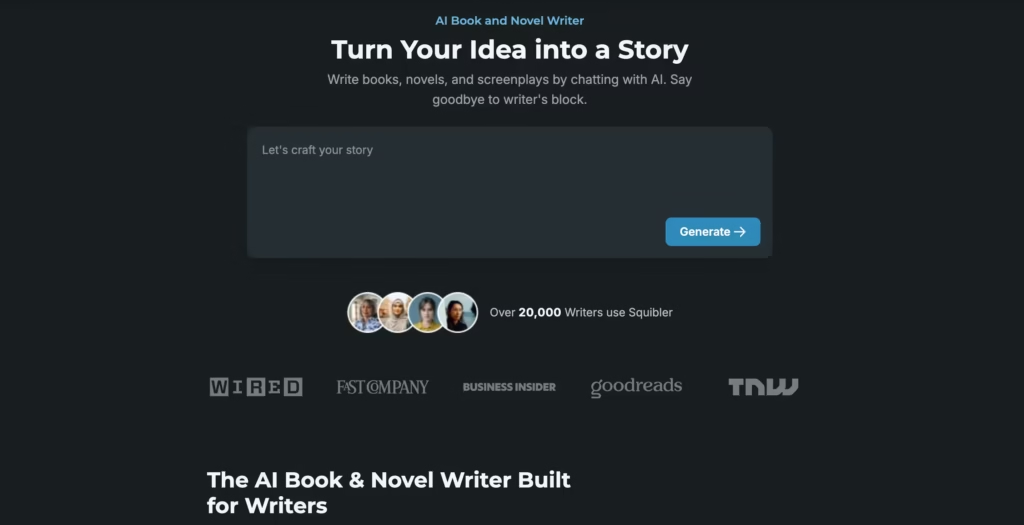
Squibler combines AI generation with project management for fiction. It includes novel templates, character sheets, timeline tools, and AI-powered scene expansion.
The interface is simpler than NovelCrafter and less overwhelming than Sudowrite for writers who have never used an AI fiction tool before.
For a first-time novelist who wants guardrails and templates rather than a blank page with infinite AI options, Squibler provides enough structure to get from “I have an idea” to “I have a finished draft” without getting lost in features.
When I tested Squibler’s scene expansion on a mystery short story, the AI generated competent prose but defaulted to a generic thriller tone regardless of the mood I set in the project settings.
I had to manually rewrite the opening paragraphs of 3 out of 5 expanded scenes to match the quieter, literary tone I wanted.
For genre fiction where a standard tone works, this would not be an issue. For anything stylistically specific, expect to do more post-editing than Sudowrite requires.
Best for: Beginning novelists who want guided structure with AI assistance.
Starting Price: $29.99/month or $15.83/month annual
How Do These Sudowrite Alternatives Compare?
| Feature | Sudowrite | NovelCrafter | Type.ai | NovelAI | Laterpress | ChatGPT/Claude | ProWritingAid | Inkfluence | Squibler |
| Core strength | Prose quality (Muse model) | Worldbuilding + BYO model | Inline prose drafting | Uncensored fiction generation | Structured beat-to-draft | Free brainstorming | AI-powered editing | Full publishing pipeline | Guided novel structure |
| AI model | Muse, Claude, GPT-4o (chosen by Sudowrite) | BYO API (you choose) | Proprietary | Kayra-XL (fiction-trained) | Proprietary | GPT-4o / Claude | Proprietary analysis | Proprietary | Proprietary |
| Story Bible / Codex | Yes (Story Bible) | Yes (Codex, auto-injected) | No | Yes (Lorebook) | Yes (wiki) | No | No | Yes (3-chapter context) | Yes (character sheets) |
| Max document length | Not published | Novel-length | 150,000 words | 128K token context | Novel-length | Limited by session | No limit (analysis) | Novel-length | Novel-length |
| Content restrictions | Standard | None (BYO model) | Standard | None (Opus tier) | Standard | Standard | N/A (editing only) | Standard | Standard |
| Export formats | DOCX only | Multiple | Multiple | Text | Multiple | Text/copy-paste | Multiple | EPUB, PDF, DOCX | DOCX, PDF |
| KDP-ready export | No | No | No | No | No | No | No | Yes (EPUB + cover) | No |
| Starting price | $19/month | $4.30/month | $12/month | $10/month | $10/month | $20/month | $30/month | $9.99/month | $29.99/month |
| Best for | Literary prose quality | Complex worlds, power users | Simple prose drafting | Uncensored fiction | Plotters and outliners | Budget brainstorming | Editing, not generation | Self-publishing pipeline | First-time novelists |
Which of These Sudowrite Alternatives Should You Pick?
| Your situation | Best pick |
| Writing fantasy, sci-fi, or LitRPG with complex worldbuilding | NovelCrafter |
| Want the simplest path from outline to clean prose | Type.ai |
| Need full creative freedom with zero content filters | NovelAI |
| Think in beats and outlines before writing prose | Laterpress |
| Budget is $0 and you just need a brainstorming partner | ChatGPT or Claude (free tiers) |
| Draft manually and want AI-powered editing | ProWritingAid |
| Self-publishing and want draft-to-KDP in one tool | Inkfluence AI |
| First novel, need guardrails and templates | Squibler |
| Want the best sentence-level prose and can afford $19/month | Stay with Sudowrite |
If I could only keep one tool from this entire list, I would keep NovelCrafter. Here is why: on my 60,000-word fantasy novel, the Codex system solved the consistency problem that every other tool (including Sudowrite) failed at.
When you are juggling 40 named characters and 3 magic systems, having the AI automatically know the right context for each scene is not a nice feature.
It is the difference between usable output and output you throw away. The BYO-API model also means my costs scale with my usage, not with a flat monthly fee that assumes I write every day. Sudowrite still writes prettier sentences. But NovelCrafter helped me finish the book.
Most productive fiction writers I know use 2 to 3 tools together. That is not a flaw. It is the reality of AI-assisted fiction in 2026.
FAQs
1) What is the best free Sudowrite alternative?
ChatGPT and Claude’s free tiers are the most capable free options for brainstorming, dialogue, and scene-level drafting. For a dedicated fiction tool with a free tier, Laterpress and Squibler both offer limited free access. NovelCrafter’s lowest tier at $4/month is the cheapest dedicated fiction tool.
2) Is Sudowrite still the best AI for fiction in 2026?
For sentence-level prose quality, yes. Sudowrite’s Muse model produces the most polished fiction prose of any dedicated tool. But for worldbuilding (NovelCrafter wins), simplicity (Type.ai wins), creative freedom (NovelAI wins), and full publishing pipeline (Inkfluence wins), other tools are stronger.
3) Can I use my own AI model with these tools?
NovelCrafter is the only tool on this list that lets you bring your own API key and choose your model per task. All others either use proprietary models or let you choose from a fixed set.
4) Do professional fiction writers actually use AI?
Yes. The 2025 Author Guild survey found that 45% of published fiction writers now use AI in some part of their creative process. Bestselling authors including Hugh Howey have publicly endorsed Sudowrite. AI is primarily used for brainstorming, overcoming blocks, and first-draft expansion, not for publishing AI-generated text directly.
5) Can I publish fiction written with AI?
Platform policies vary. Amazon KDP requires disclosure of AI-generated content. Most traditional publishers expect human authorship. The consensus in 2026 is that AI-assisted writing (where you direct the creative vision and heavily edit the output) is accepted. Fully AI-generated manuscripts submitted without human editing face rejection from most traditional publishers and increased flagging on Amazon KDP.
