
The summer’s biggest AI story wasn’t Anthropic’s fight with Washington or OpenAI’s IPO prep.
It was happening on Hugging Face, OpenRouter, and Vercel, where open-weight models from China are eating the market from the bottom up.
Chinese open-weight models now account for 41% of all downloads on Hugging Face, surpassing U.S. models for the first time.
On OpenRouter, the top six most popular models are all open-weight, all from Chinese companies: Tencent, Xiaomi, DeepSeek, MiniMax, and Z.ai. Anthropic’s Claude Opus 4.7 trails in seventh.
On Vercel, open models handled nearly a third of all AI requests in June.
Those platforms don’t capture everything. Sessions hosted directly by OpenAI and Anthropic probably still account for the bulk of their usage.
But the trend line is unmistakable: for the workloads that actually power most AI apps in production, open models are winning.
Own It or Rent It
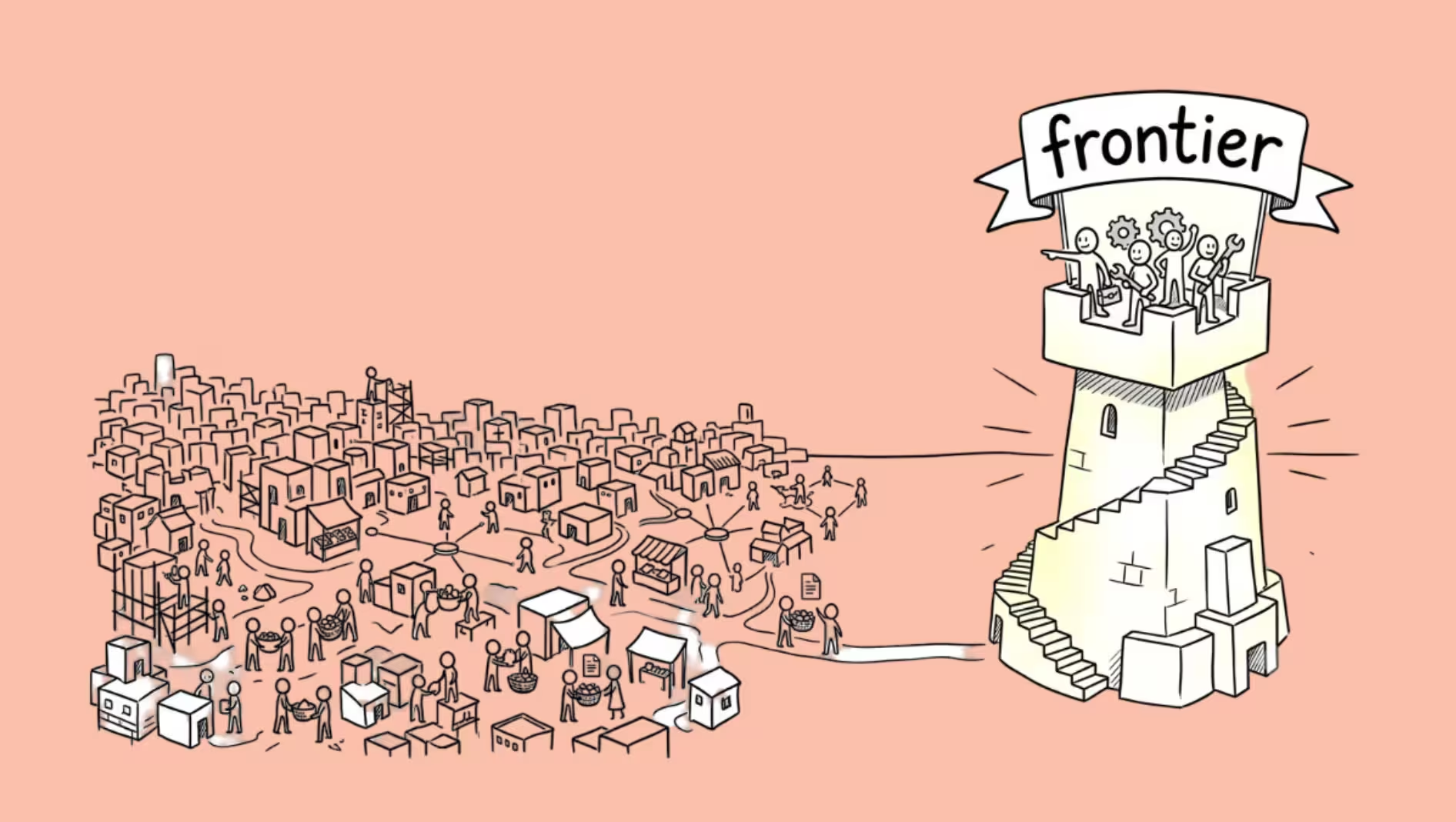
Hugging Face CEO Clem Delangue sees a split forming. Frontier models will handle the hardest, highest-value tasks. Everything else will run on cheaper, customizable open alternatives that companies control themselves.
“If you’re an AI company or a technology company, you don’t want to outsource your core capabilities to another company, to a black box API that you don’t control, don’t have any visibility on, and don’t really have any sort of ownership,” Delangue said on TechCrunch’s Equity podcast.
The numbers back him up. A new repository is created on Hugging Face every seven seconds.
The platform hosts nearly three million public models and one million public datasets. Half of all Fortune 500 companies are using it to deploy their own private or open-source models. That’s not “one model to rule them all.”
That’s thousands of companies running dozens of models customized for their specific needs.
Microsoft CEO Satya Nadella is making a similar argument.
He recently warned against single-provider lock-in, pointing out that closed AI companies learn from customer data while restricting customers from doing the same.
“If learning flows in only one direction, economic value converges toward the owners of the learning infrastructure rather than the creators of the knowledge itself,” Nadella said.
The Chinese Model Factory
Every few months, another Chinese lab drops a powerful open-weight model that undercuts the economics of proprietary American AI.
The latest example is GLM-5.2 from Z.ai (formerly Zhipu AI), released in mid-June.
It’s a 753-billion parameter model with a million-token context window, MIT-licensed, and tuned specifically for agentic coding.
It tops the Artificial Analysis Intelligence Index for open-weight models and comes within striking distance of Anthropic’s Opus 4.8 on coding benchmarks.
The API pricing? Roughly $1 to $2 per million input tokens, compared to $5 to $15 for the leading closed-source competitors.
Before GLM-5.2, it was DeepSeek V4. Before that, Qwen 3.5. Before that, MiniMax M2.7. The cadence is relentless.
And Alibaba’s Qwen family alone now has more than 113,000 derivative models on Hugging Face, more than Google and Meta combined.
The ecosystem effect is self-reinforcing. More developers build on these models. More fine-tuned versions appear. More tooling gets built. More developers show up. The flywheel is spinning.
The Security Debate That Won’t Go Away
Not everyone is thrilled. Anthropic CEO Dario Amodei has argued that releasing powerful open model weights could be dangerous because once they’re out, they can’t be controlled.
Bad actors could use them for disinformation, cyberattacks, or worse.
Delangue sees it differently. “The biggest risk in AI is concentration of power,” he said. “The way you make the world safer, in my opinion, is by leveling up the playing fields and creating transparency on these models.”
His argument: keeping models closed doesn’t eliminate risk.
It’s easy to jailbreak frontier model APIs. Weights get stolen and leaked.
All that closed-source restrictions actually accomplish, Delangue says, is concentrating power in a handful of companies while reducing everyone else’s ability to understand how the technology works.
“You don’t really make it safe by keeping it behind closed doors for just a few players. You make it more dangerous because you create asymmetry of power and asymmetry of capabilities.”
The CSIS agreed that this argument has geopolitical weight. When the U.S. government pulled Anthropic’s Fable 5 and Mythos 5 offline for 18 days in June, it sent a signal to every foreign developer: American model access can disappear without warning.
That pushes international users toward Chinese open-weight alternatives they can host themselves, no strings attached.
What This Means for the Frontier Labs
This doesn’t mean frontier models are dead.
For the hardest problems, for cutting-edge research, for tasks where the absolute best reasoning matters, closed-source systems from Anthropic, OpenAI, and Google still lead.
Nobody is running Mythos-level cybersecurity work on an open-weight model.
But “the hardest problems” is a shrinking share of total AI usage. Most production workloads don’t need the smartest model.
They need a good-enough model that’s fast, cheap, customizable, and runs on infrastructure the company controls. Open-weight models check every one of those boxes.
The billions that American labs have poured into building the most capable models in the world may turn out to be the R&D phase of an industry where the actual profits flow to whoever deploys the cheapest, most practical version of that technology at scale.
And right now, that’s the open-source ecosystem.
“Maybe in a few years, the frontier models will be for experimenting and for some really high-value tasks, and most of the production workloads will actually be powered either by private models within companies or by open source models,” Delangue said.
If that’s right, the real AI race isn’t happening at the frontier anymore. It’s happening everywhere else.
