
Genspark started as an AI search engine with 5 million users.
Then in early 2026, it launched an autonomous agent platform and the growth numbers went vertical: $10 million in annual recurring revenue within 9 days, $36 million ARR within 45 days, adding roughly $1 million in daily revenue during that sprint.
Over 60% of generated research briefs get saved to workspaces or exported to Notion, which signals real usage rather than just curiosity signups. The 120,000+ phone calls placed through Call For Me show adoption of even the newest features.
Those numbers matter because they explain why Genspark feels ambitious to the point of being overwhelming. This isn’t a focused tool that does one thing well.
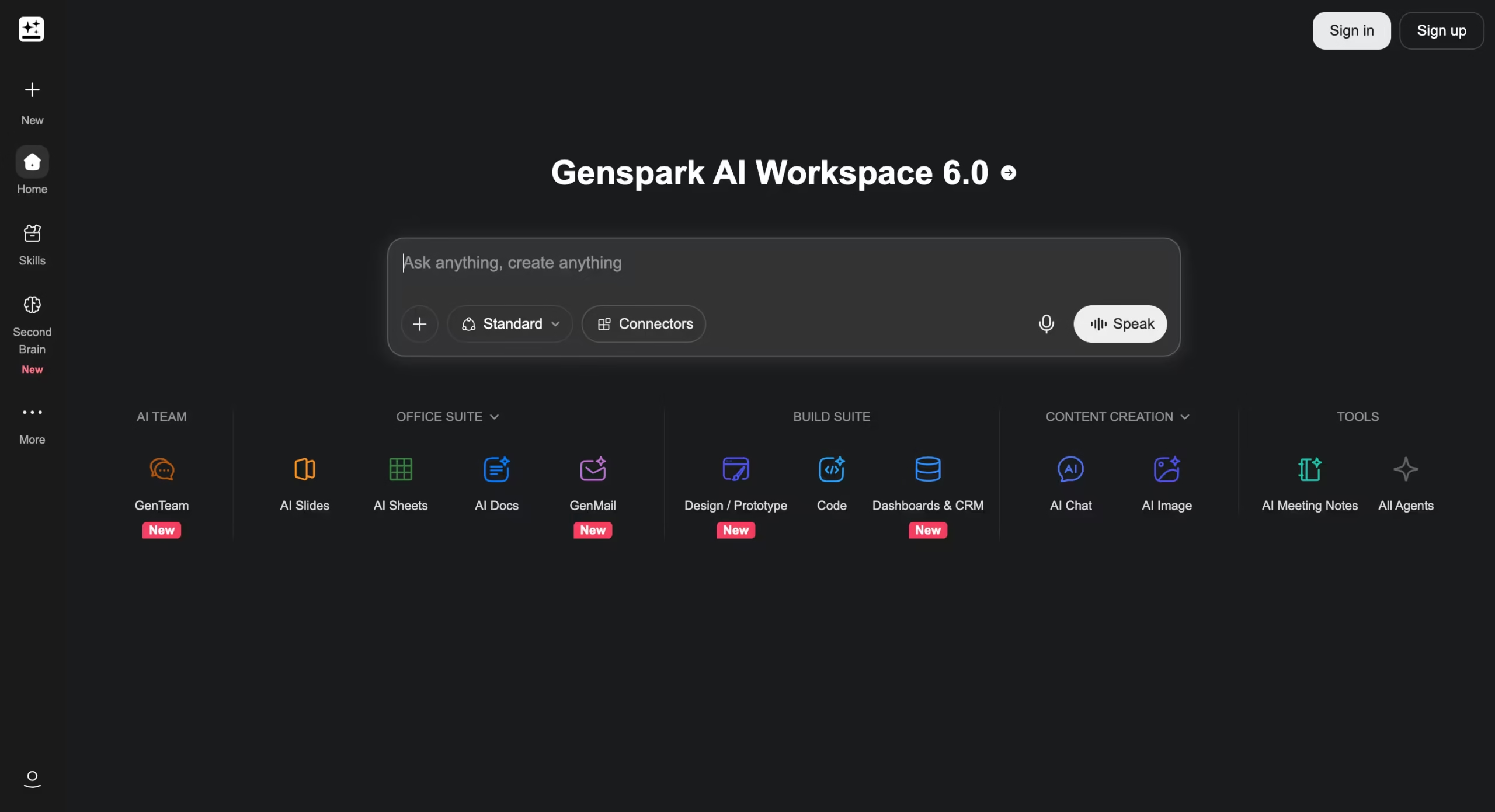
It’s a platform trying to be your search engine, your content studio, your presentation builder, your data analyst, your autonomous web browser, and your phone assistant, all in one workspace.
I tested Genspark across three weeks, using it as my primary AI workspace for research, content creation, and task automation.
My honest verdict: Genspark is the most capable all-in-one AI workspace at this price point in 2026, and also the most confusing one. The breadth of features is real, not marketing fluff.
But the credit system creates constant anxiety about whether a given task is worth the credits it’ll consume, and the lack of a published per-task credit table means you’re guessing until after the credits are already gone.
For users who want one subscription that covers research, content creation, and light automation, Genspark Plus delivers genuine value at $25/month. For users who want predictable pricing and a focused tool that does one thing perfectly, stick with Perplexity for research or ChatGPT for conversation.
Key Features
Super Agent: Multi-Model Orchestration
The Super Agent is Genspark’s orchestration layer. Instead of sending your prompt to a single AI model, the Super Agent reads your request, determines which combination of models and tools will produce the best result, and coordinates them.
A research query might route through one model for web search, another for synthesis, and a third for fact-checking.
This Mixture-of-Agents (MoA) architecture produces outputs that are more thorough and better-sourced than single-model responses, at the cost of being slower.
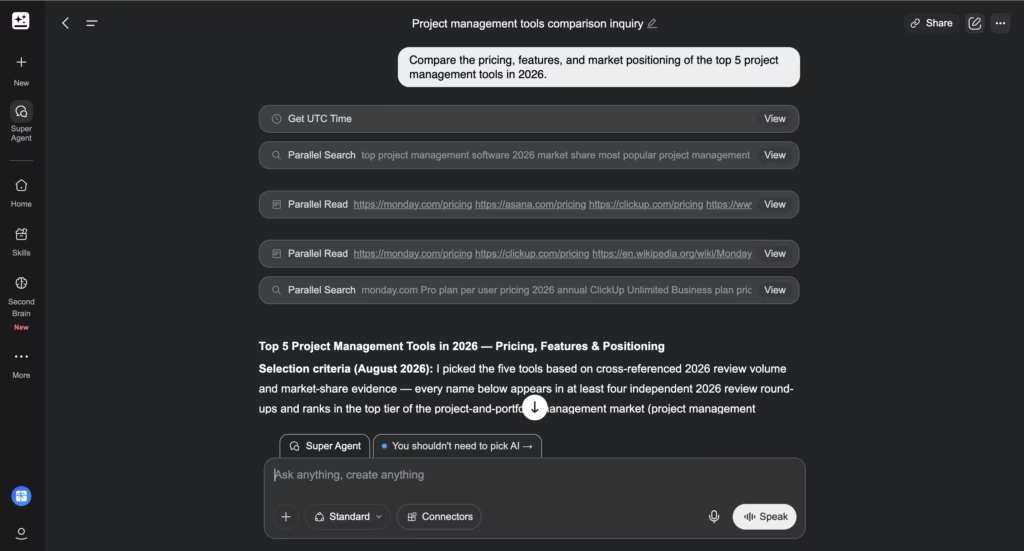
I tested the Super Agent on a competitive analysis query: “Compare the pricing, features, and market positioning of the top 5 project management tools in 2026.”
A single ChatGPT query would have given me a decent but surface-level table.
Genspark’s Super Agent searched multiple sources, cross-referenced pricing pages, compared feature sets, and delivered a structured Sparkpage with citations, comparison tables, and a summary analysis.
The output took about 90 seconds (versus ChatGPT’s 15 seconds), but the depth was noticeably stronger. I could trace every claim to its source, which matters when you’re using AI output for business decisions rather than casual curiosity.
Sparkpages: Structured Research Output
Sparkpages are Genspark’s answer to Perplexity’s cited responses.
Instead of a chat-style answer, Genspark generates a full structured page with a title, table of contents, sections, inline citations, comparison tables, and integrated media.
You can share a Sparkpage via link, making it useful for team collaboration or client deliverables.
I generated 8 Sparkpages across different research topics. The strongest output was a market analysis of AI video tools that included a comparison table, pricing breakdown, feature matrix, and competitive positioning summary, all with inline source links.
The weakest was a “best restaurants in Austin” query that produced generic descriptions that read like rewritten Yelp summaries. Sparkpages excel at structured research and analysis. They struggle with subjective, taste-based queries where personal experience matters more than data.
For researchers and analysts, Sparkpages are Genspark’s strongest differentiator over Perplexity.
The output is more structured, more detailed, and more shareable. For casual “what should I eat tonight” queries, Perplexity is faster and more conversational.
AI Slides
Type a prompt and Genspark builds a slide deck with titles, key points, summary slides, and visual structure.
You can start from pre-built templates or let the AI structure it from scratch. I tested this on “Create a 10-slide investor pitch deck for an AI-powered fitness app” and got a structurally sound deck in about 10 minutes.
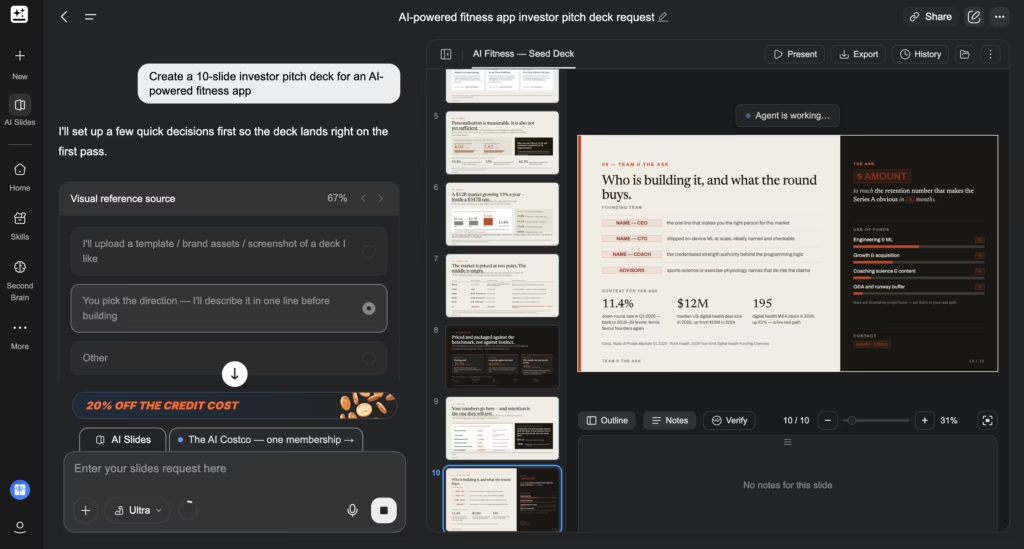
The content hierarchy was logical (problem, solution, market size, traction, team, ask), and the key points were relevant without being generic.
The visual design is functional but not polished. Slides look like competent first drafts, not finished presentations. If you’d normally build a rough deck in Google Slides and then spend an hour refining the design, Genspark handles that rough-deck phase in minutes.
The refinement still falls to you (or to a tool like Gamma or Beautiful.ai for visual polish).
Each presentation costs roughly 100 to 450 credits depending on length and complexity. Four slide decks across my testing consumed approximately 1,200 credits total.
Call For Me: AI Phone Calls
This is the feature that makes people stop scrolling. You give Genspark a phone number, a task (“call this dentist and book a cleaning for next Tuesday afternoon”), and it places an actual phone call using an AI voice agent.
The AI speaks, listens, responds to the receptionist, and reports back with a summary.
I tested 3 calls: booking a restaurant reservation, asking a local gym about membership pricing, and inquiring about a dental appointment. The restaurant reservation worked flawlessly. The AI confirmed the date, time, and party size.
The gym pricing call retrieved the information but struggled when the receptionist asked a follow-up question (“Are you interested in a personal training package?”) and gave a vague response.
The dental appointment call connected but the receptionist asked to be transferred, which the AI couldn’t handle.
Calls cost roughly 1 credit per second, so a 3-minute call burns about 180 credits. At that rate, a Plus user’s 10,000 monthly credits support roughly 55 phone calls (assuming nothing else consumes credits).
It’s a powerful feature for people who hate making phone calls, with the caveat that complex or multi-step calls still need a human.
Claw: Autonomous Agent (“AI Employee”)
Launched March 12, 2026, Claw is positioned as your first “AI employee.”
You assign it a task via a message, and it executes the entire workflow across real software interfaces: researching, scheduling, emailing, coding, and reporting back. Every Claw user gets a dedicated Genspark Cloud Computer, an always-on cloud instance with the agent pre-installed.
This is Genspark’s most ambitious feature and its most uneven.
Simple tasks (research and summarize, draft an email based on notes, compile data into a spreadsheet) complete reliably. Complex multi-step tasks that require navigating unfamiliar interfaces or making judgment calls still need supervision.
The AI Browser underlying Claw handles about 60-70% of straightforward web tasks (booking lookups, form fills, comparison shopping).
Complex multi-step flows still need babysitting, which is consistent with every autonomous browsing tool in 2026, including ChatGPT Operator and Claude Computer Use.
AI Image and Video Generation
Genspark generates images and videos from text prompts using its multi-model stack.
On paid plans, AI chat and image generation currently cost zero credits (promotional through December 31, 2026). Video generation is the most expensive feature on the platform, consuming 600+ credits per clip in my testing.
Image quality is comparable to mid-tier dedicated generators. Not Midjourney quality, but usable for social media posts and blog illustrations. Video quality is basic, suitable for social teasers and rough concepts rather than polished production.
Competitors Comparison
| Feature | Genspark | Perplexity AI | ChatGPT | Manus | You.com |
| Starting Price | $24.99/mo (Plus) | $20/mo (Pro) | $20/mo (Plus) | $20/mo | $20/mo (Pro) |
| Free Plan | Yes (100-200 credits/day) | Yes (limited) | Yes (limited) | No | Yes (limited) |
| Multi-Model Routing | Yes (MoA architecture) | No (single model) | Yes (model picker) | Yes (multi-model) | Yes (model picker) |
| Structured Research Pages | Yes (Sparkpages) | Yes (Pages, basic) | No | Yes | No |
| Slide Generation | Yes | No | No | Yes | No |
| AI Phone Calls | Yes (Call For Me) | No | No | No | No |
| Autonomous Agent | Yes (Claw) | No | Yes (Operator, limited) | Yes (core feature) | No |
| AI Browser | Yes | No | Yes (Operator) | Yes | No |
| Video Generation | Yes | No | Yes (Sora) | Yes | No |
| Citation Quality | Strong (inline sources) | Strong (inline sources) | Moderate | Strong | Moderate |
| Speed | Moderate (multi-agent overhead) | Fast | Fast | Slow (thorough) | Fast |
| Credit System | Yes (burns vary by task) | No (usage limits) | No (message limits) | Yes (credit-based) | No (message limits) |
| Best For | All-in-one AI workspace | Fast cited research | General-purpose AI chat | Complex autonomous tasks | AI search with model choice |