

The Zapier killer that wasn’t is shutting down. But the story isn’t really about Relay. It’s about what Google plans to do with Chrome next.
On Monday, Jacob Bank announced that he’s rejoining Google as VP of Product for Chrome.
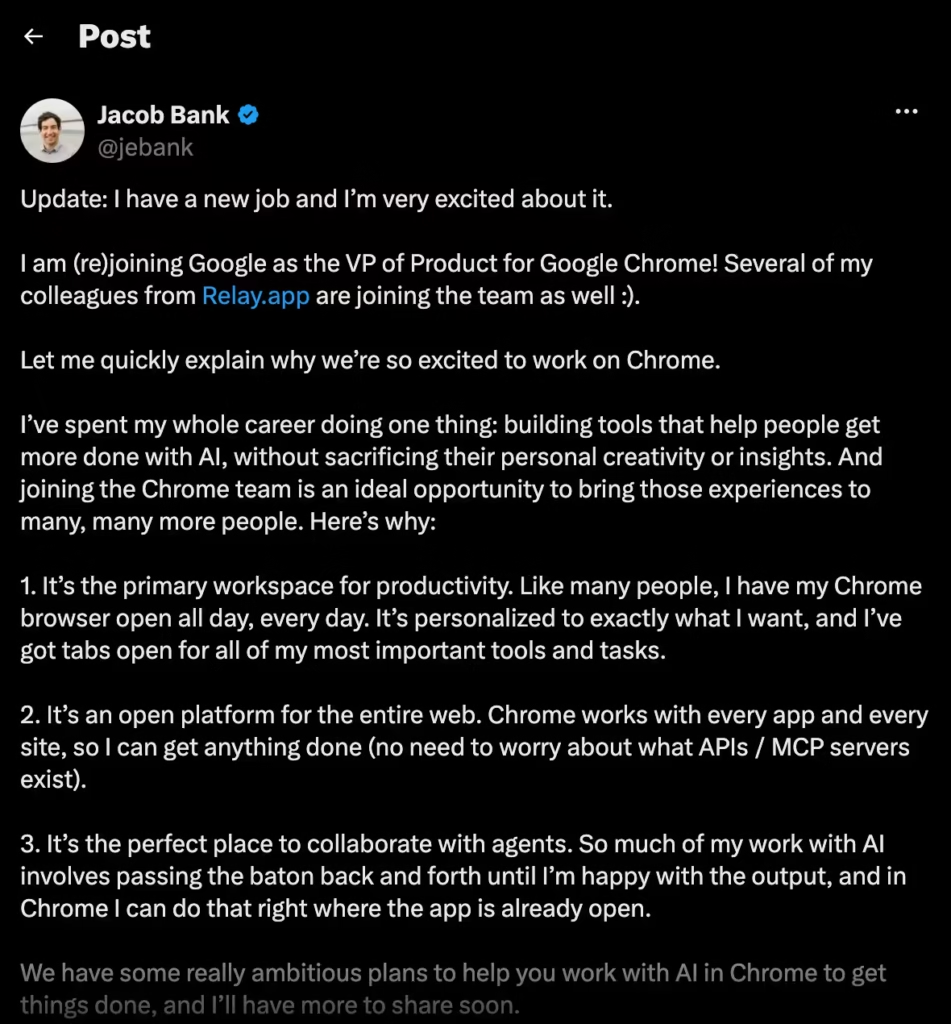
Several members of his team at Relay, the AI workflow automation startup he founded in 2021, are coming with him.
Relay itself is winding down. Free users lost access on August 15. Paying customers have until September 14.
No acquisition was announced. No buyer was named. The shutdown notice doesn’t even say why. It just says the team is sorry and that exports are available.
What makes this interesting isn’t the shutdown. Small AI startups close all the time. It’s who Google hired and what that tells us about where Chrome is headed.
Bank’s Track Record Is a Roadmap
Jacob Bank’s entire career is one continuous thread: AI-powered productivity tools.
In 2015, Google acquired his smart calendar app Timeful. Those features got folded into Google Calendar and Gmail.
Bank spent the next six years at Google, rising to Director of Product Management for Gmail, Calendar, and Chat. He shipped Smart Reply, Smart Compose, and Nudging, some of the earliest consumer-facing AI features in Google’s product line.
He left in 2021 to build Relay, which raised $8.1 million from Khosla Ventures and a16z.
The pitch was ambitious: automate business workflows with AI, with human-in-the-loop approval steps that Zapier didn’t offer. Early customers included Ramp, Warp, and Motion.
Now he’s back at Google, running product for the browser that controls roughly two-thirds of the web. He called Chrome “a perfect place to collaborate with agents.”
Chrome Is Becoming an Agent Platform
The timing of Bank’s hire lines up with a clear pattern. Google has been steadily turning Chrome into more than a browser.
Gemini was integrated into Chrome as a sidebar assistant last year.
It expanded to 11 countries this spring, with personal intelligence features that connect to Gmail, Calendar, and Photos. Gemini itself just crossed 1 billion users.
And Google’s agentic browsing feature, where Gemini can actually control the browser and complete tasks on your behalf, is already in testing for paid U.S. users.
Hiring the person who built workflow automation at both his own startup and inside Gmail/Calendar to run Chrome’s product org is a signal that Google sees the browser as the next surface for AI agents.
Not a chatbot in a sidebar. An agent that lives in the browser and does work.
As How2Shout noted: “Google is approaching the problem from the opposite end, not building a new browser for agents, but putting agents inside the browser two-thirds of the web already uses.”
What Happens to Relay’s Customers
Nothing good. Relay’s shutdown notice gives paying customers until September 14 to export their data and migrate their workflows. The company posted export guides and says workflows will keep running through the wind-down window.
But there’s no acquisition path. No “your data moves to Google” landing. Relay just ends.
For a startup that counted fintech companies and developer tools among its customers, that’s a painful transition. The community response has been a mix of frustration and resignation. Workflow automation is sticky by design. Rebuilding automations on Zapier, Make, or n8n takes real time.
The Bigger Pattern
Relay isn’t the first AI startup to fold this year, and it won’t be the last.
The pattern is consistent: small AI companies raise venture money, build useful products, struggle to compete with the labs and the platforms, and eventually get absorbed. The talent flows back to Google, Microsoft, OpenAI, or Anthropic. The product disappears.
What’s different here is the destination. Bank didn’t rejoin Google to work on Gemini or Workspace. He’s running Chrome. The browser is the one Google product that sits between users and everything else they do online.
If Google makes Chrome the default home for AI agents, it doesn’t matter which model is the smartest or which agent framework is the most popular. Chrome is the surface where the work happens.
Bank has “really ambitious plans,” he said. Given his track record, that probably means Chrome users will start seeing AI-powered workflow features that look a lot like what Relay tried to build, but with 3.5 billion users instead of a few thousand.
Relay didn’t survive. Its ideas might.
