
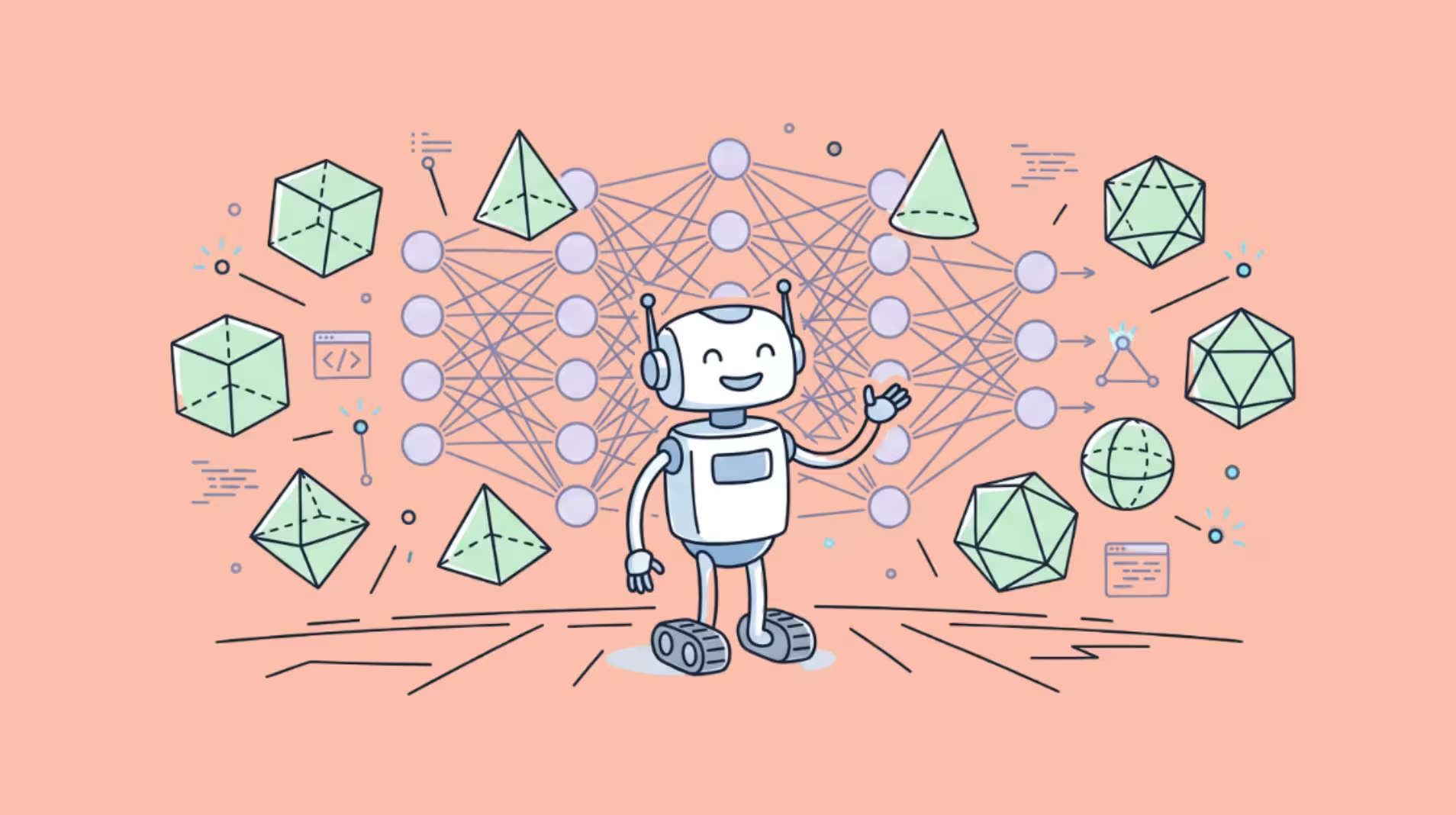

A world model is an AI system that learns how environments work – physics, cause and effect, spatial relationships – and uses that understanding to simulate what happens next.
Instead of generating pixels frame by frame with no memory, a world model builds an internal representation of a scene and predicts how it will change when something acts on it.
That is the short definition.
The longer version matters more, because the term “world model” has been stretched to cover everything from game engines to autonomous driving simulators to 3D scene generators.
Not all of them are doing the same thing.
I have tracked this space since Yann LeCun published his JEPA architecture paper in 2022, and I have covered over a dozen model launches on autogpt.net in the past year alone.
The field has split into two camps that are worth understanding before you look at any specific model.
Two Schools of Thought on How Machines Should Understand the World
The first camp says: teach the model to understand the world in abstract terms.
Do not waste capacity predicting exact pixel values. Instead, learn compressed representations – embeddings -nthat capture the structure of what is happening.
If a ball is rolling toward a wall, the model should understand “object approaching barrier, collision imminent” without reconstructing every photon.
This is the JEPA (Joint Embedding Predictive Architecture) approach, championed by Meta’s AI research lab. V-JEPA 2 is the latest result.
The second camp says: prediction IS understanding.
If a model can accurately generate what a scene looks like one second from now – every shadow, every reflection, every object interaction – then it has learned the physics implicitly.
This is the approach behind NVIDIA Cosmos, Google Genie 3, and most of the video-generation-based world models. The output is pixels, but the internal representations that produce those pixels encode real physical knowledge.
Both approaches work. They just work for different things. And the models below reflect that split.
1. NVIDIA Cosmos 3
Released: May 31, 2026 | Architecture: Mixture-of-Transformers | Access: Open weights (OpenMDW 1.1 license)
Cosmos 3 is the model every robotics and autonomous driving team is evaluating right now.
NVIDIA released it in three sizes: Super (64B parameters), Nano (16B), and Edge (4B, designed to run on Jetson Orin hardware at the edge).
The architecture is called Mixture-of-Transformers, which is distinct from the Mixture-of-Experts approach used in most LLMs.
Instead of routing different tokens to different experts, MoT applies separate weight matrices to different modalities within the same model.
Text, images, and video get their own processing pathways but share a unified attention mechanism. The result is a model that handles multi-modal input without the efficiency penalty of running separate encoders.
The adoption numbers tell the story. NVIDIA reports that Doosan Robotics, Samsung, LG, Li Auto, and Xiaomi are already using Cosmos for synthetic data generation – creating training scenarios for robots and self-driving systems that would be dangerous or expensive to collect in the real world.
What makes it matter: Open weights at this scale for physical AI is rare.
The Edge model running on a $500 Jetson board means small robotics teams can run world simulation locally. NVIDIA’s previous Cosmos release was already significant, but the 3.0 generation closes the quality gap with closed models.
The limitation: When I reviewed the OpenMDW 1.1 license terms, the redistribution restrictions stood out.
You can use Cosmos commercially and fine-tune it internally, but you cannot offer a managed service built on top of it or redistribute derivative weights.
If your plan is “wrap Cosmos in an API and sell it,” the license blocks that. For internal robotics training or on-device deployment, the terms are fine. For platform plays, they are not.
2. Meta V-JEPA 2

Released: 2025 | Architecture: JEPA (Joint Embedding Predictive Architecture) | Access: Open source (MIT license) | Parameters: 1.2B
V-JEPA 2 is the only open world AI model on this list that was not trained to generate pixels at all.
It predicts in embedding space – abstract representations of what is happening in a scene – rather than reconstructing visual output. This makes it fundamentally different from every video-generation-based world model.
Meta trained it on over one million hours of video plus 62 hours of DROID robotic manipulation data.
The result is a model that scored highest on Something-Something v2 and Epic-Kitchens-100, two benchmarks that test whether a model actually understands physical interactions (not just visual patterns).
But the number I keep coming back to is this: V-JEPA 2 achieved 65-80% success rates on pick-and-place robot tasks with zero-shot transfer. No task-specific fine-tuning.
The model watched videos of the physical world, built internal representations of how objects behave, and transferred that understanding directly to controlling a robot arm it had never been connected to before.
What makes it matter: MIT license. 1.2 billion parameters (small enough to run on consumer hardware). And a proof-of-concept for the JEPA hypothesis that you do not need to generate pixels to understand physics.
The limitation: V-JEPA 2 does not generate visual output. You cannot ask it to show you what a scene will look like. It produces embeddings that downstream systems use for decision-making. If you need visual simulation, this is the wrong tool.
3. Google DeepMind Genie 3
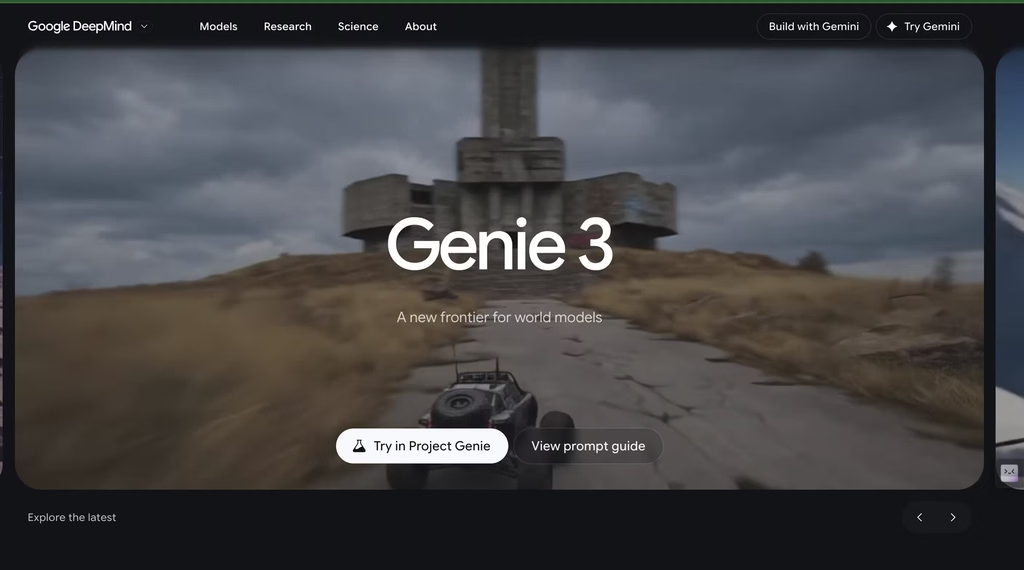
Released: August 5, 2025 | Architecture: Autoregressive transformer | Access: Closed (research preview)
Genie 3 generates playable, interactive 3D environments from text descriptions.
You type “a sunlit forest clearing with a stone bridge over a stream,” and Genie 3 creates a navigable world you can move through in real time at 720p and 24 frames per second.
The model maintains approximately one minute of visual memory, meaning objects and terrain you walked past stay consistent if you turn around and walk back.
That sounds minor until you realize most video generation models have no spatial memory at all — leave the frame and everything resets.
What makes it matter: Genie 3 is the first model I have seen that generates a space you can walk through, not just a video you watch. The jump from “generate a video of a forest” to “generate a forest you can walk through” is not incremental.
It requires the model to maintain a persistent 3D state, handle viewpoint changes, and keep physics consistent as the user interacts.
The limitation: It is closed. Google has not released weights, code, or API access.
The agent actions are constrained (basic movement, limited interaction), it cannot model multiple independent agents, and sessions cap at minutes, not hours. This is a research direction indicator, not a usable product.
4. World Labs Marble
Released GA: November 12, 2025 | Architecture: Proprietary | Access: Closed (commercial product)
Marble is that open world AI model that does something none of the other models on this list do: it generates 3D geometry you can actually export and use.
From text, images, or video input, Marble produces Gaussian splats and meshes that work in standard 3D pipelines.
The Chisel tool lets you sculpt and modify the generated 3D assets directly, and the open-source Spark renderer handles real-time visualization.
For studios and game developers, this is the part that matters – the output is not locked inside World Labs’ ecosystem.
What makes it matter: Most world models generate video. Marble generates assets. A game studio can describe an environment, get exportable geometry, and drop it into Unity or Unreal. That workflow did not exist a year ago.
The limitation: Closed and commercial. No published model architecture, no weights, no way to self-host. You are dependent on World Labs’ infrastructure, pricing decisions, and continued operation.
5. LTX-2.5 (Lightricks)

Released: August 11, 2026 | Architecture: Diffusion transformer (DiT) | Access: Open weights (permissive license) | Downloads: 33M+ on HuggingFace
LTX-2.5 does not get the attention that Cosmos or Genie gets, and that is probably because Lightricks is a mobile apps company, not a research lab.
But the engineering here is worth paying attention to.
The model processes 8,192 pixels per token, compared to the 1,024 pixels per token that is standard in most video diffusion models.
That 8x compression ratio means it generates 10-second video clips in 6.8 seconds on appropriate hardware. It is one of the few models in this space where generation is faster than playback.
LTX-2.5 has crossed 33 million downloads on HuggingFace, which puts it among the most-pulled video generation models on the platform.
For context, the Artificial Analysis benchmark ranked LTX-2 third for image-to-video quality and seventh for text-to-video at launch. The 2.5 update improved on both.
What makes it matter: Speed plus open weights plus a permissive license.
If you are building a product that needs video generation as a component (not the product itself), LTX-2.5 is the practical choice. No API costs, no rate limits, no dependency on someone else’s servers.
The limitation: It is a video generation model, not a full world model. It does not maintain state between clips, does not support interaction, and has no memory of what it generated before. Use it for synthesis, not simulation.
6. Wayve GAIA-4
Released: August 3, 2026 | Architecture: Proprietary | Access: Closed
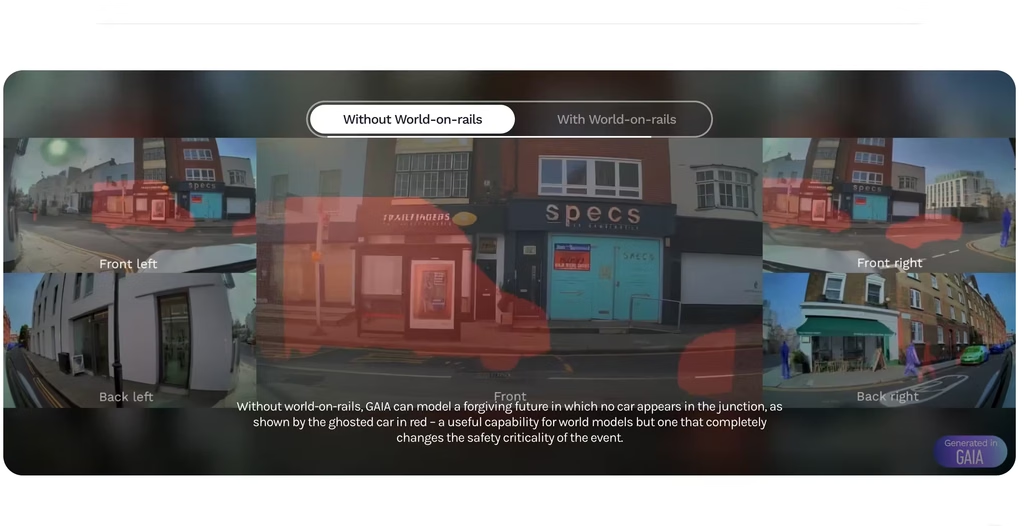
GAIA-4 is a world model built specifically for autonomous driving simulation.
It generates closed-loop driving scenarios including camera, LiDAR, and – this is the industry first – radar sensor data. Every other driving simulator I have reviewed generates camera and sometimes LiDAR. Radar generation is new.
Wayve reports a 2.5x improvement in fidelity over GAIA-3, and the model uses a “world-on-rails” constraint that keeps generated scenarios physically plausible rather than drifting into impossible situations.
What makes it matter: Autonomous driving companies need to test edge cases they cannot safely reproduce on real roads. A pedestrian stepping into traffic.
A tire blowout at highway speed. GAIA-4 generates those scenarios synthetically, across all sensor modalities, so the driving system can be tested against them before it ever encounters them in the real world.
The limitation: This is a vertical tool. It does not generalize to other domains. You cannot use it for game development, robotics outside of driving, or general-purpose simulation. It also remains closed, so only Wayve and its partners have access.
7. Odyssey-2
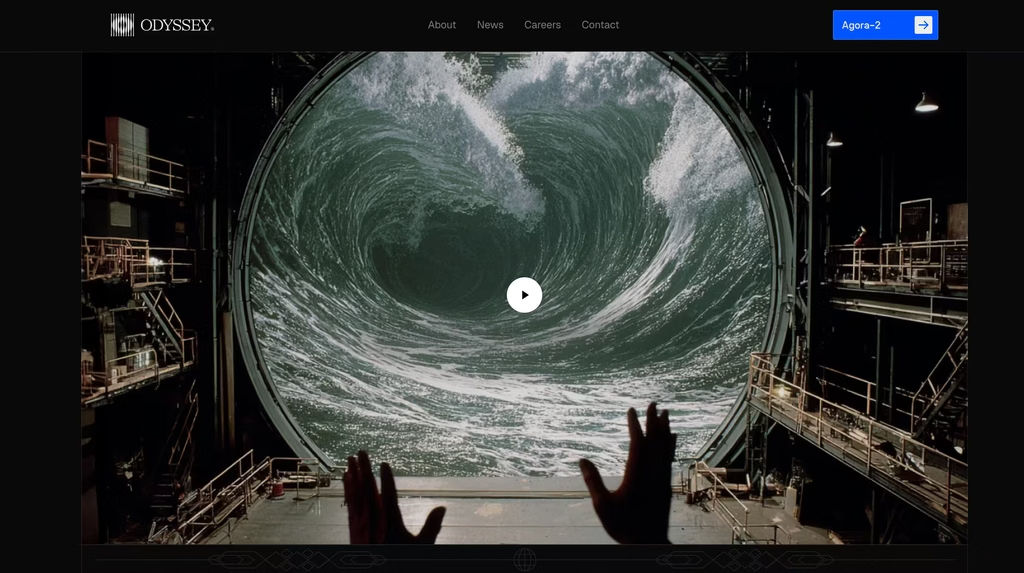
Released: October 27, 2025 | Architecture: Causal autoregressive | Access: Closed (API planned)
Odyssey-2 generates interactive video environments at 20 frames per second – one frame every 50 milliseconds.
You describe a scene in text, and the model produces a video environment you can interact with through natural language commands.
The causal autoregressive architecture means each frame is generated based on all previous frames plus the user’s input, which gives it a form of temporal consistency that diffusion-based models struggle with.
What makes it matter: 20fps interactive generation is fast enough to feel responsive.
Most competing approaches either generate non-interactive video (fast but passive) or interactive environments at much lower frame rates (responsive but choppy). Odyssey-2 sits at the intersection.
The limitation: Closed, with an API “coming soon” that has not materialized as of this writing. The demo videos are impressive, but until external developers can test it, the claims are unverified.
8. Oasis AI (Decart/Etched)
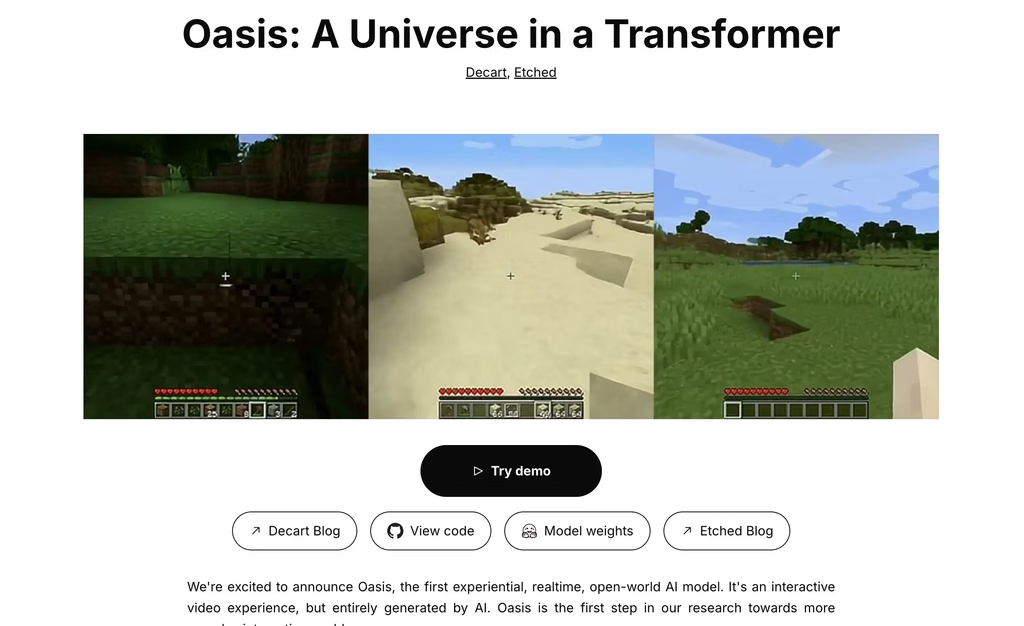
Released: 2024 (ongoing) | Architecture: Transformer-based | Access: Open / playable in browser
Oasis made headlines by generating a Minecraft-style world entirely through a neural network – no game engine underneath. Everything you see is generated frame by frame by the model, running at 20 frames per second in a browser.
Decart and Etched (the hardware startup behind it) claim “100x faster” generation compared to diffusion-based approaches, which they attribute to the specialized inference hardware. The browser-based demo is publicly playable.
What makes it matter: It is the most accessible world model demo that exists. You can play it right now, in a browser, without signing up for anything.
As a proof of concept for real-time neural world generation, it is hard to argue with.
The limitation: The generated world is visually simple (Minecraft-style blocks), the physics are approximate, and the environment does not persist between sessions.
You would not ship a game on this today, but it proves the architecture works at interactive speeds.
9. HY-World 2.0 (Tencent Hunyuan)
Released: April 15, 2026 | Architecture: Proprietary | Access: Open source
Tencent’s contribution to the world model space is notable because it outputs native 3D geometry – meshes and Gaussian splats -rather than video. The output is engine-ready, meaning you can import it directly into Unity or Unreal without conversion.
What makes it matter: Along with Marble, HY-World 2.0 represents the branch of world models that is most immediately useful for game development and 3D content creation.
Open source access means you can run it on your own infrastructure.
The limitation: Documentation and community support are thinner than for Western open-source models. Most of the technical materials are Chinese-language first, with English translations that lag behind.
10. Waypoint (Overworld)
Released: April 9, 2026 | Architecture: Proprietary | Access: Open source (Apache 2.0)
Waypoint runs entirely on local hardware and generates interactive environments at up to 720p resolution and 60 frames per second. The Apache 2.0 license means no restrictions on commercial use.
What makes it matter: If your requirement is “world model that runs on my own GPU with no cloud dependency,” the options are limited.
Waypoint is one of the few that delivers real-time generation locally at a resolution and frame rate that is usable.
The limitation: Overworld is a smaller team with less resources than NVIDIA, Google, or Meta. The model’s quality on complex scenes does not match the closed frontier models.
Open World AI Models Side by Side
| Model | Access | Generates | Interactive | Key Strength |
| NVIDIA Cosmos 3 | Open weights | Video / sensor data | No | Multi-modal physical AI, edge deployment |
| Meta V-JEPA 2 | Open source (MIT) | Embeddings (not pixels) | No | Zero-shot robot control |
| Google Genie 3 | Closed | Interactive 3D environments | Yes | Navigable world generation |
| World Labs Marble | Closed (commercial) | 3D meshes + Gaussian splats | Partial (Chisel tool) | Exportable 3D assets |
| LTX-2.5 | Open weights | Video | No | 8x compression, speed |
| Wayve GAIA-4 | Closed | Multi-sensor driving sim | Yes (closed-loop) | Radar generation (industry first) |
| Odyssey-2 | Closed | Interactive video | Yes | 20fps causal generation |
| Oasis AI | Open / playable | Game environments | Yes | Browser-playable demo |
| HY-World 2.0 | Open source | 3D meshes / Gaussians | No | Engine-ready output |
| Waypoint | Open source (Apache 2.0) | Interactive environments | Yes | Local, 720p@60fps |
If I were starting a robotics project today, I would pick V-JEPA 2 over Cosmos Edge.
The MIT license removes all future risk – no redistribution surprises, no license version changes to track – and for control tasks, the zero-shot transfer results matter more than visual fidelity.
Cosmos wins if you need synthetic training video or sensor data at scale, but for a team building a manipulation pipeline with limited compute, V-JEPA 2 is the answer that does not come with strings.
Where Open World AI Models Are Headed
Three trends are shaping where this field goes.
First, the convergence of video generation and world simulation.
Models like Cosmos 3 and Genie 3 are blurring the line between “generate a video of something” and “simulate a world you can interact with.”
The underlying architectures are increasingly similar. Within a year, the distinction may not be meaningful.
Second, the hardware race.
World models are compute-hungry. NVIDIA’s Edge model (4B parameters on Jetson Orin) represents early efforts to bring world simulation to edge devices.
As these models shrink, the applications expand – from factory robots to self-driving cars to consumer electronics.
Third, open source is pulling ahead on adoption. Five of the twelve models on this list are fully open source. Two more have open weights.
The closed models (Genie 3, Marble, GAIA-4, Odyssey-2) may lead on quality, but the open-source community is closing the gap fast, and for many applications, “good enough and self-hostable” beats “best-in-class but API-dependent.”
The question is not whether world models will matter.
They already do – every major autonomous driving company, every large robotics program, and an increasing number of game studios are using them.
The question is which approach (understanding vs. generation, open vs. closed, cloud vs. edge) wins for your specific use case.
And right now, there is no single answer.
FAQs
What is an AI world model?
An AI world model is a system that learns how environments work – physics, spatial relationships, cause and effect – and uses that understanding to predict or simulate what happens next. Unlike traditional simulators that run hand-coded physics engines, world models learn these rules from data (typically video, images, or sensor recordings).
What is the difference between a world model and a video generation model?
A video generation model produces visual output frame by frame.
A world model maintains an internal representation of a scene’s state and predicts how that state changes over time. Some world models generate video as output (Cosmos 3, Genie 3), but others work in embedding space (V-JEPA 2) or latent space) without generating pixels at all. The key difference is whether the model understands the scene or just renders it.
Which open-source world models can I run locally?
V-JEPA 2 (MIT license, 1.2B parameters) and Waypoint (Apache 2.0, up to 720p@60fps) runs on local hardware. NVIDIA Cosmos 3 Edge (4B parameters) runs on Jetson Orin devices. LTX-2.5 runs locally with appropriate GPU hardware.
Are world models used in production or just research?
Both. NVIDIA Cosmos is used by Doosan Robotics, Samsung, LG, Li Auto, and Xiaomi for synthetic training data. Wayve uses GAIA-4 for autonomous driving simulation.
World Labs Marble is a commercial product used by 3D studios. But many models on this list (Genie 3, Odyssey-2) remain research-stage.
What hardware do I need to run a world model?
It depends on the model. V-JEPA 2 at 1.2B parameters runs on mid-range hardware. NVIDIA Cosmos Edge runs on a $500 Jetson Orin. The larger models (Cosmos Super at 64B parameters, full Genie 3) require datacenter-class hardware or cloud APIs.
