
OpenAI says it will add an invisible watermark to text from ChatGPT and Codex in the European Union to follow new EU rules.
The company shared the news in a blog post. And soon every sentence ChatGPT writes will carry a tiny, invisible stamp. You can’t see it, but other system tools can find it.
The update will take a few weeks and will reach eligible users on all plans. But for now, it only applies in the EU.
EU AI Act
The EU AI Act has transparency rules that took effect on August 2. They require AI companies to mark AI-made content. And the mark must be something other systems can spot.
The watermark lives in the words themselves. AI models pick each next word from a list of likely options.
OpenAI’s method gently directs those choices by using a secret key to sort the options. The result is a pattern that readers can’t see.
Detectors then look for the pattern using only the text and the key. One nudge means little, but hundreds of nudges add up fast.
Because the pattern sits inside the words, it travels with them. Copy and paste the text, and the watermark comes along.
OpenAI also says it doesn’t identify the user. And the company saw no meaningful drop in model performance with the watermark turned on.
Developers get a bit more control, however. Anyone using OpenAI’s API, anywhere in the world, can switch the watermark on for select models starting today. It’s off by default, though.
TextGrain
Alongside the news, OpenAI released a technical report about the method, textGrain. Researchers from the University of Pennsylvania and Yale helped write it.
The report walks through an example by showing how a secret key sorts next-word predictions to finish a sentence.
Editing
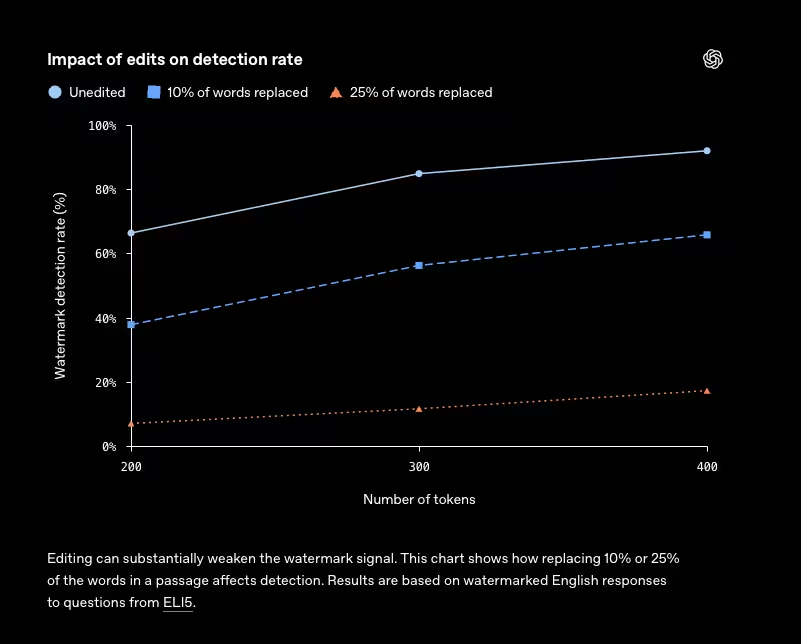
Editing texts can reduce the watermarks; OpenAI’s own tests show this. In one test, the team swapped 10% of the words for synonyms. Detection fell from about 92% to 66%.
Other types of text are tougher. Short passages, math answers, and translated text are all harder to detect.
Because of these limits, OpenAI is holding back the detector for now. Only approved researchers and expert organizations will get access at first.
They can help check how reliable it is and how people should use it.
Missing Watermarks
OpenAI warned that no watermark “does not prove human authorship.” That’s because the text may be too short, have been edited heavily, or may have come from another company’s AI.
The company also noted that a watermark can show an OpenAI system helped with a passage. But it can’t show how much human thinking, editing, or creativity went into it.
Anthropic
OpenAI isn’t first. Two months ago, Anthropic said it would watermark text from Claude. And Anthropic is applying it worldwide.
That caused some backlash. Some Claude users argued they supplied the instructions, context, and decisions. In their view, Claude was only the tool.
OpenAI had built a text watermark years ago but never released it. The Wall Street Journal reported in 2024 that the company worried users might leave for rivals without watermarks.
But since competitors have implemented watermarks, OpenAI has followed suit.
Anthropic, Google, Meta, Microsoft, and OpenAI have all committed to the EU’s code of practice on AI-generated content.
