

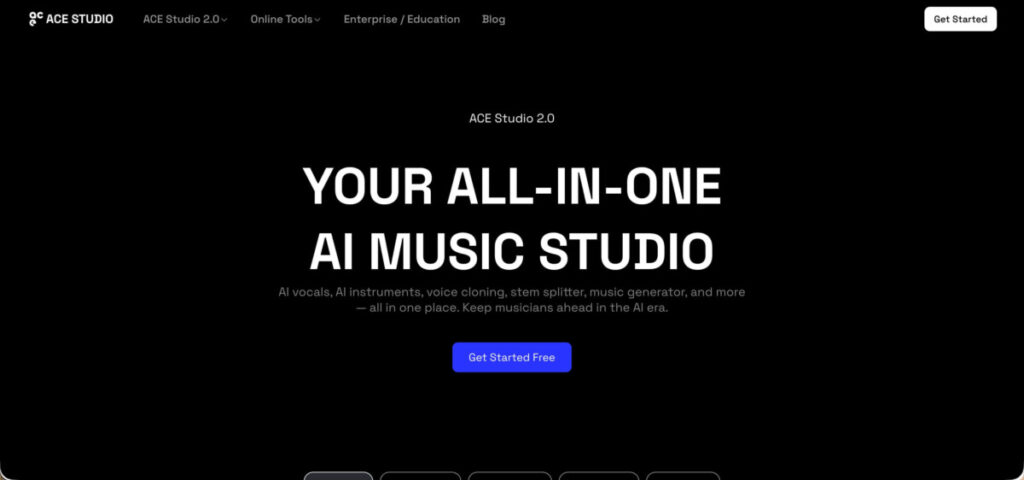
With version 2.0, ACE Studio is trying to answer a practical question many producers have about AI: how do you move from “cool demo” to something you can actually build a track around?
The new release reframes ACE Studio from a vocal-only AI tool into what the company calls an “AI Music Studio,” centered on three pillars: Generative Kits, AI Instruments, and its existing AI vocal engine, all brought together inside a clip-based Canvas and backed by cloud rendering.
For music creators who already live in a DAW, the value here isn’t a promise of instant, finished songs. It’s a tighter loop: get from idea to structured demo faster, then move the result back into your main environment.
Generative Kits as Fast Idea Starters
The most obvious “front door” into ACE Studio 2.0 for many producers will be its Generative Kits – Inspire Starter, Layer Generator and Music Enhancer, designed to generate loops, layers, and textures on demand.
Instead of scrolling through endless packs trying to find a starting point, you give ACE a direction and let it hand you raw material you can rework. That is particularly clear in Inspire Me, the flagship generative tool in the AI Tools section.
Inspire Me: Prompting the Track You Hear in Your Head
Inspire Me is essentially text-to-music, but framed in a way that lines up with how producers already think: mood, genre, and lyrics. It offers two modes – From Idea and From Lyrics.
In From Idea, you describe the vibe you want: for example, “upbeat dance pop with a retro 80s synth feel.” As a result, you get a track that follows that brief – not as a final master, but as a playable sketch you can cut up, re-arrange, and layer over.
In From Lyrics, you start from text. You paste your lyrics into one field, then use a separate “Styles / Tags” box to tell the system what kind of production you want behind them – “acoustic folk ballad,” “high-energy future house,” and so on. Inspire Me then generates a song idea that tries to match both the words and the production feel.
For working writers and producers, that means you can: turn a notebook full of lyrics into listenable demos without booking a session, test the same lyrics against different genres before committing, or generate rough beds for toplining, then swap out parts later with more detailed sound design.
The important thing is that the output doesn’t stay locked in a separate “AI experiment” folder. Generated tracks live inside the ACE project, so they can be combined with AI instruments and vocals in the same Canvas session.
AI Instruments with Performance Controls
On the sound design side, AI Instruments are ACE Studio 2.0’s answer to a familiar bottleneck: getting convincing performances out of strings and brass without spending hours on keyswitches and automation.
The new instrument model currently covers violins, violas, cellos, saxophones, trumpets, and duduk, with a specific emphasis on “ultra-realistic strings.”
From a producer’s point of view, AI Instruments slot into the workflow much like any other virtual instrument: you treat them as MIDI-driven sound sources, then let the engine generate a performance from your notes.
The difference is in how much musical control you get after that point. Instead of behaving like a static ROMpler, ACE Studio lets you dive into standard note editing, adjust articulations and expression so parts phrase more like real players, build ensembles without manually programming every individual line, and even import existing MIDI or MusicXML files so full arrangements can be instantly re-voiced through the AI rather than rebuilt from scratch.
For film composers, pop producers using string overdubs, or anyone layering brass over electronic foundations, the practical appeal is obvious: you get something closer to a playable performance right away, but still have enough control to make it fit the track instead of fighting it.
Closing the Loop with AI Vocals
ACE Studio’s original focus – AI vocals – is still central in 2.0. The vocal synth powers over 140 voices across eight languages, spanning genres from pop to rap to theatre.
For music creators, the value of ACE Studio’s vocal engine is in how naturally it plugs into the same flow as the new tools: you can spin up a backing track or full sketch with Inspire Me, enrich the arrangement with AI Instruments for strings, brass, or duduk to add organic texture.
Bring in vocals on top and refine the performance inside the Canvas before Cloud Rendering processes everything and you export stems or a full mix to your main DAW for final production.
The result is a rounded creation flow that starts from a prompt or lyric and ends with something structured enough to take into a professional mix session – not a replacement for a DAW, but a focused AI-writing room that talks in the same terms producers already use: vibe, parts, performance, and arrangement.
