


Deepgram launched in 2015. Since then, it has grown into one of the more recognizable names in speech AI. The company builds its own deep learning models rather than relying on third-party engines, which gives it tighter control over performance.
As a result, Deepgram can tune its models for specific use cases, such as noisy call center audio or medical terminology. Today, Deepgram counts NASA, Spotify, Citi, and Twilio among its customers, and the company says it has processed over 50,000 years of audio and transcribed more than 1 trillion words.
Notably, NASA uses Deepgram to transcribe communications between the ISS and Mission Control, plus low-quality audio from underwater astronaut training exercises.
Deepgram’s flagship model is Nova-3. It’s built specifically for speed and cost efficiency, and it supports real-time multilingual transcription. In fact, independent testing gives Deepgram high marks here.
On Product Hunt and G2, Deepgram is rated 4.6 and 4.9 out of 5. In my testing, Deepgram proved to be a strong tool for fast, real-time transcription, though not without some sharp edges I’ll cover below.
Also read: The Future of Voice Synthesis with AI
Key Features
1. Speech-to-text
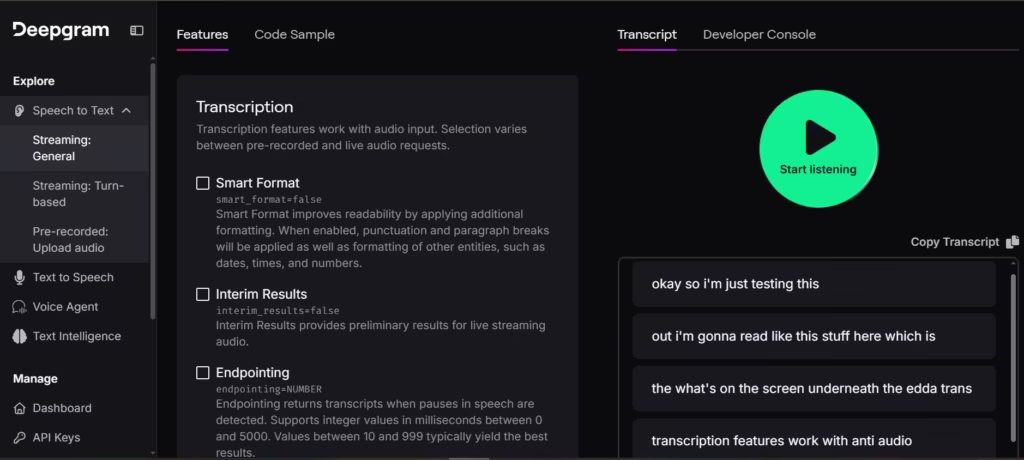
Deepgram is a standard transcription tool that records voices and returns text transcripts in real-time. I hit the record button, and the live transcript appeared almost instantly. In my 15-minute test recording, Deepgram missed 3 words out of approximately 2,000, giving it roughly 99.85% accuracy on my West African accent. But to be fair, I did stumble over some of my words.
2. Text-to-speech
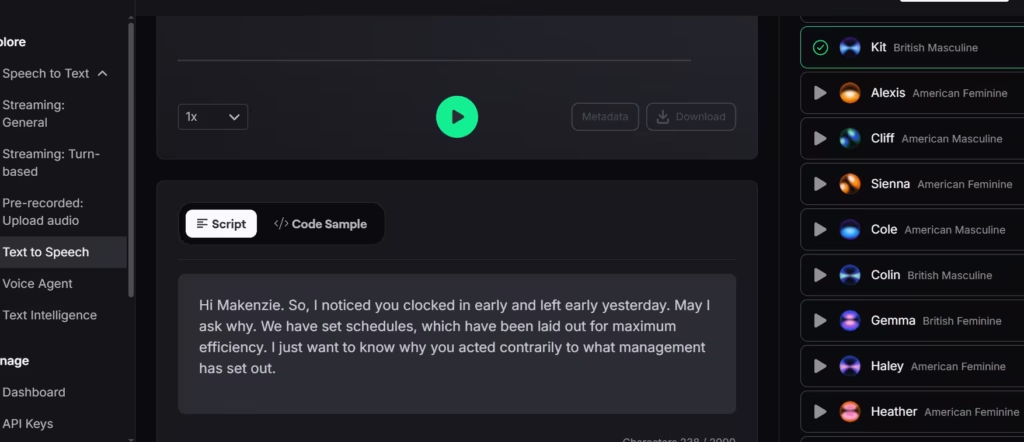
Deepgram has a list of voices to choose from: American, Irish, British, Indian, Filipino, Australian, and Singaporean. That’s a wider accent range than most competitors offer, which matters if your product serves a global audience. The diversity of accents means that Deepgram can be used for global audiences to boost content appeal. There are other languages as well, mostly European languages and then Japanese.
In my testing, I noticed that each voice has a distinct personality that carries over to the speech. I typed in a script of a manager questioning an employee and found voice ‘Colin’ more suitable than voice ‘Kit.’ Colin had that authoritarian edge, while Kit sounded like a friend making a casual mention.
3. Voice Agent
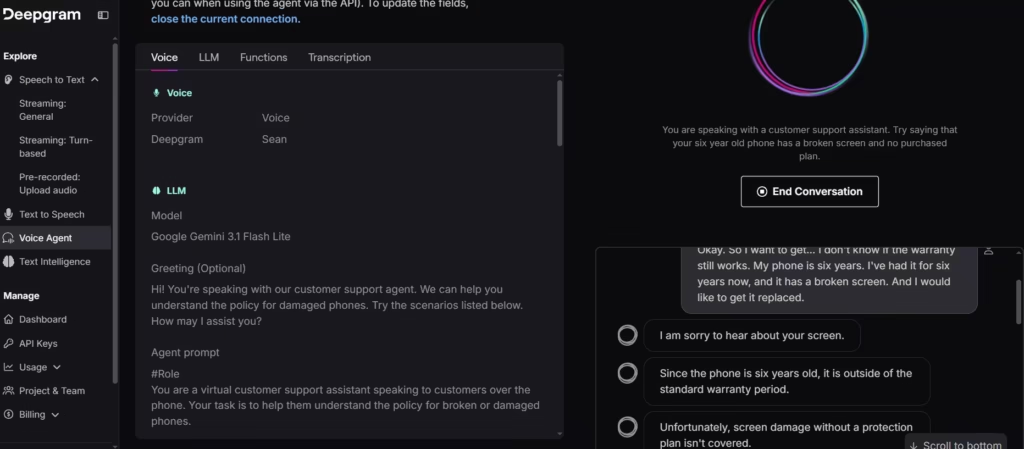
Deepgram’s voice agent is essentially a front-end interface with options for use cases to choose from. I went with the customer support representative and gave a hypothetical complaint. In my test, replies landed in well under 300 milliseconds, so it was easy to have a natural-flowing conversation. One limitation I noticed was the unmistakable robotic tone. Anyone who would rather speak to a human agent would be turned off by this.
4. Text Intelligence
This is a natural language feature that analyzes text to get meaning, sentiment, intent, and insights. Although Deepgram is primarily a voice tool, the text intelligence exists so developers can perform high-level content analysis.
In my testing, I pasted in an email from a customer upset at their purchase. The email had a passive-aggressive tone to it, laden with sarcasm, and I was hoping that Deepgram would detect it for what it was. It didn’t.
The email contained sentences like “I particularly enjoyed the thrilling suspense of pressing the power button four times and receiving nothing in return except silence and a cold, empty cup.” This was taken literally and misunderstood as a happy purchase.
It seems that Deepgram is unable to make out emotional subtexts and subtleties, especially when they mean the opposite. Aside from its inability to detect sarcasm as the medium used by the customer to express their displeasure, Deepgram was able to give an accurate summary of the email.
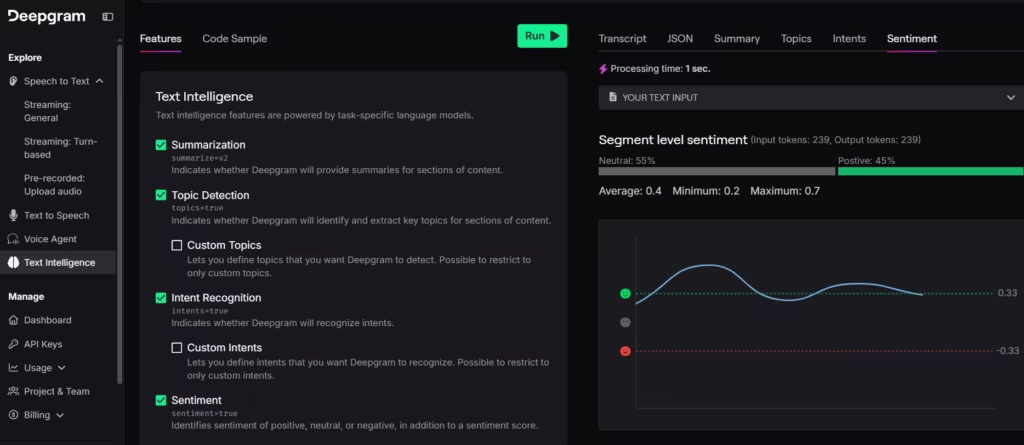
Don’t rely on Deepgram for decoding sentiment or tone in customer-facing workflows, it missed sarcasm entirely in my test.
The Bottom Line
I’d pick Deepgram for real-time voice agents where latency matters more than sentiment accuracy, but I wouldn’t trust it for customer service email analysis based on what I saw. However, anyone who prioritizes text intelligence, with delicate operations such as customer service, should explore another tool.