
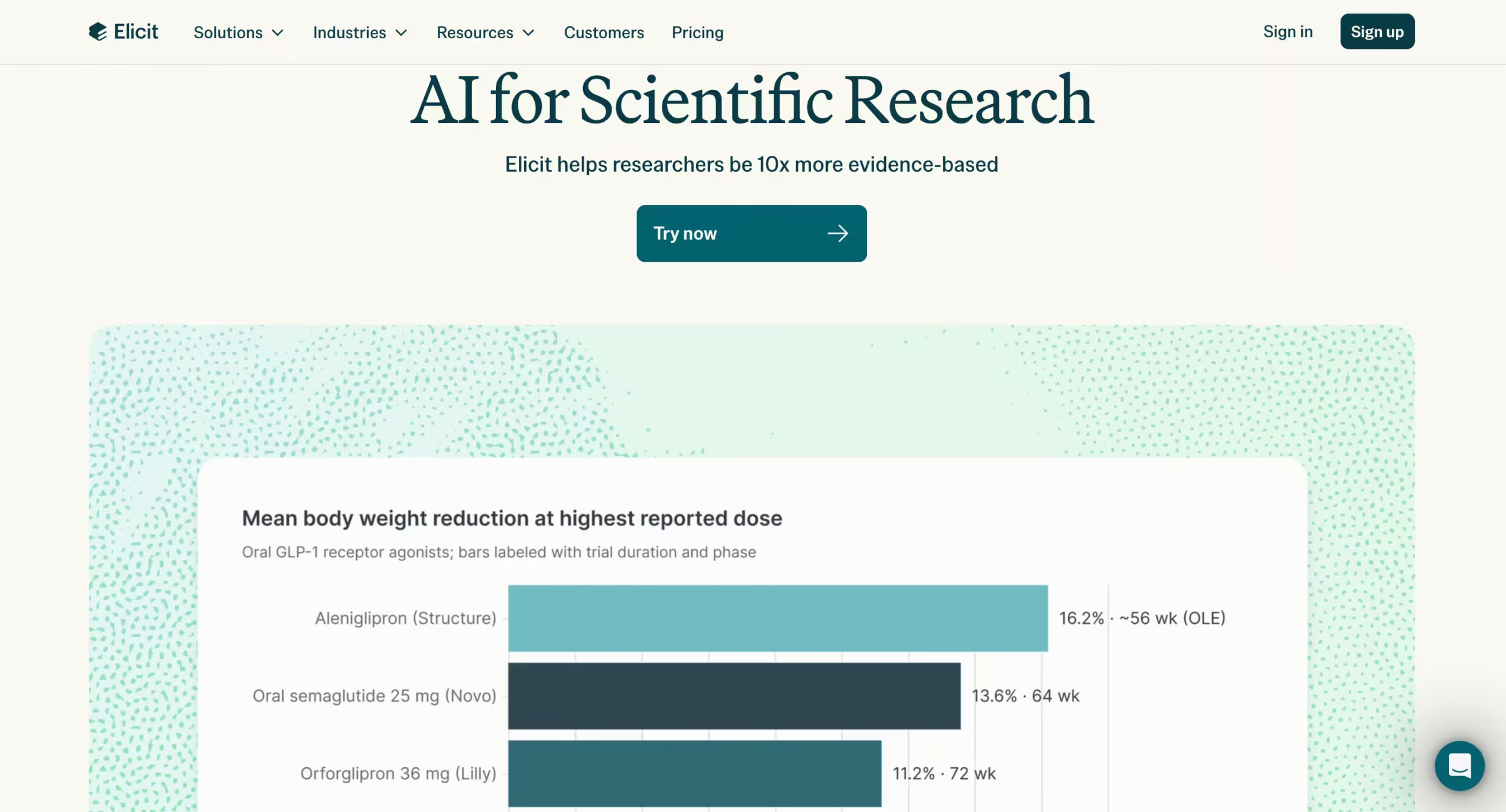


Elicit was built by Ought, a nonprofit ML research lab focused on AI-assisted reasoning.
In 2023, Elicit spun out as a public benefit corporation. The company has raised $31 million in venture funding, including a $22 million Series A in early 2025 co-led by Spark Capital and Footwork, with backing from Jeff Dean, Google’s chief scientist.
That funding pedigree matters because it signals institutional confidence in the research-specific AI approach rather than the general-purpose chatbot model.
The tool indexes more than 125 million academic papers through Semantic Scholar and 545,000 clinical trials from ClinicalTrials.gov. Unlike general-purpose AI tools (ChatGPT, Perplexity, Claude), Elicit focuses on structured research workflows: you ask a question, it finds relevant papers, and it extracts data points into sortable tables rather than generating a prose summary.
That distinction defines everything about the product.
I tested Elicit across weeks on two research projects: a scoping review of AI applications in nutritional epidemiology (my academic background) and a competitive analysis of AI research tools for this review. Across both projects, I searched roughly 200 papers, extracted data from 30, and generated 6 automated reports. The extraction accuracy was strong.
Out of 30 papers, I found 2 extraction errors, both on papers with non-standard table formatting (one used merged cells, the other used a sideways table). On standard-format papers, the extracted sample sizes, methods, and outcomes matched the source documents exactly.
The experience reinforced what every review of Elicit says: this tool does one thing better than anything else on the market, and it deliberately stops there. It finds papers. It extracts data. It organizes findings into comparable tables.
It does not write your literature review for you, it does not manage your citations (you still need Zotero), it does not generate prose summaries longer than an abstract recap, and it does not search anything beyond academic literature.
If you accept those boundaries, Elicit saves real time. If you’re looking for a general research assistant, you’ll bump into the walls fast.
Key Features
AI-Powered Literature Search Across 125M+ Papers
Type a research question in natural language and Elicit searches its index of 125+ million papers via Semantic Scholar.
Results are ranked by relevance and research quality, not just keyword matching. Each result shows the abstract summary, citation count, publication date, and a relevance score.
I tested the search with “What is the effect of intermittent fasting on insulin resistance in adults with type 2 diabetes?” and got 11 relevant papers in about 8 seconds.
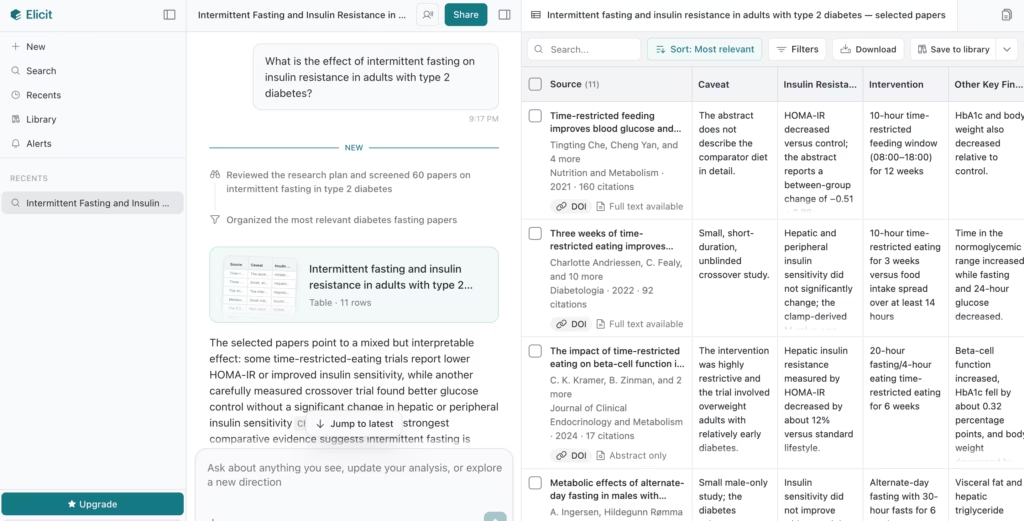
Compared to the same search in Google Scholar, Elicit returned fewer total results but with higher average relevance and no need to manually filter out editorials, conference abstracts, and tangentially related papers.
Data Extraction Into Custom Tables
This is the feature that built Elicit’s reputation among systematic reviewers.
Select a set of papers, define the columns you want to extract (sample size, study design, intervention, primary outcome, key findings, limitations), and Elicit pulls that data from each paper into a structured, sortable, exportable table.
I defined 6 custom columns for my nutrition scoping review and ran extraction across 15 papers.
Elicit populated all 6 columns for 13 papers with zero errors. Two papers had partial extractions: one because the methodology section used non-standard formatting, another because the key finding was embedded in a supplementary table that Elicit didn’t parse.
Fixing those 2 entries took about 5 minutes of manual review. Without Elicit, building the same table manually from 15 papers would have taken roughly 3 to 4 hours. With Elicit, the full extraction took about 20 minutes including quality checks.
Research Agent (Pro+)
The Research Agent expands Elicit beyond academic papers.
On Pro and above, it searches clinical trial registries, regulatory documents, press releases, and other non-journal sources. You can ask it to compile a multi-source research brief that draws from both published literature and real-world evidence.
I tested the Research Agent on “current clinical trials investigating GLP-1 receptor agonists for non-diabetes indications” and it returned results from both Semantic Scholar and ClinicalTrials.gov, with active trials tagged by phase, sponsor, and expected completion date.
This cross-referencing between published literature and active trials is something no other tool in this category handles as seamlessly.
Systematic Review Workflow (Pro+)
Elicit’s systematic review tools walk you through the standard methodology: define inclusion/exclusion criteria, screen papers against those criteria at scale, extract data, and synthesize findings.
The screening step is where the scale advantage shows. Enterprise plans can screen up to 40,000 papers against your criteria, with AI-assisted flagging of borderline cases for manual review.
For researchers conducting formal systematic reviews or meta-analyses, this workflow replaces tools like DistillerSR and Covidence for the discovery and screening phases. Elicit doesn’t handle the statistical meta-analysis step, so you’d still need R, Stata, or RevMan for pooled effect calculations.
Notebook and Paper Chat
The built-in notebook lets you organize notes, tag insights, and connect ideas across papers in your research library. Paper chat lets you ask questions about a specific uploaded PDF (“What was the primary endpoint?” “How did they handle missing data?”) and get answers with page references.
I uploaded 3 of my own research papers that weren’t in Elicit’s index and tested the chat feature. Answers were accurate for straightforward extraction questions. For interpretive questions (“Was the sample size adequate for the claimed effect size?”), the AI gave cautious, hedged responses that weren’t wrong but weren’t as useful as a human reviewer’s judgment would be.
Topic Finder
Analyzes your existing research corpus and suggests related topics, adjacent research questions, and emerging subfields you might not have considered.
I ran it on my intermittent fasting collection and it surfaced “time-restricted eating and circadian rhythm disruption” as a related topic I hadn’t included, which led me to 4 additional papers I’d have otherwise missed. A small feature, but the kind that earns its place in a research workflow.
Competitors Comparison
| Feature | Elicit | Consensus | SciSpace | Semantic Scholar | Paperguide |
| Starting Price | $11/mo | $12/mo | $12/mo | Free | $9/mo |
| Free Plan | Yes (2 reports/mo) | Yes (limited) | Yes (limited) | Yes (full search) | Yes (limited) |
| Paper Database | 125M+ (Semantic Scholar) | 200M+ (multiple) | 270M+ | 200M+ (own index) | 200M+ |
| Data Extraction Tables | Yes (strongest, custom columns) | No (summaries only) | Basic | No | Yes |
| Systematic Review Workflow | Yes (Pro+, up to 40K papers on Enterprise) | No | No | No | Basic |
| Clinical Trial Data | Yes (545K via ClinicalTrials.gov) | No | No | No | No |
| Research Agent | Yes (Pro+, multi-source) | No | No | No | No |
| Chat with Papers | Yes | Yes | Yes | No | Yes |
| Figure Extraction | Yes (Team+) | No | No | No | No |
| Student Discount | 40% off with .edu email | No | No | N/A | No |
| API | Yes (launched March 2026) | No | Yes | Yes | No |
| Citation Management | No (export to Zotero only) | No | No | No | Yes (partial) |
| Writing Assistance | No | No | Yes | No | Yes |
| Best For | Systematic reviews and structured data extraction | Quick evidence summaries with agreement meters | Paper reading and comprehension | Free paper discovery and citation graphs | End-to-end research with writing support |