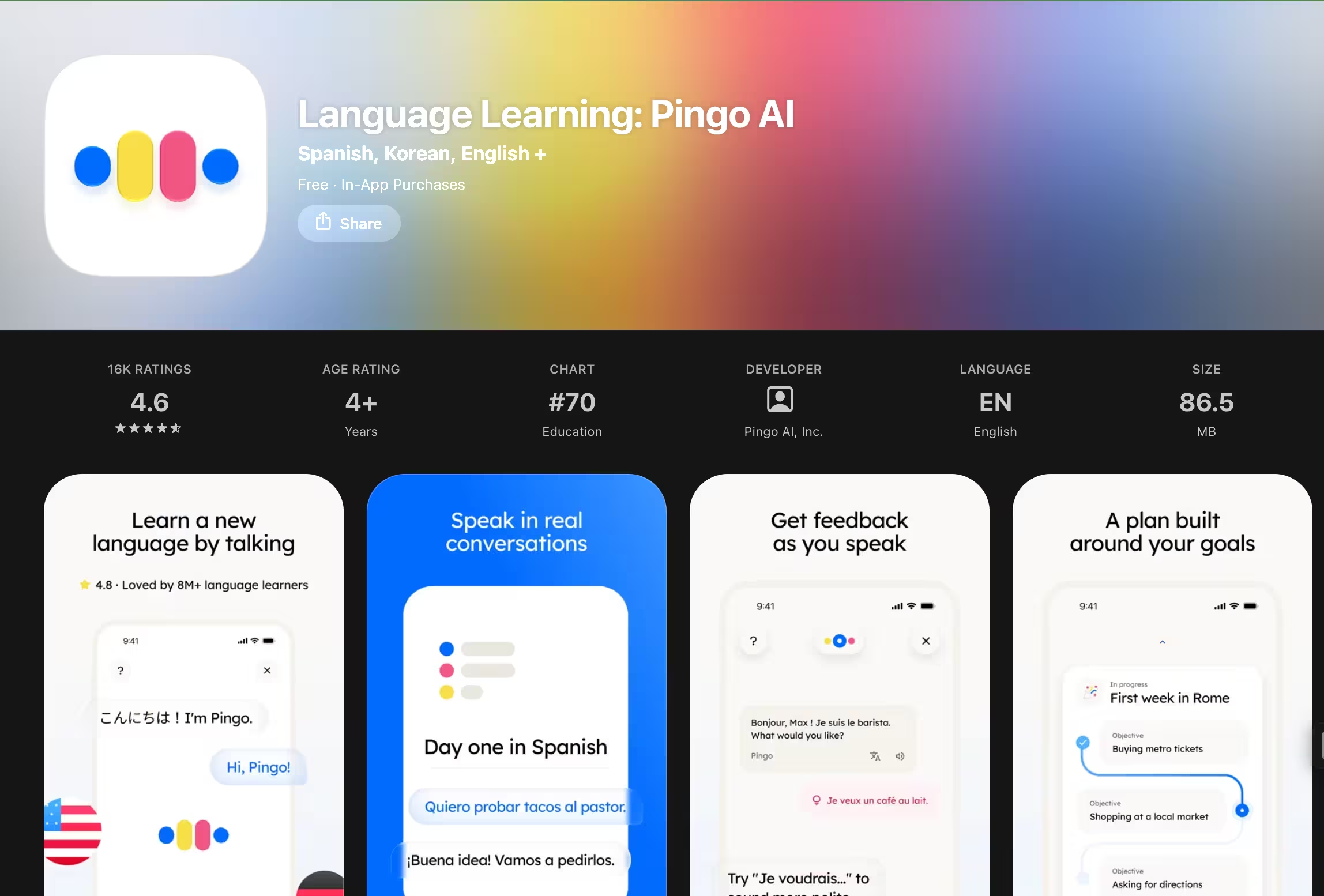
Pingo AI was founded in 2025 in San Francisco by Morrie Schonfeld and Michael Xing.
The company went through Y Combinator, raised a $100,000 seed round, and has grown to about 6 employees.
It is a small team for an app claiming 8 million users, which tells you either the product is scaling efficiently or that number includes a lot of one-session downloads.
Google Play named it Best Hidden Gem of 2025, which is the award for apps that are growing fast but not yet mainstream.
The pitch is simple: learn a language by talking.
Where Duolingo builds habits through gamified exercises and ELSA Speak drills pronunciation with accuracy scores, Pingo drops you into a conversation and teaches vocabulary, grammar, and pronunciation as they come up naturally.
The AI remembers your level, your mistakes, and your goals across sessions, so each conversation is supposed to build on the last.
I tested Pingo primarily in French (which I have intermediate-level experience with) and Spanish (beginner).
The onboarding asked about my goals, current level, and what situations I wanted to practice.
Within three minutes, I was in a spoken dialogue about ordering food at a French restaurant. The pacing felt right for a beginner – the AI spoke slowly, introduced new vocabulary one item at a time, and confirmed my responses before moving on.
The app has two main modes.
Tutor Mode runs guided dialogues structured around specific vocabulary and phrases – think “numbers and counting” or “at the hotel.”
Role-Play Mode simulates real-life scenarios where you and the AI each play a part.
There are 200+ built-in scenarios plus the ability to create custom ones. Both modes are voice-first: you speak, the AI listens, responds, and occasionally corrects.
The voices are good. Not indistinguishable from a native speaker, but clear and natural enough that listening does not feel like a chore. You can slow the playback speed and ask for repetition, which is useful at lower levels.
The interface is clean and stays out of the way.
Lesson selection is a scrollable list of topics organized by theme.
Tapping a topic shows its learning objectives (usually 2-3 per lesson), estimated length, and a start button.
There is no cluttered dashboard, no social features, no leaderboard.
For an app that wants you to talk, minimizing the time between opening the app and starting a conversation is the right design decision, and Pingo gets this right. Lessons run about 4-5 minutes each, which is short enough that “I don’t have time” is never a valid excuse.
Key Features
Conversation-First Learning
This is Pingo’s core differentiator. Instead of drilling grammar rules or matching flashcards, you learn by doing — the AI introduces a word, uses it in context, asks you to respond, and builds from there.
For absolute beginners, this removes the most intimidating part of language learning: opening your mouth for the first time. The app even includes “Clarification Cards” where it checks your understanding before moving on, though these are basic.
200+ Scenarios and Custom Roleplays
The scenario library covers everyday situations (ordering food, asking directions, making small talk), professional contexts (job interviews, presentations), and travel prep.
Custom roleplays let you define both roles and the setting. In practice, the custom scenarios felt rigid – the AI followed a predictable pattern regardless of what I specified, and my input did not meaningfully change the direction of the conversation.
Lesson Summaries and Vocabulary Tools
After each conversation, you get a mastery percentage, a list of new vocabulary with example sentences and audio, and a transcript of the full conversation. You can bookmark words and export transcripts.
These are useful for review, though there is no spaced repetition system – saved words do not reappear in future lessons automatically, which is a significant gap.
Progress Tracking
The app claims to remember your level, mistakes, and goals across sessions.
In my testing over two weeks, it did adapt the difficulty slightly – later French lessons introduced more complex sentence structures. But the adaptation was subtle, and I did not feel a clear sense of progression from session to session.
25+ Languages
The app markets 25+ target languages and 15+ native languages for instruction. The named languages include Spanish, Korean, English, French, German, Japanese, Italian, Chinese, Portuguese, Russian, Arabic, Dutch, Turkish, Polish, and Vietnamese.
Competitors Comparison
| Feature | Pingo AI | TalkPal | Speak | ELSA Speak | Duolingo Max |
|---|---|---|---|---|---|
| Starting price | $14.99/mo | $19.99/mo | In-app only | $89.99/yr | In-app only |
| Free tier | One lesson | 10 min/day | 7-day trial | Yes (limited) | Yes (ad-supported) |
| Languages | 25+ | 57+ | 7 | English only | 40+ (AI features limited) |
| Focus | Conversation practice | Conversation practice | Structured speaking | Pronunciation accuracy | Gamified all-skills |
| Speech recognition | Lenient | Moderate | Moderate | Strict (phoneme-level) | Moderate |
| Spaced repetition | No | No | No | No | Yes |
| Platform | iOS, Android, Web | iOS, Android, Web | iOS, Android | iOS, Android | iOS, Android |