
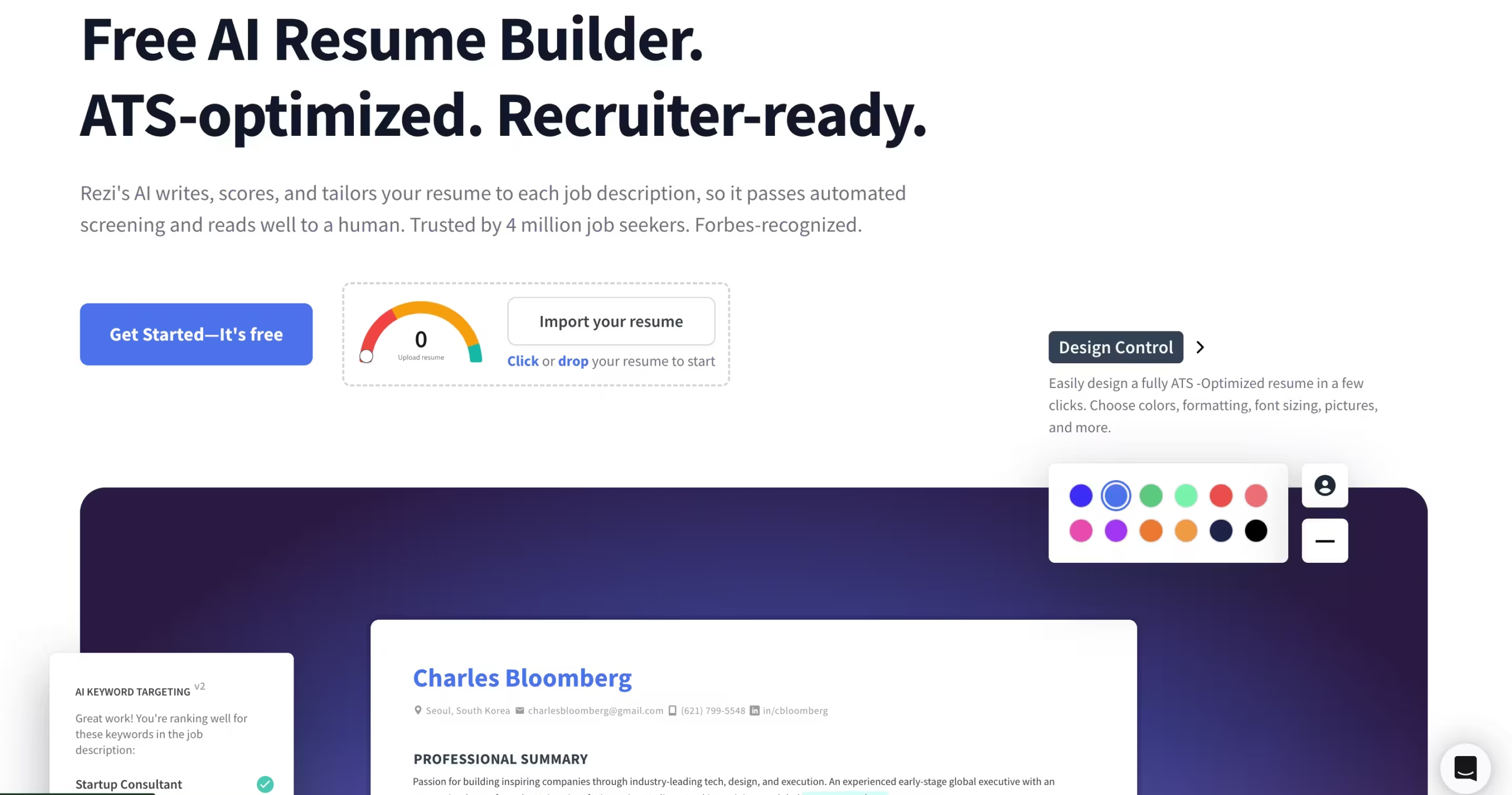

Rezi was built with a single thesis: the most important audience for your resume isn’t a recruiter.
It’s the software that decides whether a recruiter ever sees it.
Applicant Tracking Systems reject an estimated 75% of resumes before a human reads them, and Rezi’s entire product is engineered around surviving that filter.
That focus shows in everything from the template design (deliberately plain, no graphics, no columns, no fancy formatting that breaks ATS parsers) to the scoring system (a real-time 100-point grade on ATS compatibility) to the keyword scanner (which compares your resume against a job description and flags exactly what’s missing).
If ATS optimization is your top priority, Rezi takes it more seriously than any competitor I’ve tested.
I used Rezi across three weeks to rebuild my resume for a content strategy director role.
Rezi is a resume builder, not a job search platform. There’s no application tracker, no one-click apply, no networking tools, no CRM. The built-in job board only covers US-based tech roles.
If you want a full job search command center, tools like Teal or Swooped cover more ground.
If you want the strongest possible ATS-optimized resume, Rezi does that one thing better than the broader platforms.
Key Features
1. Rezi Score: Real-Time Resume Grading
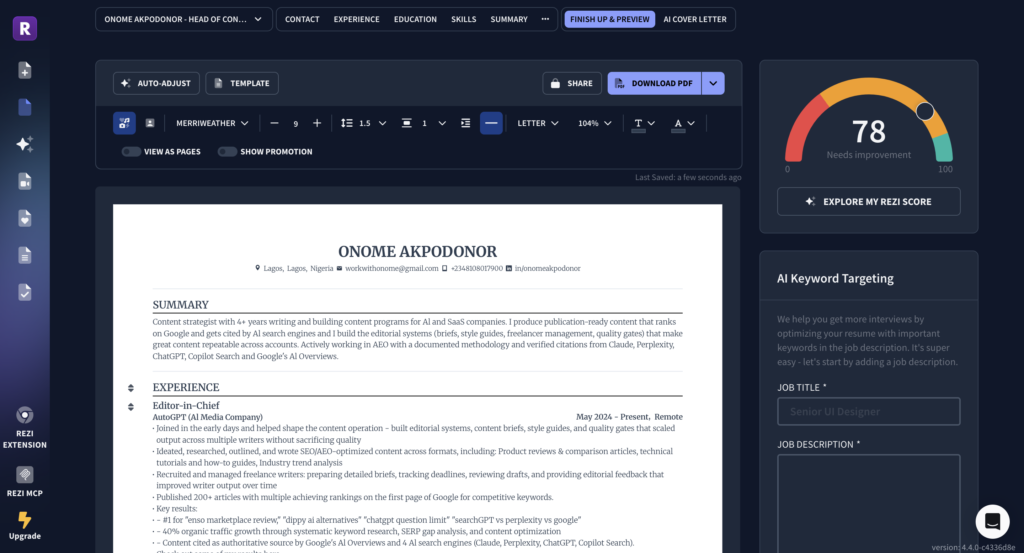
The Rezi Score is the feature that keeps you inside the platform. It evaluates your resume on a 100-point scale across content quality, formatting, keyword optimization, and ATS compatibility.
The score updates in real time as you edit, using color-coded feedback to flag urgent issues (red), improvement areas (yellow), and strengths (green). Scores above 80 indicate strong ATS compatibility. Below 70 means you’re likely getting filtered out before a human sees your resume.
My LinkedIn-imported resume scored 78 on the first pass.
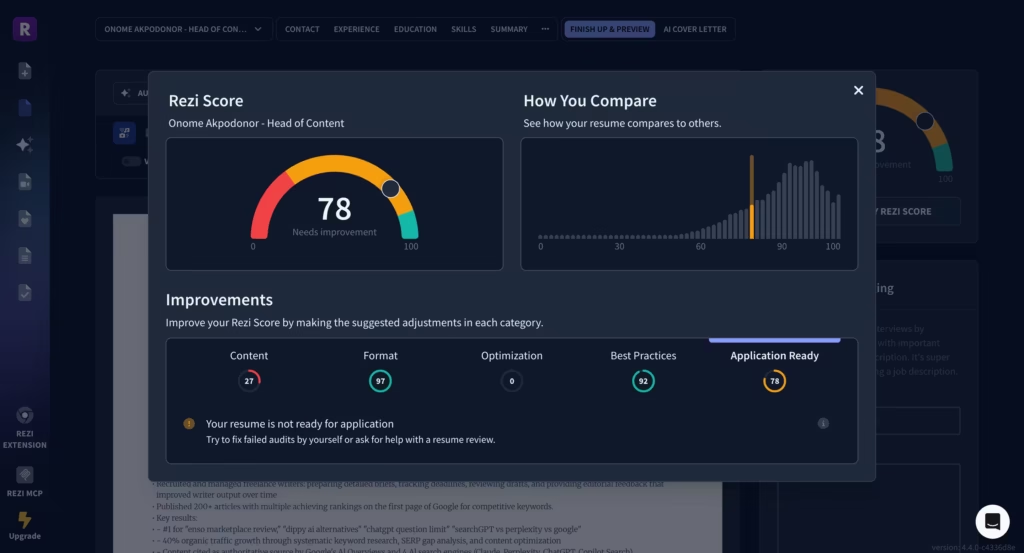
The score flagged three categories: weak action verbs in 4 bullet points, missing keywords for the target role, and a summary section that was too long for ATS parsing.
After addressing all three (rewriting bullets, adding keywords via the scanner, and trimming the summary from 90 words to 45), the score jumped to 91.
The real-time feedback loop made the revision process feel productive rather than aimless. Instead of guessing what to fix, I knew exactly where to focus.
One caveat: some Rezi Score parameters are locked behind the Pro plan on the free tier.
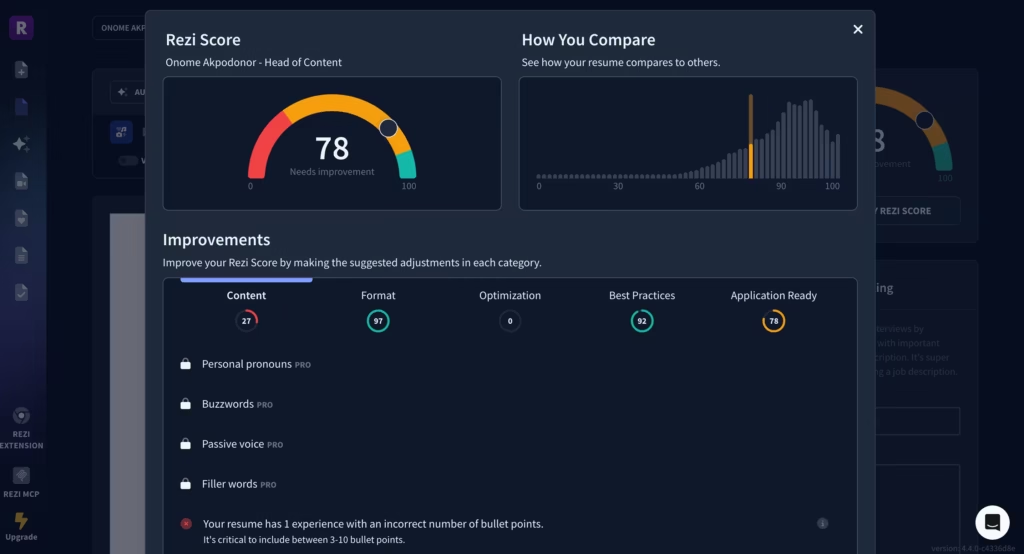
You’ll see the overall score, but the detailed breakdowns on formatting and content analysis require upgrading. This means the free plan’s scoring feedback is useful but incomplete.
2. AI Resume Writer
Rezi’s AI generates bullet points, rewrites existing entries, and creates resume summaries tailored to specific job descriptions.
You highlight a bullet point, click rewrite, and the AI produces 2 to 3 alternative versions using action verbs and quantifiable results. I tested this on 12 bullet points across two resume versions.
The strongest results came from entries where I provided specific context.
The weakest results came from generic role descriptions.
When I tested the AI across three “head of content” roles at different companies, the bullet points for all three were nearly interchangeable. Same action verbs, same sentence structures, same achievement framing.
If a recruiter reads two of those bullets back to back, they’ll notice the repetition. Every AI-generated bullet point needs manual editing to inject your specific accomplishments and voice.
3. Keyword Scanner and ATS Targeting
Paste a job description into Rezi, and it highlights which keywords from the posting appear in your resume and which are missing. This feature works similarly to Jobscan’s core product but lives inside your resume editor instead of requiring a separate tool.
I tested it against a product marketing manager posting.
The scanner identified 14 keywords from the job description. My resume contained 8 of them. The 6 missing keywords included “go-to-market strategy,” “sales enablement,” “competitive analysis,” “product positioning,” “cross-functional,” and “pipeline.”
The AI then helped me rewrite existing bullet points to incorporate those keywords naturally rather than stuffing them in. After revision, the scanner showed 13 of 14 keywords present.
The one I couldn’t fit (“Salesforce CRM experience”) genuinely wasn’t in my background, which is the correct outcome, you shouldn’t add keywords for skills you don’t have.
4. Templates: Conservative by Design
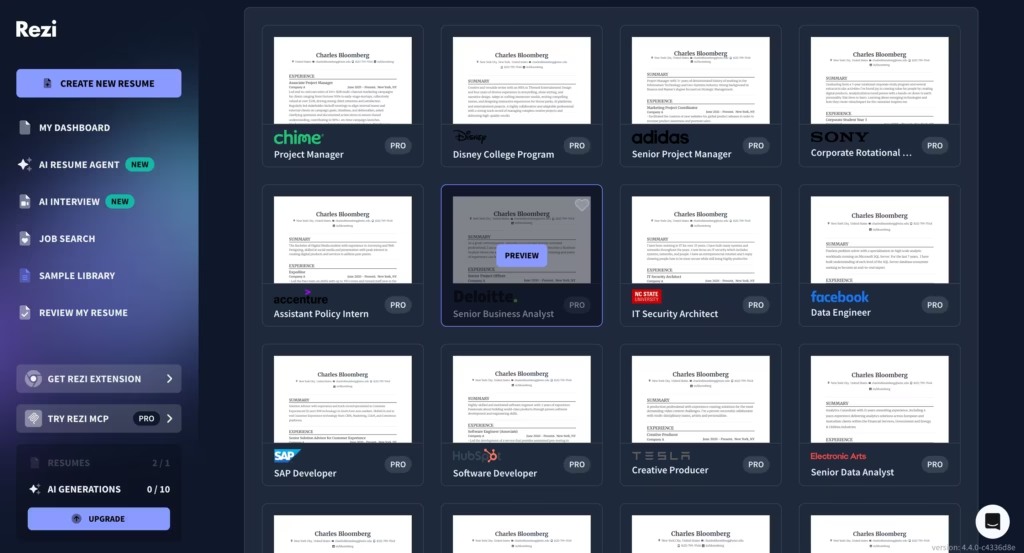
Rezi offers 30+ resume templates, and they’re all deliberately plain. No graphics, no icons, no multi-column layouts, no color accents.
This is intentional: complex formatting breaks ATS parsing. The templates prioritize clean headers, standard section ordering (experience, education, skills), and machine-readable text hierarchy.
If you’re coming from a visually designed resume built in Canva or Figma, Rezi’s templates will feel boring. That’s the trade-off. A beautiful resume that gets rejected by ATS software is worse than a plain resume that reaches a recruiter.
For creative roles where visual presentation matters (graphic design, UX, art direction), Rezi’s templates may actually work against you. For corporate, tech, and enterprise applications where ATS filtering is standard, the conservative approach is the right call.
5. LinkedIn Import
Connect your LinkedIn profile and Rezi pulls your roles, dates, company names, and skills into the correct resume sections. In my testing, the import captured everything accurately.
It also pulled in more content than I needed, so I spent about 10 minutes trimming rather than adding. As a starting point for building a resume from scratch, it saves 20 to 30 minutes of manual data entry.
6. AI Cover Letter Generator
Feed it your resume and a target job description, and Rezi generates a tailored cover letter. I tested this against the product marketing manager role.
The output opened with a relevant hook about the company’s market position, connected my experience to the role’s requirements in the body, and closed with a call to action.
The body paragraphs were solid.
The opening hook felt formulaic (the same “I was excited to see this opportunity” pattern that every AI cover letter defaults to), and I rewrote it. As a first draft that saves 20 minutes, it works. As a finished product, it needs a human pass.
7. AI Interview Practice
Rezi generates role-specific interview questions based on your resume and lets you practice answering.
The questions are relevant but generic. “Tell me about a time you managed cross-functional stakeholders” is useful for preparation but won’t surprise anyone who’s interviewed before.
Treat it as a warm-up tool for rehearsing your stories out loud, not as a replacement for mock interviews with a real person.
Competitors Comparison
| Feature | Rezi | Teal | Jobscan | Kickresume | Enhancv |
| Starting Price | $29/mo | $13/week | $49.95/mo | $15.20/mo | $9.15/mo |
| Free Plan | Yes (1 resume, 3 PDFs) | Yes (generous) | Yes (5 scans/mo) | Yes (limited) | Yes (1 resume) |
| Lifetime Plan | $149 (one-time) | No | No | No | No |
| ATS Score | Yes (Rezi Score, 100-point) | Yes | Yes (strongest match %) | Basic | Yes |
| Keyword Scanner | Yes (built into editor) | Yes | Yes (core feature) | Basic | Yes |
| AI Bullet Writing | Yes | Yes | No | Yes | Yes |
| Templates | 30+ (conservative, ATS-safe) | Multiple | Limited | 50+ (designer-quality) | 40+ (visually polished) |
| Cover Letter Generator | Yes (AI) | Yes | No | Yes (AI) | Yes |
| Job Tracker | No | Yes (full CRM) | No | No | No |
| Expert Review | Yes (1/mo on Pro) | No | No | No | No |
| Job Board | Yes (US tech only) | Yes (broad) | No | No | No |
| Best For | ATS optimization with scoring | Free all-in-one job search | Deepest keyword matching | Designer templates + AI | Visual + ATS balance |