


Amazon already poured $8 billion into Anthropic, the AI company behind Claude. Then, earlier this month, it dropped another $50 billion into OpenAI, the company behind ChatGPT.
That’s two massive bets on two fierce rivals. So, naturally, people started asking: Isn’t that a conflict of interest?
AWS CEO Matt Garman has a simple answer. No. And he has a solid reason why.
Also read: Altman and Amodei Get Awkward at the India AI Summit
“We’ve Built This Muscle”
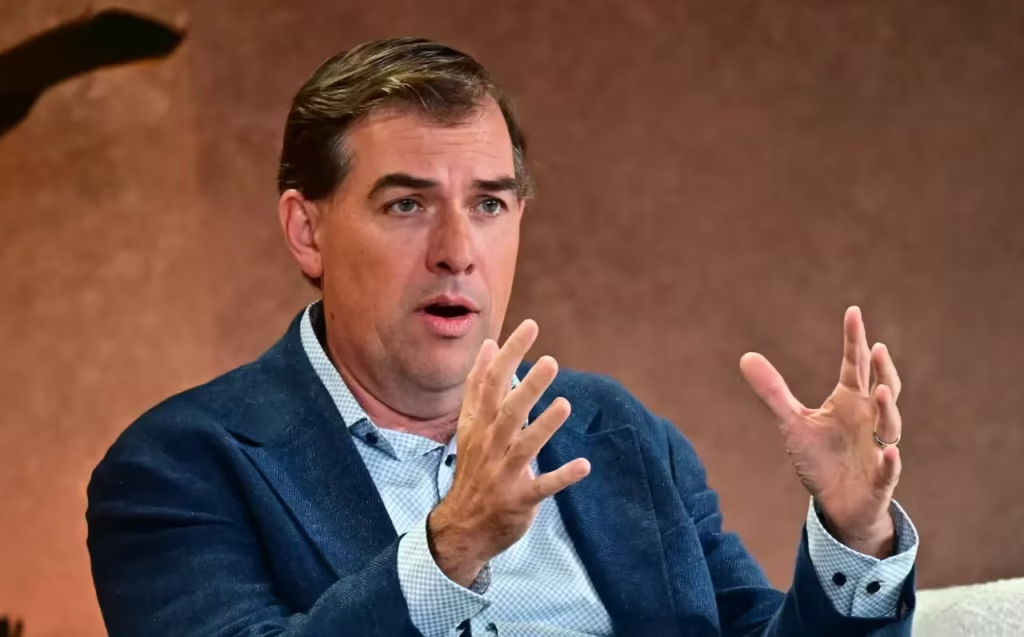
Garman spoke at the HumanX conference in San Francisco this week. He’s been with Amazon since 2005, back when he was just a business school intern.
He watched AWS launch in 2006 from the inside. So when someone in the audience challenged him about backing both Anthropic and OpenAI, he didn’t flinch.
“We also knew that we would have to compete with our partners, because technology is interconnected,” Garman said.
He explained that AWS learned early on that it couldn’t build everything itself. So it partnered with others, even knowing those partnerships would get complicated.
“For a very long time, we’ve built this muscle up of how we go to market with our partners,” he added.
“But we also may even have first-party products that compete with them, and that’s okay.”
The key promise AWS made is that there would be no unfair advantages. They compete, yes. But they play fair.
Amazon
Here’s a shocking fact. Oracle, one of AWS’s biggest competitors, actually sells its own database services on AWS.
It’s a case of a rival running its business on a competitor’s platform. Back in 2006, this kind of arrangement would have seemed crazy.
Tech companies back then lived by a simple rule: never bite the hand that feeds you. Partners stayed partners, and competitors stayed competitors. The two were never to meet.
Amazon blew that idea up, and over time, everyone got used to it. The same thing is now happening in AI, just faster and with much bigger checks.
Loyalty
Amazon isn’t even the most extreme example of this. When Anthropic closed a massive $30 billion funding round in February, more than a dozen of its investors were also backing OpenAI.
That group included Microsoft, OpenAI’s primary cloud partner. In any other industry, this would spark lawsuits and scandals.
The reason for this abnormality isn’t far-fetched: the stakes are simply too high for anyone to stay loyal.
Everyone wants a piece of the future, even if that means hedging every single bet.
AWS’s Logic
For Amazon, investing in OpenAI was almost a survival decision. Microsoft’s Azure cloud already carries both OpenAI’s models and Anthropic’s models.
AWS’s biggest rival had both major players in its corner. If AWS didn’t act, it risked falling behind in one of the most important technology changes in decades.
Customers want access to the best AI models. If those models aren’t on AWS, customers might just move their entire cloud operation to someone who offers them.
That’s not a risk Amazon was willing to take.
Competition
AWS and Microsoft aren’t just picking winners anymore. They’re building systems that let AI models compete in real time, and then automatically use whoever wins.
These are called model-routing services. The idea is simple. Instead of locking into one AI model, customers can set up their cloud to automatically pick the right model for each task.
Garman broke it down like this: one model might be best for planning a complex project. Another handles reasoning. A cheaper, faster model handles simple tasks, like filling in code.
“I think that is where the world will go,” Garman said.
The Sneaky Part
Amazon has its own homegrown AI models, and so does Microsoft. By building these model-routing services, both companies quietly slip their own products into the mix.
A customer signs up, thinking they’re getting the best of OpenAI and Anthropic. And yes, they are, but Amazon’s own model starts handling a chunk of the workload too.
The tasks may be cheaper and requests simpler, but volume adds up fast.
