

In 2025, support teams are under more pressure than ever. Customers expect instant replies. They want answers, not excuses.
Recent industry reports show that businesses using AI-driven support resolve issues up to 80% faster and cut support costs by nearly 30%.
This explains why AI, when used well, is reshaping modern customer service.
But let’s be honest, not all tools deliver, and this is more than a shiny CRM… Some generic chatbots just repeat the same unhelpful answers over and over.
This then raises the question – which AI customer service tools actually deliver on quality?
In this article, we’ll break down the best AI tools for customer service, the ones you can actually trust.
Top AI Tools for Customer Support
1. Zendesk AI
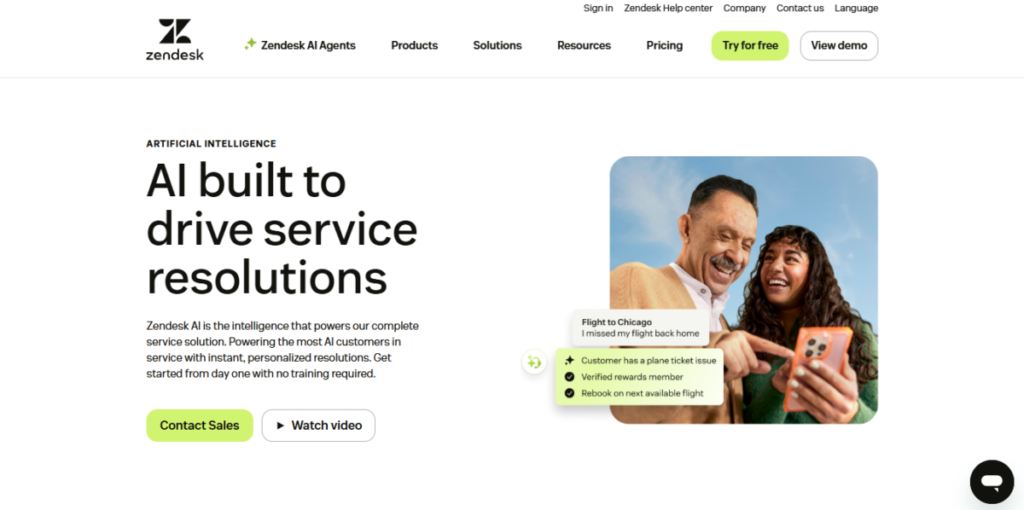
Zendesk is one of the best AI tools for customer support that trains its models using billions of real customer conversations, which shows in how naturally it handles requests. Emails, live chat, voice calls, social messages, everything flows into one smart system.
When issues come in, Zendesk AI doesn’t just log tickets. It actively tries to resolve them. Many routine questions get answered instantly, while trickier cases are passed to the right human at the right time.
That balance is why large brands like Uber trust it. They deal with massive volumes, and Zendesk AI keeps things from spiraling.
If you’re running a growing support operation and want AI for customer service that actually understands context, Zendesk AI sets a high bar.
Key Features
- Autonomous AI agents that resolve complex customer questions without human input
- Smart ticket routing that sends issues to the best agent based on skill, urgency, and history
- AI Copilot for agents, offering real-time reply suggestions and helpful context during live chats
- Predictive analytics that flag trending issues before they turn into full-blown crises
- Fully integrated multi-channel customer support, covering email, chat, voice, social, and help center tickets
Pros and Cons
| Pros | Cons |
| Handles multichannel support smoothly | Can be pricey for very small teams |
| Scales easily as your business grows | A learning curve during initial setup |
| Strong security and GDPR compliance | Limited out-of-the-box UI customization |
| Powerful automation for high ticket volumes | Advanced features require higher plans |
Best For
- Mid-sized to large companies handling high support volumes.
- Fast-growing startups that need scalable customer service AI.
- Enterprises with multiple-channel customer interactions.
- Teams that want deep analytics and proactive issue detection.
2. Freshdesk (Freshworks)
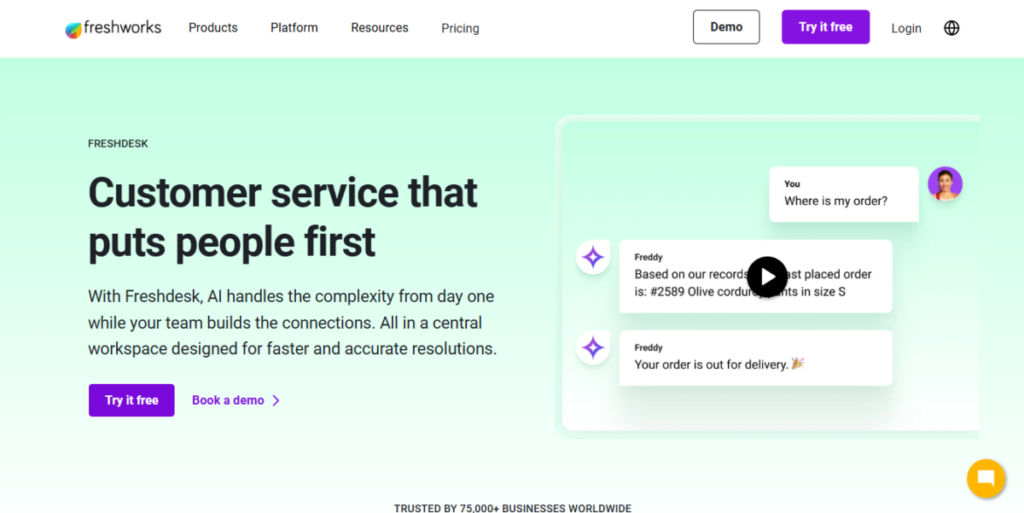
Freshdesk makes AI for customer service feel simple. At the heart of the platform is Freddy AI, Freshworks’ built-in intelligence that handles a huge chunk of support work without drama.
Routine questions get resolved fast, often instantly, so agents can focus on the cases that actually need a human touch.
What really positions Freshdesk as a great pick is how easy it is to set it up. Many teams go live within hours. This is a big reason over 60,000 businesses rely on it every day.
You don’t need a dedicated tech team or months of onboarding. You sign up, connect your channels, train Freddy AI, and you’re off.
For growing teams that want reliable AI for customer service without the complexity of enterprise-level solutions, Freshdesk hits a sweet spot. It’s practical, fast, and friendly to new users.
Key Features
- Freddy AI bots that handle support on WhatsApp, email, and live chat
- Intelligent workflows that automate common support tasks like refunds, ticket escalations, and follow-ups
- Real-time insights that highlight trends, spikes, and common customer issues
- Vertical AI agents you can build in minutes for specific use cases or departments
- Mobile-first support, making it easy for agents to work from anywhere
Pros and Cons
| Pros | Cons |
| Affordable plans for small teams | Voice AI is less advanced |
| Fast setup with minimal configuration | Fewer deep integrations than enterprise tools |
| Easy-to-use interface | Reporting may feel basic for advanced teams |
| Excellent mobile app for remote support | Limited customization on lower plans |
Best For
- Small to mid-sized businesses scaling their customer service.
- Startups that need quick deployment without heavy setup.
- Teams supporting customers via WhatsApp and chat.
- Businesses looking for budget-friendly AI for customer service.
3. Intercom (Fin AI & Support Suite)
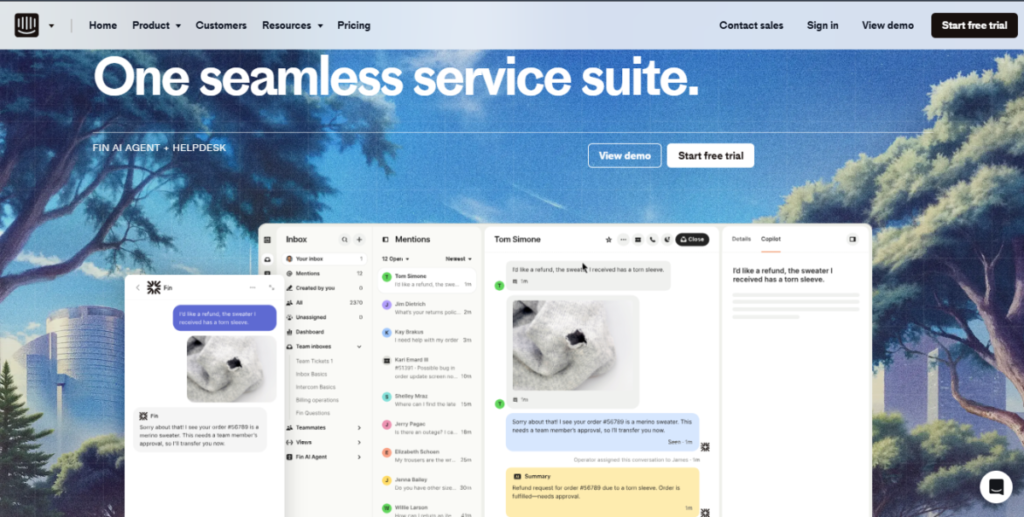
Intercom’s Fin AI feels less like a bot and more like a sharp support teammate. It doesn’t just reply to messages, it understands them.
Fin can handle text chats, emails, voice conversations, and even images, all while keeping context. That means customers don’t have to repeat themselves. And neither do your agents.
Fin AI can solve many questions on its own. When things get tricky, it smoothly hands the conversation to a human, along with full context.
This mix of automation and human backup is why Intercom stands out in the AI for customer service space.
Key Features
- Multimodal AI that understands text, images, and voice messages
- Smart knowledge retrieval that pulls accurate answers from your help documents every time
- Built-in automation that handles refunds, upgrades, and follow-ups
- Conversation-based workflows that guide users toward helpful actions
- Performance dashboards that show how AI impacts support speed and revenue
Pros and Cons
| Pros | Cons |
| Human-like conversations that impress customers | Higher cost per active user |
| Smooth flow with CRMs like Salesforce | Can be too advanced for basic FAQ needs |
| Always-on support across time zones | Setup may need light developer help |
| Strong blend of support and sales | Can be a learning curve for new teams |
Best For
- Tech startups that want personal support at scale
- Product-led growth teams using AI for customer service to onboard users
- SaaS companies turning support chats into sales opportunities
- Brands that care about tone, context, and customer experience
4. Zoho Desk
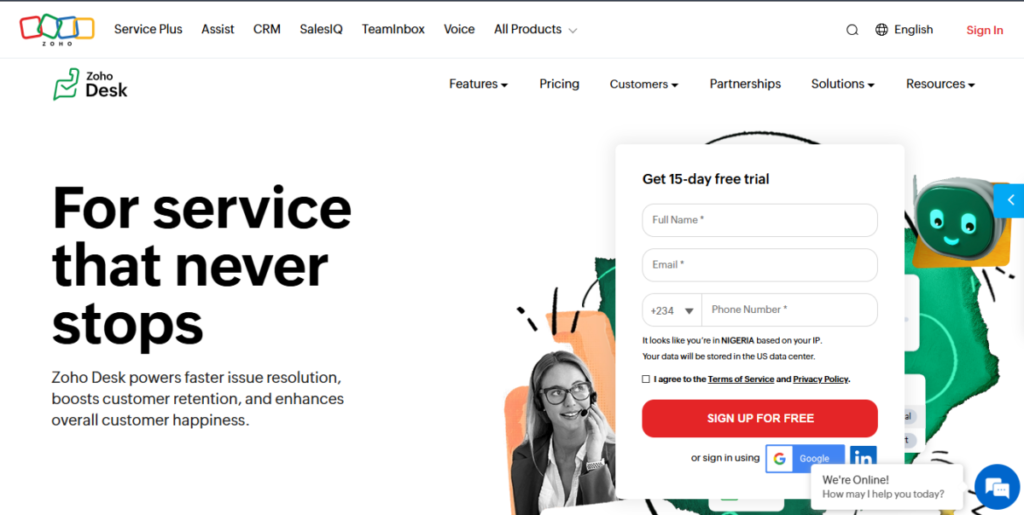
Zoho Desk takes a practical approach to AI for customer support. Instead of flashy bots, it focuses on helping teams stay organized, fast, and prepared.
At the center is Zia AI, Zoho’s built-in assistant that learns from past tickets and support patterns. It predicts problems before they spike and helps agents respond faster.
What makes Zoho Desk stand out is how tightly it connects with the wider Zoho ecosystem.
If your business already uses Zoho CRM, Zoho Books, or Zoho Projects, everything clicks together easily. Customer data flows in one direction. Support agents see the full picture without switching tools.
For teams that want an all-in-one business hub with dependable customer service AI, Zoho Desk keeps things simple and cost-effective.
Key Features
- Zia AI predictions that warn you about ticket surges before they happen
- Automatic ticket sorting with suggested replies for faster responses
- Multi-channel support across email, social media, phone, and web
- Self-service portals with AI-powered search for quick customer answers
- Multi-language support, covering over 50 languages
Pros and Cons
| Pros | Cons |
| Very affordable if you use the Zoho suite | Interface can feel outdated |
| Strong language support for global teams | Slower with extremely high volumes |
| Detailed analytics and reports | Bot conversations feel basic |
| Free tier available | Limited customization compared to rivals |
Best For
- Small businesses already using Zoho tools
- Budget-conscious teams needing reliable AI for customer service
- International teams handling multiple languages
- Companies that prefer structure over flashy chatbots
5. Kommunicate
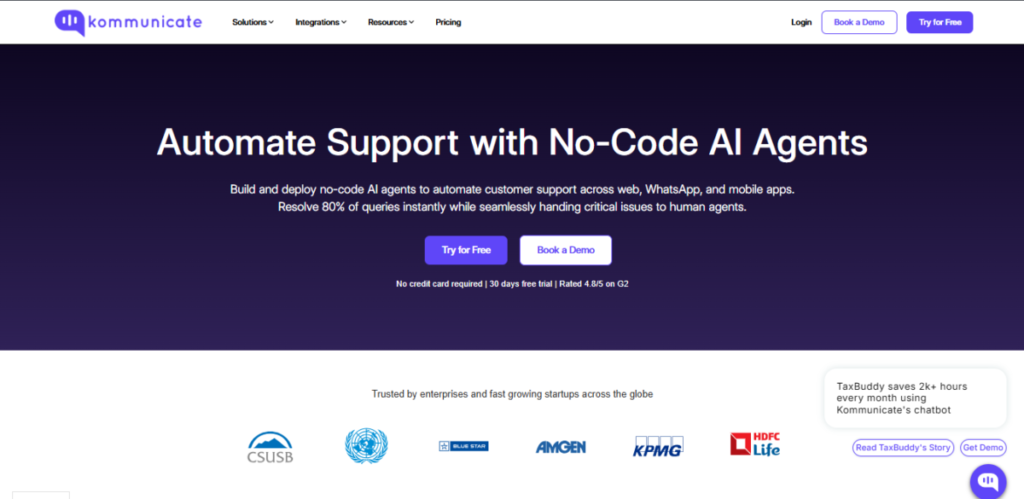
Kommunicate focuses on one thing, making chat support work better with AI for customer service.
It combines live chat with smart bots that know when to step back and let a human take over. Customers start with AI, and if things get emotional or complex, the handoff feels smooth and natural.
One big plus is how easy it is to use. You don’t need to code or hire a developer. You can build custom bots for FAQs, order questions, or onboarding flows in minutes.
This makes Kommunicate a strong pick for teams that want fast results without technical headaches.
If your support strategy involves chats and messaging apps, Kommunicate keeps things simple and effective.
Key Features
- No-code bot builder for creating FAQ and support bots quickly
- Instant human takeover, allowing agents to jump into chats at any time
- Popular messaging apps support, including WhatsApp and Facebook Messenger
- Sentiment detection that flags frustrated or angry customers early
- Conversation history tracking so context is never lost
Pros and Cons
| Pros | Cons |
| Very easy to set up and use | Limited analytics when used alone |
| Smooth handoff between bots and humans | Smaller user community |
| Affordable as support volume grows | Weaker tools for e-commerce use |
| Great chat-first experience | Fewer advanced automation options |
Best For
- Agencies managing chat support for multiple clients
- Teams mixing AI for customer service with live agents
- Non-technical teams that want quick wins
- Businesses focused on messaging-based support
6. Tidio
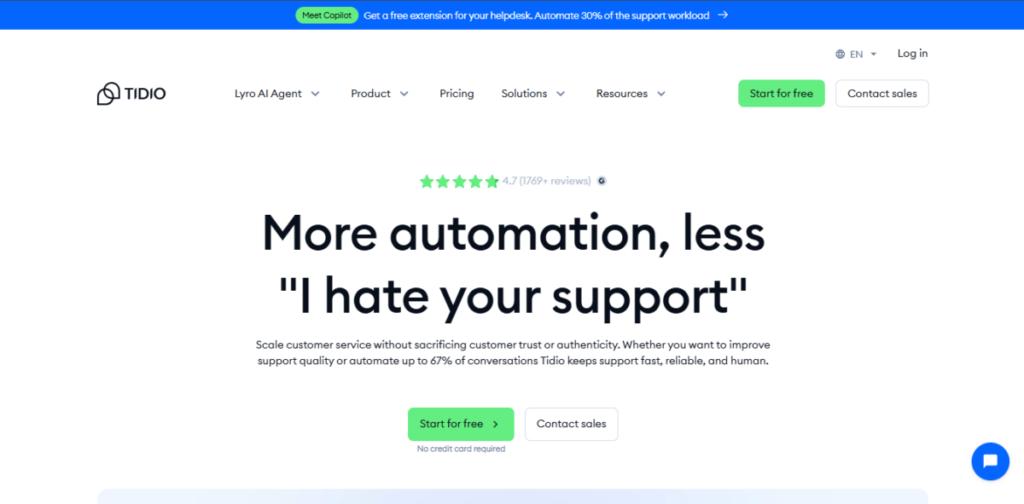
Tidio is a favorite among small businesses that want AI for customer service without complexity.
Its AI assistant, Lyro, doesn’t guess answers or make things up. Instead, it learns directly from your website, help documents, and FAQs. That’s why its replies feel accurate and on point.
Lyro AI can handle a large share of common questions on its own. In fact, many businesses report resolution rates of around 67% without human help. That’s a big win for lean teams.
Pair that with Tidio’s clean live chat interface, and you get a fast upgrade to your support experience.
Tidio also shines in online sales. It blends chat support with simple e-commerce tools, helping turn conversations into conversions. For small teams, that mix of support and sales feels powerful and practical.
Key Features
- AI training from your own content, including FAQs and help articles
- Natural, multilingual replies that sound human, not robotic
- Live chat and AI working together for smooth customer conversations
- E-commerce tools like cart recovery and product suggestions
- Easy setup that works right out of the box
Pros and Cons
| Pros | Cons |
| Strong free plan for small teams | Limits on monthly conversations |
| Very easy to set up and use | Fewer advanced enterprise features |
| Helps recover abandoned carts | Voice support options are basic |
| Clean, modern chat interface | Automation depth is limited |
Best For
- Online stores
- Solopreneurs needing affordable AI for customer service
- Small teams that want fast setup and simple tools
- European teams that need strong multilingual support
Tidio proves you don’t need a massive budget to get solid customer service AI. If you want quick wins, better chats, and more sales without heavy setup, Lyro AI is a smart place to start.
7. Forethought.ai
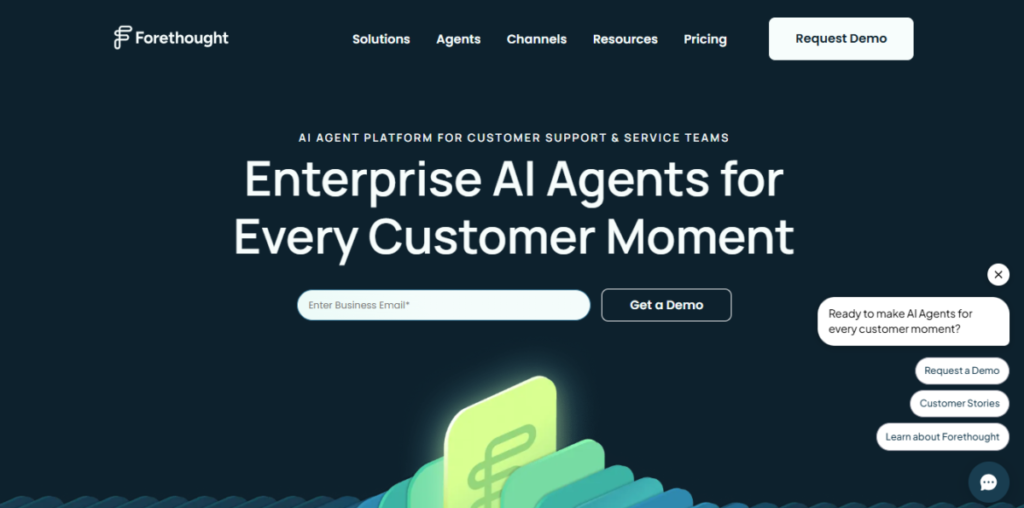
Forethought.ai is built for teams that want AI for customer support to do the heavy lifting.
Instead of just assisting agents, Forethought focuses on full ticket resolution. Its autonomous AI agents can solve over 60% of support tickets from start to finish.
The platform works across email, chat, and voice. It reads incoming requests, understands intent, and takes action. This approach helps teams deflect a large volume of tickets before they ever reach a human. Fewer tickets mean lower costs and less burnout for support agents.
Forethought shines in complex environments. It handles long, messy customer questions better than many basic bots. If your support inbox feels overloaded and repetitive, this kind of customer service AI can bring real relief.
Key Features
- Autonomous AI agents that resolve tickets end-to-end
- Strong enterprise security, including SOC 2 compliance
- Custom AI skills tailored to your industry and support needs
- Clear analytics dashboard to fine-tune responses and workflows
- Multi-channel coverage across email, chat, and voice
Pros and Cons
| Pros | Cons |
| High ticket deflection saves time and money | Some features require approval |
| Handles complex, unstructured questions well | Pricing isn’t fully transparent upfront |
| Proven fast return on investment | Smaller brand compared to older players |
| Reduces agent workload significantly | Best results need good training data |
Best For
- High-volume support teams aiming for more automation
- B2B companies with complex products or workflows
- Businesses focused on cutting support costs
- Teams ready to rely heavily on AI for customer service
8. Wonderchat
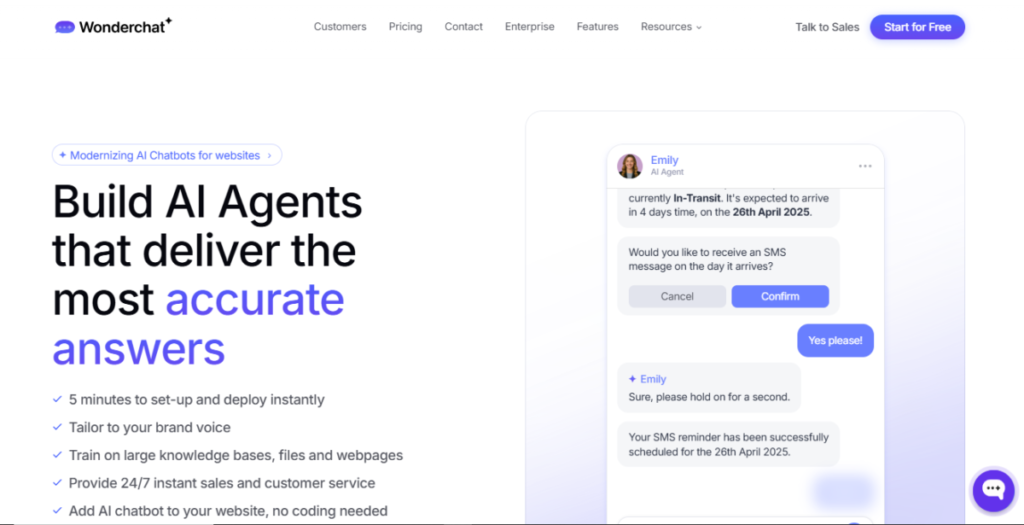
Wonderchat is big on speed, privacy, and simplicity in AI for customer service. Its GPT-powered bots learn directly from your website content and are ready to go in about five minutes.
No complicated setup, no waiting for developers. Customers get accurate, helpful answers instantly.
What sets Wonderchat apart is its privacy focus. Data stays with you, no sharing with third parties.
Plus, it speaks over 100 languages, making it a solid choice for businesses with international audiences. Whether your site visitors are in Berlin, Tokyo, or Lagos, the bot can handle them.
If you want an AI assistant that’s quick to deploy, secure, and multilingual, Wonderchat hits the mark.
Key Features
- Auto-training on your website content for accurate answers
- Supports 100+ languages for global reach
- Embeddable anywhere, including websites, Slack, or internal tools
- Lead generation from chats, turning conversations into potential sales
- Privacy-first design, no third-party data sharing
Pros and Cons
| Pros | Cons |
| Extremely fast setup | Limited deep analytics |
| Strong privacy controls | Conversation volume caps on cheaper plans |
| Built-in lead capture | Less effective for hybrid human-AI flows |
| Multilingual support | Fewer advanced automation options |
Best For
- Bootstrapped startups needing instant AI for customer service
- Privacy-conscious teams in regulated industries
- Websites with multilingual audiences
- Teams wanting simple, plug-and-play AI without coding
Bottom Line
So, here’s the deal. Zendesk AI crushes it when you need scale and top-tier full channel coverage. Big teams, lots of tickets, global reach? Zendesk’s your friend. Freshdesk keeps it easy with fast setup.
Freddy AI handles routine questions, perfect for teams that don’t wanna waste time. Intercom (Fin AI) shines if your chats double as sales moments. Want context-aware conversations? Then intercom is gold.
Zoho Desk is the budget-friendly all-in-one hub for small to mid-sized businesses. Kommunicate is great if you live in chat apps and want bots and humans in harmony.
Tidio (Lyro AI) makes solopreneurs and small e-com shops feel like pros. Forethought.ai is all about autonomous ticket handling- high volume, less stress. Wonderchat gets you live in five minutes, multilingual, and it’s privacy-tight.
Ever waited forever for a reply? You won’t with these AI for customer support tools.
Test 2 or 3 free trials. Your customers will thank you!
