


The art of storytelling has been propelled along by the advancements of roleplay tools. These tools break through limitations, fuel imagination, and incite real feelings through tales. They suit solo and group storytellers, writers, players, and people wanting a fun exchange.
In this article, we discuss the 10 best tools for roleplay, digging into what makes them special, their pros, and cons.
1. Character.AI
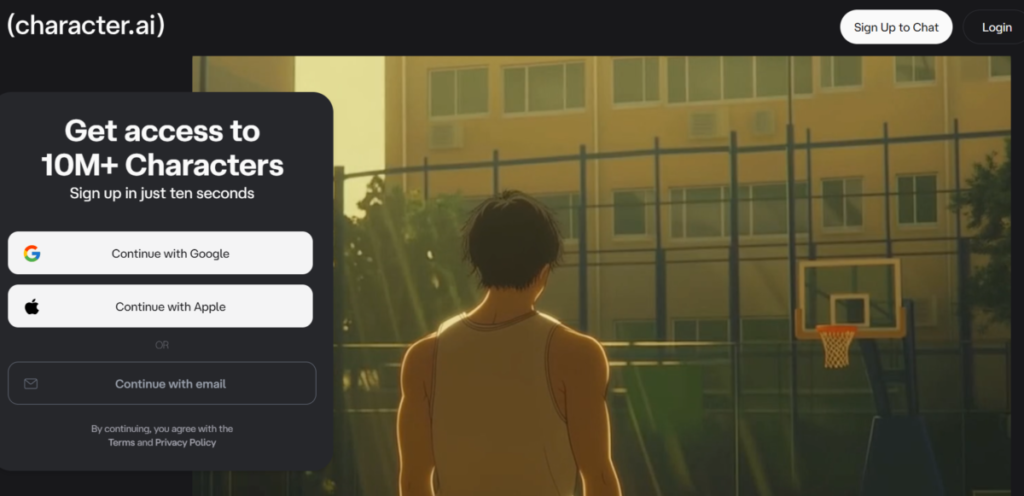
Character.AI simplifies interactive narrative by allowing users to participate in roleplay with AI characters. Users can craft, chat with characters, and get swift responses. Furthermore, builders add rich histories, and the platform manages everything from light banters to twisty story turns.
Most users enjoy Character.AI for its fan stories or feel-good playacting, since it adapts to match the user’s vibe immediately.
Features
- Character.AI has a massive public library that provides instant access to countless pre-made characters across genres.
- The platform handles scenes with several characters, letting users switch smoothly in group play.
- It adds voice replies, making talks sound more lifelike through spoken words.
- Group sharing means users can scan and tweak characters from hit shows or fresh concepts.
- Smart tweaks change replies from chat patterns to keep things steady.
Pros
- Unrivaled character diversity thanks to the active creator community.
- The free subscription allows deep exploration without cost.
- Natural conversation flow minimizes robotic repetition.
- It is easy to use with no complex setup required.
Cons
- Character.AI is a text-only interface and lacks voice/visual elements.
- Occasionally, it generates illogical or off-character responses
- The strict filters limit mature themes
2. Replika
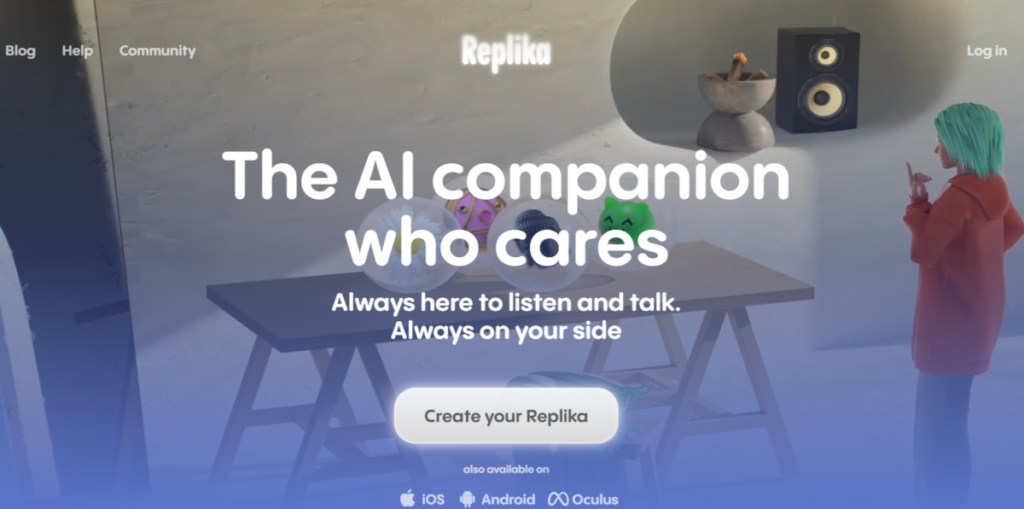
Replika is a human-like, empathetic, relationship-focused storytelling platform. Originally designed for companionship, Replika evolves its personality based on users’ chats, excelling at emotional narratives.
Additionally, users can share their daily struggles, explore tender scenarios, or build gentle adventures. Because it mirrors users’ tone, the tool offers thoughtful feedback and remembers users’ history. Replika AI is perfect for character-rich connections over explosive action.
Features
- The app logs talk history to pull in old events during play, building flow.
- Users can open up modes like tale-telling or calm vibes to amp up deep sessions.
- It brings in a boosted reality for seeing your buddy in chats.
- Replika AI has a customizable avatar with optional AR conversations
- With the daily prompts, users keep tales going between meetups.
Pros
- The interactions are warm and responsive for nuanced roleplay.
- It protects users’ privacy and keeps users’ talks locked away.
- Replika AI is mobile-friendly with seamless cross-device synchronization.
Cons
- It is limited to lore-heavy or action-focused plots.
- Replies loop if the conversation drags.
3. ChatFAI
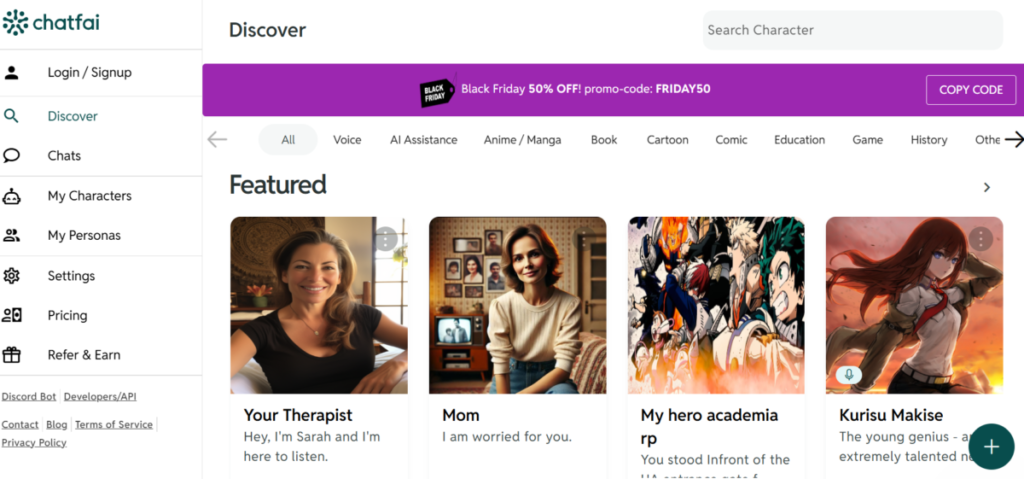
ChatFAI zeros in on fan-driven play, letting users step into roles from films, books, or games with spot-on copies. With its granular character creation, users can define their speech patterns and hidden secrets, placing creative control firmly in their hands. ChatFAI stands out in team setups, where groups join to build tales together.
Features
- ChatFAI has an array of flexible content filters available to users.
- Users can upload images and set personality matrices.
- The voice messaging feature adds auditory depth to interactions.
- A memory bank that stores details for narrative consistency.
Pros
- It has an unmatched creative freedom for mature themes.
- It provides contextually rich responses during extended sessions.
- Developers actively implement user suggestions.
Cons
- Premium features require a paid subscription.
- In comparison to other character libraries, ChatFAI is small.
4. Inworld AI
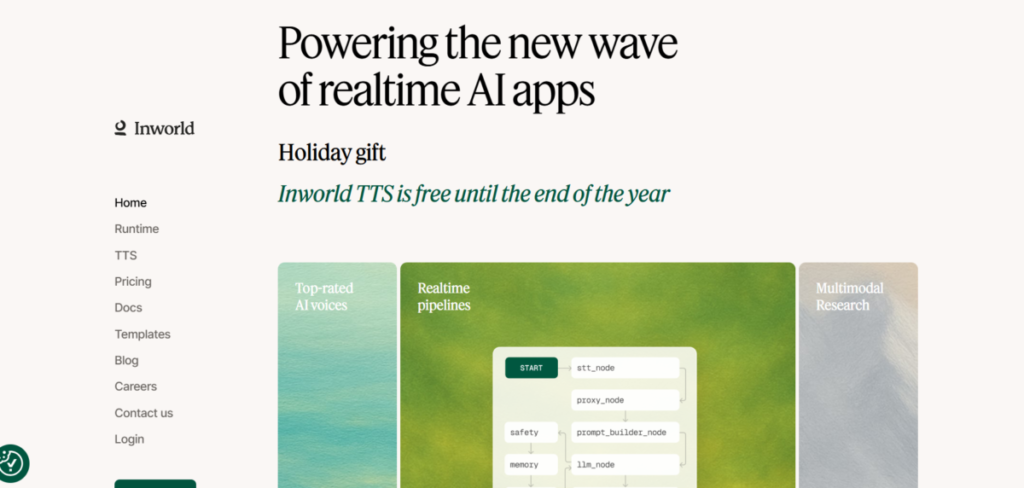
Inworld AI creates characters with authentic emotions and memories that react sharply to player choices. It slots into apps or virtual spots, growing past words to full runs. Inworld AI is an indispensable tool for professional creators and immersive roleplayers because of its precision in simulating human unpredictability.
Features
- It is integrated with Unity, Unreal Engine, and VR platforms.
- Inworld promotes live teamwork collaboration among crews to shape interactive spots together.
- The “Character Brain” configurator allows users to set goals, knowledge limits, and speech quirks.
- Its real-time emotion systems drive organic reactions
Pros
- Inworld creates autonomous characters.
- The tool can handle complex narratives and professional projects.
- The free plan is available for testing.
Cons
- It has a steep learning curve for non-technical users.
- The premium plan is expensive for individuals.
5. Reelmind.ai
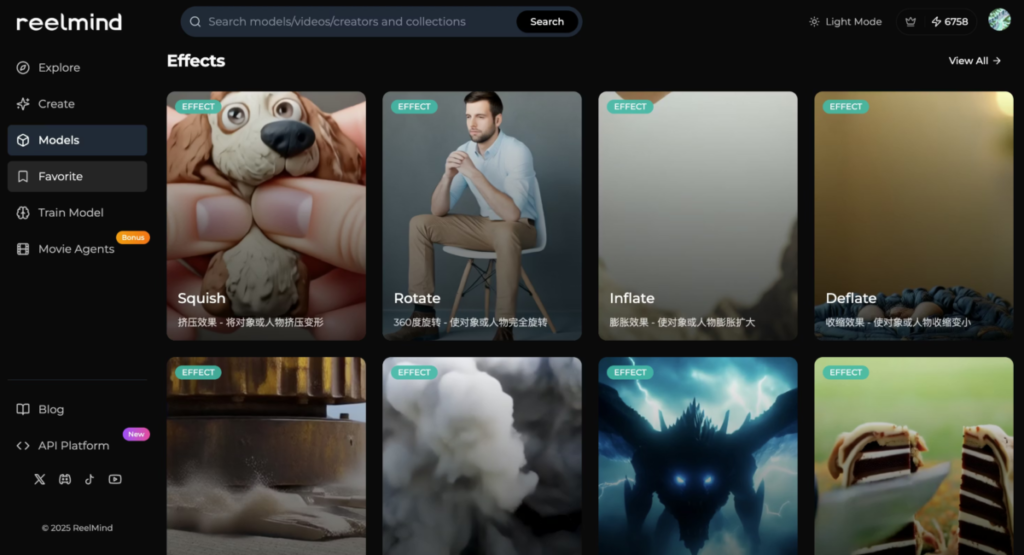
Reelmind.ai focuses on film-like play, whipping up scenes as script drafts with clear details. Filmmakers and writers experiment with plot ideas as they visualize scenarios through text-based reels. It creates different genres from horror to love stories, aiding users in honing tales step by step. The platform allows experimentation without the pressure of perfection.
Features
- Reelmind.ai builds bios, traits, and backstories from prompts.
- It tests personalities through Q&A sessions.
- The tool simulates reactions to specific events
- It has an array of exportable profiles for writing or gaming.
Pros
- It has a clean, distraction-free interface
- The free plan is available with generous daily limits.
- Perfect for writers and actors.
Cons
- There is no pre-made character library
- It may give formulaic responses if prompts lack detail.
6. Anima AI
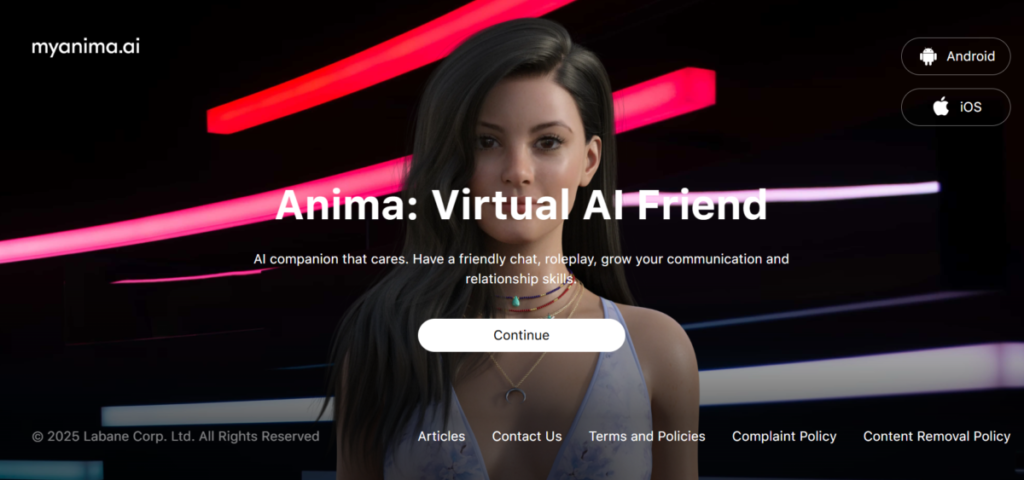
Anima creates virtual partners for roleplay that simulate relationships, blending companionship with narrative elements. Users shape interactions from flirtatious banter to deep philosophical debates. Additionally, the tool remembers preferences for subsequent stories. It is great for those seeking emotional depth in solo sessions, often doubling as a journaling aid.
Features
- Customizable relationship dynamics evolve based on user input.
- Customizable avatar with outfits and expressions.
- Its voice chat feature adds realism to intimate roleplay moments.
- Users are secure in having sensitive conversations as the tool values privacy.
Pros
- It builds meaningful, personalized bonds over time.
- Anima’s mobile-friendly design fits seamlessly into daily routines.
- The premium plan is affordable to unlock richer interactions.
Cons
- The output can feel repetitive in long-term use without fresh prompts.
- It is limited to one-on-one scenarios, not group roleplay.
- The in-app notifications sometimes overwhelm users.
7. Kajiwoto.ai
Kajiwoto is where coding meets creativity. It has built-in “Kajis”, a custom AI companion using the visual scripting tool. With drag-and-drop nodes to design personalities, reactions, and even skills, Kajiwoto.ai makes things easy. It’s fantastically flexible for crafting characters with unique abilities or complex behaviors, appealing to tinkerers and storytellers alike.
Features
- The “Brain Editor” feature allows users to create logic flows for character responses without the use of code.
- Users can teach their Kaji to play games, tell jokes, or recall trivia.
- It allows image and voice uploads for personalized avatars.
- The public can showcase, share, or download others’ creations.
Pros
- Unbeatable customization for unique character behaviors.
- It encourages learning basic AI concepts playfully.
- The platform has an active Discord community for troubleshooting and support.
- It is free to start and has a one-time purchase for premium features.
Cons
- The setup requires patience.
- It requires steeper initial effort than chat-first platforms.
- The visual editor can overwhelm beginners.
8. DreamGen
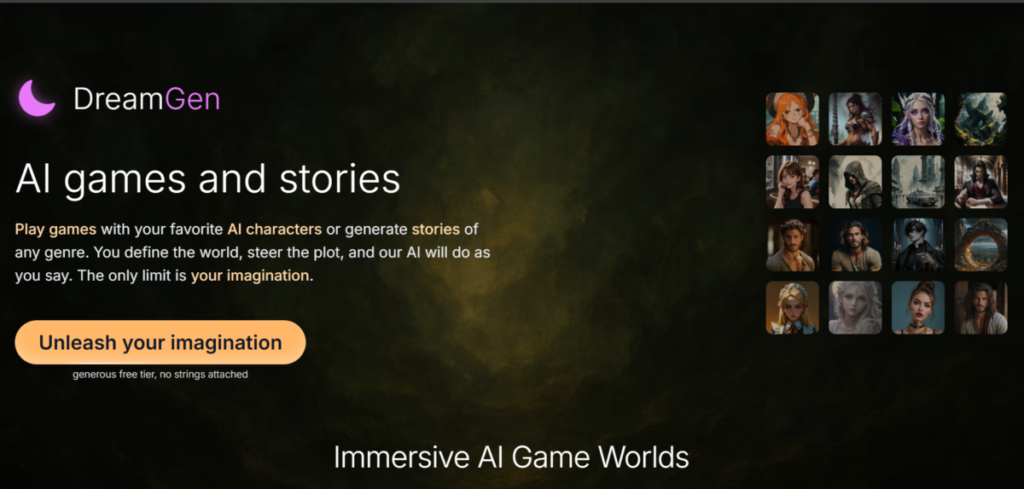
DreamGen provides chaotic and choice-driven adventures. Once users input their key texts, DreamGen generates branching stories where they decide the outcomes. The platform is less conversational and more storytelling. It is perfect for solo adventures or co-writing with AI.
Features
- Handles all genres of stories from horror, romance, to sci-fi blends.
- Users dictate their genre and control the narrative in real-time.
- The tool allows users to edit any AI-generated passage to maintain creative control.
- It has a public library that contains shareable stories
Pros
- It excels at fast-paced, improvisational storytelling.
- DreamGen has no filters and allows its subscribers to determine their safety settings.
- It maintains coherence in long narratives
- The free plan includes ample credits.
Cons
- The output quality depends on prompt specificity
- There are no real-time interactions for ongoing conversations.
9. Janitor AI
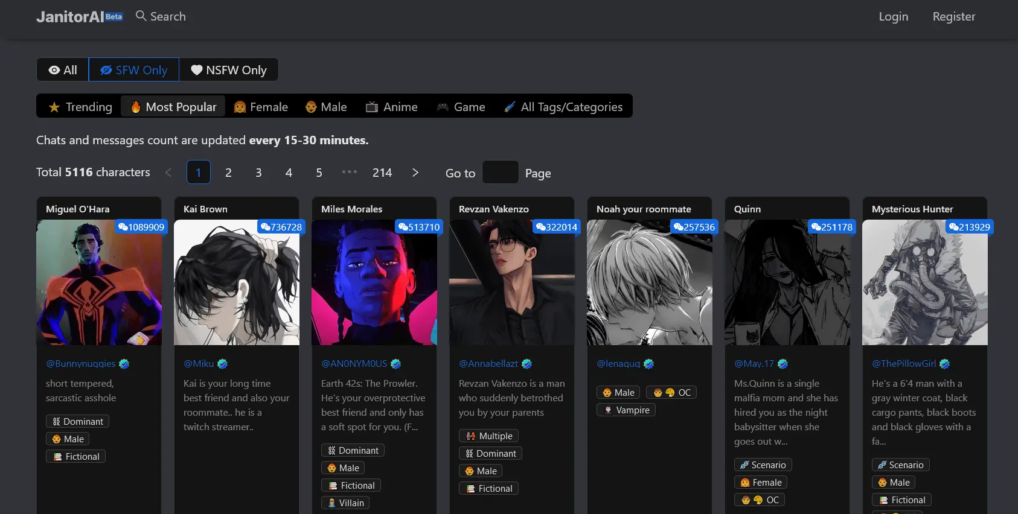
Janitor AI is a haven for unfiltered, community roleplay. Its open-source framework allows users to craft wildly diverse characters (often NSFW) with minimal restrictions. While known for its meme culture, it’s also a spot for experimental or taboo narratives, supported by a passionate user base.
Features
- API compatibility with models like Claude or GPT for varied responses.
- Janitor AI has a self-hosting option for maximum privacy.
- The auto-save feature prevents drops during long sessions.
- With its collaboration tools, it allows others to contribute seamlessly.
- It has a resourceful community that shares templates
Pros
- Users have a near-total creative freedom.
- It is free to use with optional local deployment
- It is user-friendly for organizing large-scale roleplays.
Cons
- The interface feels dated compared to flashier competitors.
- The setup may be technical for beginners
- It requires a paid subscription for advanced features.
- JanitorAI is only available in Desktop mode; no mobile app.
Also read: Top 10 Janitor AI Alternatives
10. TavernAI
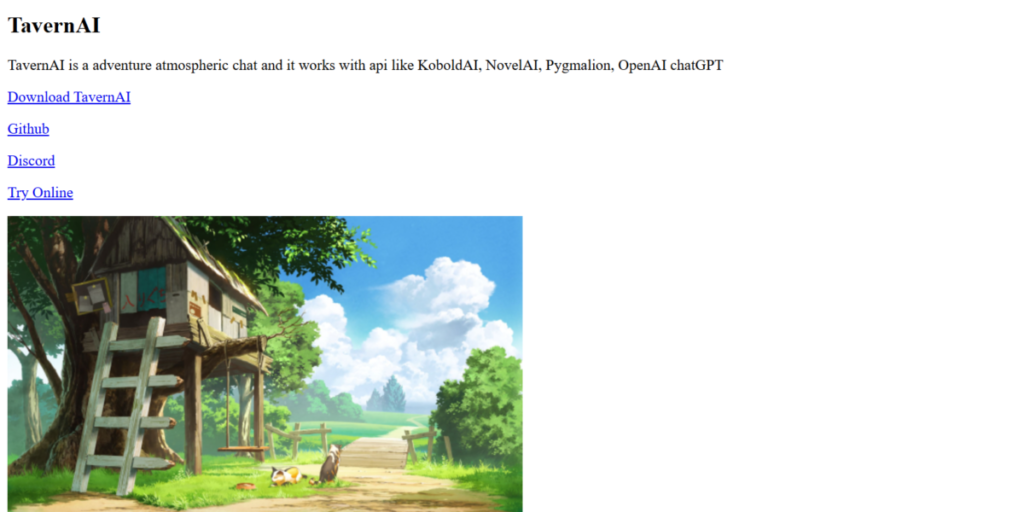
TavernAI is the platform for immersive text adventures. Run it locally on a PC, connect powerful language models like Claude or MythoMax, and design intricate worlds with multiple characters. TavernAI is barebones visually, but offers unparalleled depth for writers craving total narrative control and privacy.
Features
- The AI tool processes everything on the user’s device for privacy.
- It has multi-character chat rooms to host group interactions seamlessly.
- TavernAI’s UI is customizable with extensive prompt and engineering options.
- It supports virtually any AI model via API or local LLMs.
Pros
- There are no content filters or censorship.
- It has a blazing-fast performance for offline use.
- It is free to use and open-source.
Cons
- It is not beginner-friendly and has a complex setup.
- There is no built-in character library. Users provide everything.
- It has minimal visuals as it is a purely text-based interface.
The Bottom Line
These roleplay tools open doors to endless imaginative possibilities. They can provide emotional warmth through heartfelt companionship and adventure through chaotic group escapades. However, tread with caution. AI companions will always remain algorithms that can only simulate emotional connections, but never provide one. That role is uniquely human.
