
SEO is one industry that the AI revolution has hit. AI SEO tools help to produce authoritative content with sufficient content depth in only a fraction of the time. They analyse what works and inform effective, high yield SEO strategies. This article will cover our top picks of these tools.
1. Writesonic
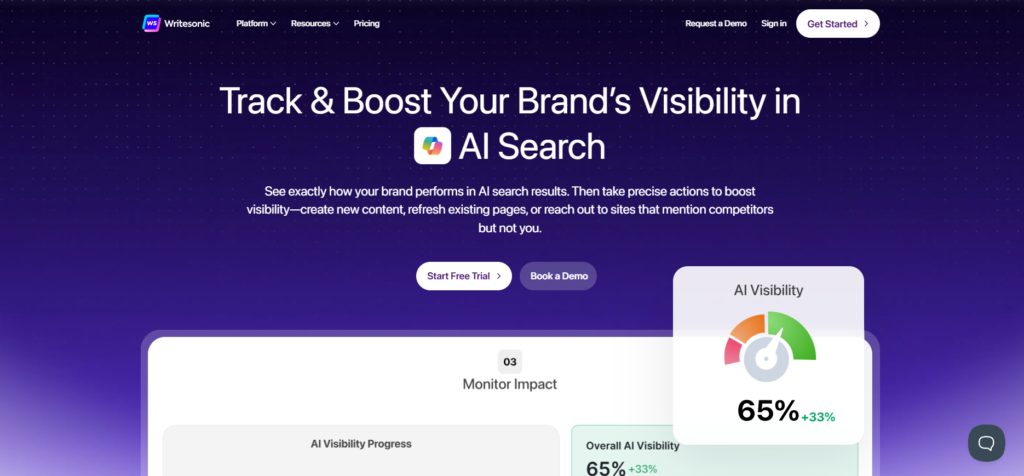
Writesonic is an AI content creator that produces SEO-optimized blog posts, landing pages, and marketing copy. It is fitted with AI models that uphold SEO principles throughout. Content outlines, full articles, and meta descriptions have proper keyword placement and readability optimization.
Features
- Writesonic’s AI generates SEO articles, blog posts, landing pages, and marketing copy using AI trained on marketing datasets.
- The platform includes built-in keyword optimization tools that structure content for search engine rankings.
- It provides automated content outlines and article structures based on target keywords and search intent.
- Writesonic has access to SEO data sources to provide recommendations for headings, keywords, and readability.
- There are dedicated AI chat assistants and templates for marketing and SEO content production.
Pros
- Marketing teams can generate large volumes of SEO content quickly with Writesonic.
- The content creation process becomes easier with templates that guide writers through SEO best practices.
- Writesonic’s outlines cover relevant topics and search intent.
- It caters to multiple content formats: blogs, ads, and landing pages.
- The interface is beginner-friendly.
Cons
- The AI sometimes produces generic or repetitive content that requires editing to add originality.
- Long-form articles may need intense human review for factual accuracy and brand voice consistency.
- Advanced SEO data and analytics features are limited compared with specialized SEO platforms.
- Pricing can increase quickly for teams producing large volumes of content.
- Generated content may occasionally miss deeper topical coverage, especially when it includes highly competitive keywords.
2. Ahrefs AI
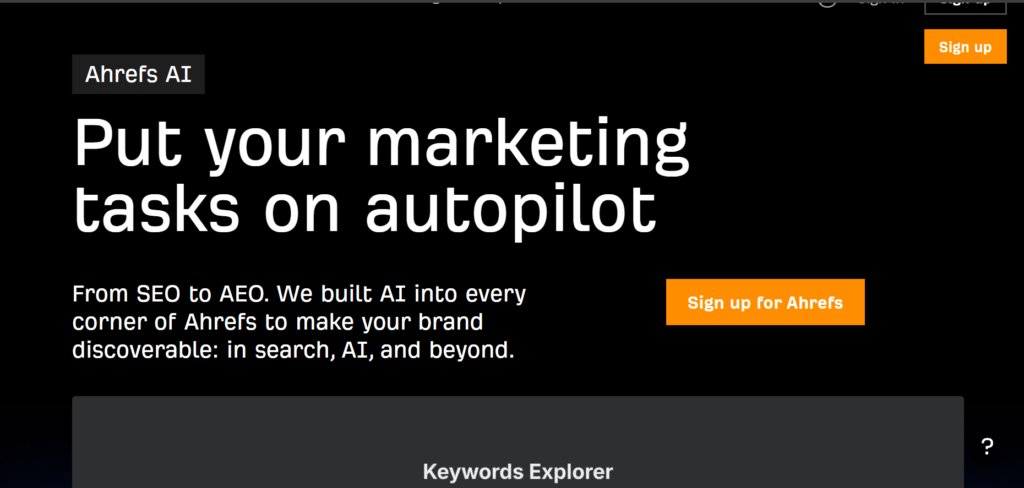
Ahrefs AI is an extension of the Ahrefs SEO platform. It uses AI in keyword research, search intent analysis, and competitive content evaluation. The best use case is the research and strategy phase to identify high-value keywords, evaluate ranking difficulty, and wield content strategies.
Features
- Ahrefs AI performs keyword research and SERP analysis.
- It analyzes competitor content to identify keyword gaps and ranking opportunities.
- It makes suggestions to improve existing content to increase rankings.
- Ahrefs AI processes large keyword datasets to identify search trends and emerging opportunities.
- The system generates insights that prove useful in SEO strategies.
Pros
- Ahrefs AI provides reliable SEO data based on one of the industry’s largest backlink and keyword databases.
- It helps marketers discover valuable keyword opportunities quickly.
- Competitive analysis features make it easier to understand why certain pages rank.
- AI-aided search reduces the time needed for manual keyword research.
- Ahrefs has research, ranking analysis, and link insights in a single environment.
Cons
- Ahrefs AI niches down to research and analysis rather than content creation.
- It can be expensive for freelancers or small businesses.
- The large amount of SEO data can be overwhelming for beginners.
- Some AI recommendations still require interpretation by experienced SEO professionals.
- The tool does not provide automated content production and publishing.
3. Surfer SEO
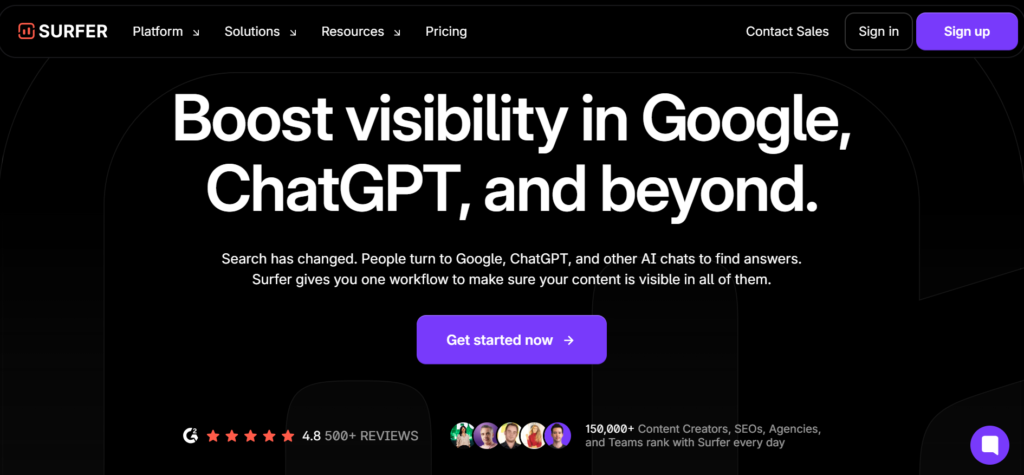
Surfer SEO is a content optimization tool that analyzes information about top-ranking pages to make recommendations for on-page SEO. It checks for keyword usage, headings, content length, and semantic terms, then generates a live optimization score while writing.
Features
- Surfer SEO analyzes top-ranking pages to provide recommendations for on-page SEO.
- It has a content editor that scores articles based on keyword usage and structure.
- It generates keyword clusters and semantic term suggestions to improve topic coverage.
- Surfer SEO creates both outlines and content.
- It is integrated with Google Docs and content management systems.
Pros
- Surfer SEO gives highly actionable on-page optimization recommendations based on SERP analysis.
- The live content score helps writers optimize content while drafting.
- Semantic keyword suggestions improve topical relevance and depth.
- The tool is widely used by SEO professionals and integrates well with other platforms.
- Surfer SEO helps ensure content aligns with patterns found in top-ranking pages.
Cons
- Over-reliance on content scores can lead to rigid, formulaic content that lacks originality.
- Some recommendations may encourage keyword stuffing if followed too strictly.
- It focuses mainly on on-page SEO rather than technical or link-building aspects.
- Pricing can become costly for larger teams and agencies.
- The learning curve can be steep for newbies.
4. Jasper
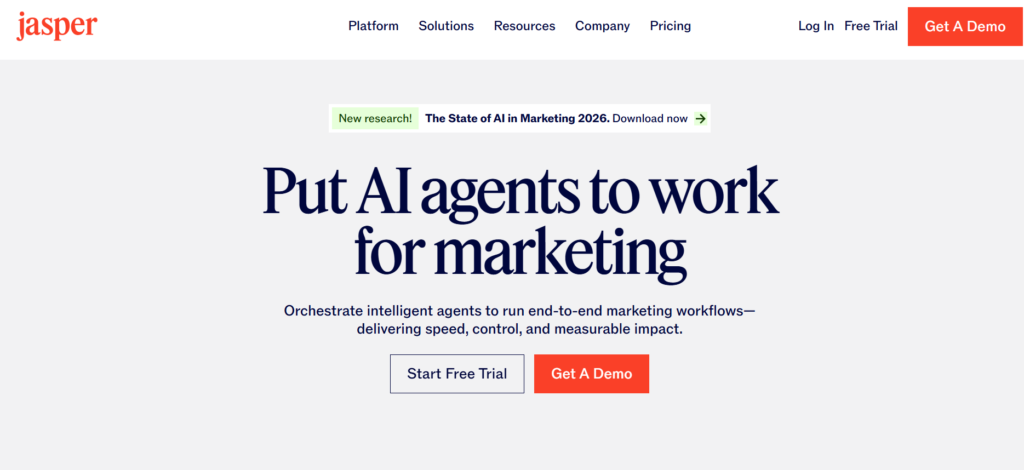
Jasper is a template-rich AI writing assistant that helps marketing teams to generate SEO-focused content at scale. It writes blog posts, ad copy, product descriptions, and social content. Jasper is also integrated with platforms and tools that help with keyword-guided writing.
Features
- Jasper provides writing tools designed for marketing and SEO content creation.
- It includes templates for blog posts, product descriptions, ads, and social media copy.
- Jasper helps teams to define brand voice guidelines that guide AI-generated content.
- It integrates with SEO tools to assist with keyword-focused content creation.
- It supports collaboration and cohesion marketing teams.
Pros
- Jasper ensures marketing teams produce content quickly without sacrificing structure.
- The brand voice feature helps maintain consistency across content.
- Templates ease the task of creating SEO articles and marketing copy.
- It works well for multi-channel marketing content beyond just SEO.
Cons
- Jasper can generate repetitive content when producing large volumes of text.
- It relies on integrations for advanced SEO data and optimization insights.
- Long-form articles often require manual editing to improve depth and accuracy.
- Pricing can be high compared with simpler AI writing tools.
- Some users may find that the AI output lacks strong originality without human editing.
Also read: Top 10 Free AI Essay Writers
5. Gemini Deep Research
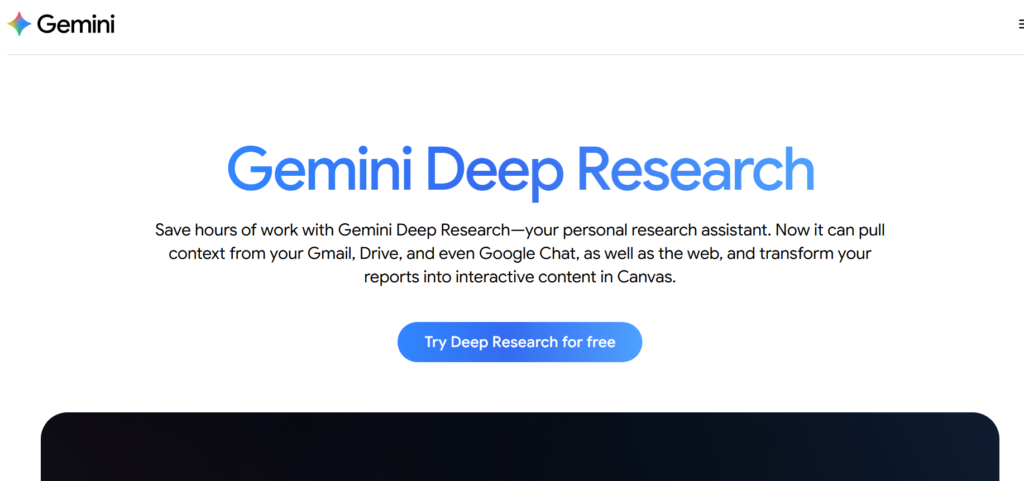
Gemini Deep Research is an AI research tool that exists within Google’s Gemini ecosystem. In the SEO workflow, it is particularly useful during the topic research and planning stage. Gemini Deep Research helps marketers to build comprehensive and authoritative content strategies. It informs deep topic exploration, competitor content analysis, and identifies content gaps in search results.
Features
- Gemini Deep Research analyzes large sets of information to generate structured research summaries.
- The tool helps identify key topics, trends, and insights from multiple sources.
- It can condense research findings into organized outlines and reports.
- The system executes complex research tasks that require cross-referencing many documents.
- Gemini Deep Research integrates with Google’s AI ecosystem for advanced data processing.
Pros
- Gemini Deep Research functions as the name implies; it allows deeper topic exploration for authoritative SEO content.
- It helps marketers quickly understand complex subjects and research-heavy industries.
- Gemini Deep Research can identify content gaps and emerging trends.
- It fits into the topic research and planning stages.
- It is particularly useful for building comprehensive pillar content and guides.
Cons
- It is not specifically designed as a dedicated SEO platform.
- It does not provide direct keyword metrics or SERP ranking data.
- Users must still translate research insights into SEO strategies manually.
- The workflow may require integration with other tools for content production.
- Some research outputs may require fact-checking and refinement.
6. Frase
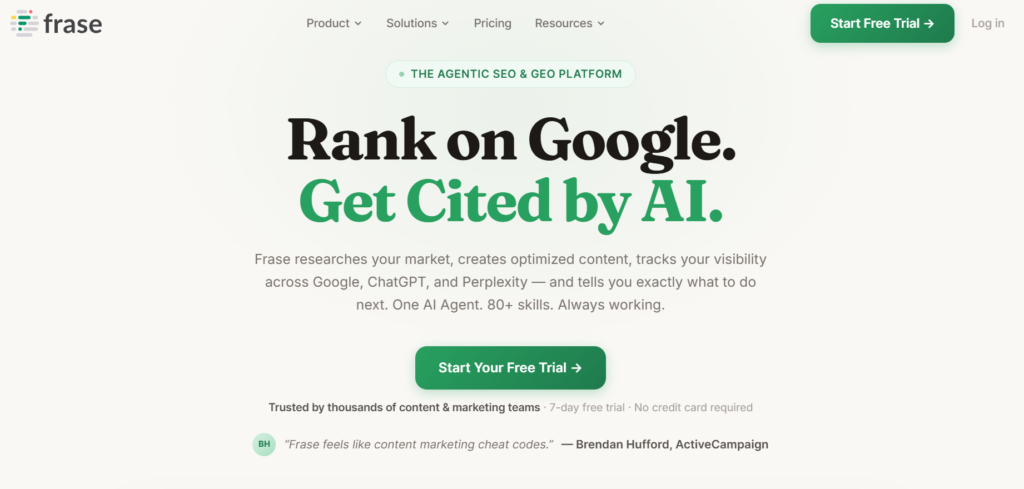
Within the SEO workflow, Frase sits between research and writing. It is an AI SEO content tool that helps with research, content briefing (main focus), and optimization. Fraze creates structured briefs that cover all relevant subtopics needed to effectively compete in search results.
Features
- Frase generates detailed SEO content briefs from search results.
- It identifies important questions and subtopics related to a keyword.
- It makes content optimization suggestions based on competitor pages.
- Frase includes an AI writing assistant for drafting and expanding content.
- Fraze scores topics to evaluate how well the content covers a subject.
Pros
- Frase creates structured and comprehensive content briefs.
- It helps writers cover important questions users search for online.
- It uses data wrung from SERP analysis to ensure content aligns with search intent.
- The interface is designed specifically for content marketers and SEO teams.
- Frase reduces research time when planning blog posts and articles.
Cons
- The AI writing tools are less advanced than some dedicated AI content platforms.
- The platform focuses mainly on content research and optimization.
- Some recommendations can feel repetitive when working with similar keywords.
- The tool may require additional editing to create fully polished articles.
- Advanced SEO analytics features are limited compared with larger SEO platforms.
7. QuillBot
QuillBot is an AI writing and paraphrasing tool that refines existing text. Its paraphrasing, summarization, grammar checking, and tone adjustments improve clarity and readability. Quillbot has associated tools that help to check AI content and plagiarism.
Features
- QuillBot is a paraphraser for rewriting and improving text.
- It includes grammar checking and writing enhancement features.
- It offers summarization tools that condense long text into shorter versions.
- QuillBot supports multiple rewriting modes to adjust tone and clarity.
- The tool integrates with browser extensions and word processors.
Pros
- QuillBot helps writers quickly improve the clarity and readability of content.
- The paraphrasing feature helps reduce duplication and improve originality.
- The platform is easy to use and accessible for beginners.
- It works well for editing drafts produced by other AI writing tools.
- QuillBot offers useful features for both academic and marketing writing.
Cons
- QuillBot does not provide SEO-specific optimization features.
- The paraphrasing tool can occasionally alter the intended meaning of sentences.
- Advanced features require a paid subscription.
- The platform focuses on editing rather than generating full articles.
- It lacks integrated keyword research or SERP analysis capabilities.
8. AirOps
AirOps automates and scales content creation. It connects AI models, structured data, and internal workflows to generate large volumes of programmatic SEO content. This translates to an easier path of creating landing pages and product descriptions without sacrificing quality standards.
Features
- AirOps enables automatic content creation and SEO optimization.
- It supports programmatic SEO content generation at a large scale.
- It connects structured data sources with AI models to produce targeted content.
- AirOps includes tools for creating automated pipelines for marketing operations.
- It integrates with various APIs, data tools, and AI models.
Pros
- AirOps multiplies companies’ SEO efforts.
- The platform is highly customizable for complex marketing workflows.
- It supports programmatic SEO strategies that rely on structured datasets.
- Automation features significantly reduce manual content production tasks.
- AirOps works well for large organizations and data-driven marketing teams.
Cons
- The platform may be overly complex for small businesses or solo marketers.
- Setting up workflows often requires technical knowledge or engineering support.
- The learning curve can be steep for teams unfamiliar with automation platforms.
- Costs can increase depending on usage and workflow complexity.
- AirOps focuses on automation rather than traditional SEO analytics.
SEO Dominance
AI helps with SEO by making most time-consuming tasks much faster and more data-led. Marketers can now use AI to make better sense of search results, identify what audiences are looking for, and build content that directly addresses those needs.
