

Is using AI for academic writing allowed? In most cases, yes, but only within certain defined limits. It depends on who grades or publishes your work. In a classroom, a professor sets the rules for a course.
In publishing and academia, a journal sets the rules for a paper. Therefore, the answer is never a simple yes or no. Instead, it is “yes, if you follow the policy and disclose your use.” Below, you’ll find what schools tend to allow, what journals demand, and how to use AI without inviting a misconduct charge.
When AI Is Allowed in Academic Writing and When It Isn’t
AI is usually allowed when it supports your thinking. It is usually banned when it replaces your thinking. Generally, AI is allowed (with permission or disclosure) for brainstorming topics and research questions, building outlines, making summaries of already read sources, and grammar polishing.
As a rule of thumb, AI use is restricted from authoring your work and generating images in journal figures. Students are also prohibited from citing references that AI invented.
Also read: How to Tell If Something Was Written by AI
What Universities and Professors Usually Permit vs. Prohibit

Universities rarely issue one blanket rule. Instead, rules vary by course. Take the UK’s Russell Group. In July 2023, the vice chancellors of its 24 universities backed shared principles on the ethical and responsible use of generative AI, which shape work at both the institution and course level. The key point was that appropriate uses of generative AI are likely to differ between academic disciplines.
All 24 Russell Group universities have also reviewed their academic conduct policies to reflect generative AI. In practice, this creates commonalities:
1. Low-risk uses: Many instructors accept brainstorming, outlining, and language editing. These uses help you think and write without replacing your ideas. The distinction makes sense on paper, but it blurs quickly in practice.
An AI-built outline can quietly shape your whole argument. And because each instructor enforces the line differently, a use that passes in one class may not pass in the next.
2. High-risk uses: Ghostwriting crosses the line almost everywhere. If AI drafts your essay and you submit it, most schools treat that as misconduct. Similarly, paraphrasing AI output to hide its source still counts as dishonest.
3. The gray zone: Summarizing readings is trickier and is subjective. Some professors allow it while others ban it because summarizing is the skill they want to assess.
In my view, journal policies are easier to follow. They live in one published document, while university rules can change from one syllabus to the next each semester.
What Journals and Publishers Require
1. AI Cannot Be an Author
The Committee on Publication Ethics (COPE) laid down that ground rule early. In a statement first published on 13 February 2023, COPE stated that AI tools cannot be listed as authors because they cannot take responsibility for submitted work. Moreover, as non-legal entities, they cannot declare conflicts of interest or manage copyright and license agreements.
2. You Must Disclose AI Use
Medical journals take their cue from the International Committee of Medical Journal Editors (ICMJE), and it has a clear rule on AI use. At submission, journals should ask authors whether they used AI-assisted technologies, such as large language models, chatbots, or image creators.
Authorship is off the table. Chatbots cannot be responsible for the accuracy, integrity, and originality of the work, so they cannot be listed as authors. Where you disclose depends on what the AI did.
Writing, editing, or proofreading help belongs in the acknowledgments. Help with data collection, analysis, or figures belongs in the methods section. ICMJE refreshed this guidance in January 2026, adding a new standalone Section V, “Use of Artificial Intelligence in Publishing.”
However, not every publisher asks for the same thing. Springer Nature draws its line around light editing. Using an LLM for “AI-assisted copy editing” needs no declaration. Any other LLM use, however, must be documented in the Methods section, or in a suitable alternative section if there is no Methods section.
Elsevier has a similar rule. You may use AI in manuscript preparation before submission, as long as there is appropriate oversight and disclosure.
3. AI-Generated Images Are Usually Banned
Images face the strictest limits. Elsevier does not permit generative AI or AI-assisted tools to create or alter images in submitted manuscripts. Likewise, Springer Nature journals do not permit AI-generated images and videos for publication, as legal issues remain broadly unresolved.
Yet, that policy excludes text-based and numerical display items such as tables, flow charts, and simple graphs without images. Similarly, the Science journals do not permit AI-generated images and other multimedia without explicit permission from the editors.
4. Humans Stay Accountable
Whatever the tool did, the responsibility lands on you. COPE states that authors are fully responsible for their manuscript’s content, including parts an AI tool produced, and are liable for any breach of publication ethics.
How to Use AI Without Risking Misconduct
1. Check the Policy First
Everything else depends on this. Read your syllabus, school policy, or journal guidelines before you open any AI tool. Policies change often, so check the current version. Once you know what’s allowed, you’ll also know what you’ll need to disclose.
2. Disclose or Cite Your Use
A disclosure is only as good as your records. So write down which tool you used and why as you work, not the night before submission. For APA Style, a reference looks like this: OpenAI. (2023). ChatGPT (Mar 14 version) (Large language model). The in-text form is (OpenAI, 2023). Update the year and version to match the tool you actually used.
Some journals ask for even more detail. Science’s guidelines, for example, ask for the model name and version number, and some journals require you to list the prompts you used to create new text. [Optional: add when you last checked APA’s guidance and what you found.]
3. Verify Every Reference
Citations deserve the most attention because AI tools often invent sources that look real. A detector score is debatable, but a fake reference is objective evidence that anyone can check in seconds.
In one study, 41 of 59 references (69%) that ChatGPT provided were fabricated, even though they appeared real. In another, 47% of 115 ChatGPT-generated references were entirely fabricated, and another 46% contained incorrect details. Therefore, look up every citation in a database such as PubMed or Google Scholar. Then read the source yourself.
4. Keep Your Drafts
Verified sources protect your content. Your drafts, in turn, protect your process. Save your outlines, notes, and version history. If someone questions your work, these files prove how you built it.
5. Understand AI Detector Risks
Drafts are very important because AI detectors make mistakes, and false flags happen. For example, a Stanford study found that detectors were near-perfect on essays by U.S.-born eighth-graders but classified 61.22% of TOEFL essays by non-native English students as AI-generated.
In my own testing, I penned down(typed out) an emotionally charged, heartfelt paragraph. Then, I ran it through QuillBot, Copyleaks, and Scribbr. In my case, all three tools agreed, giving a score of 0% AI text.
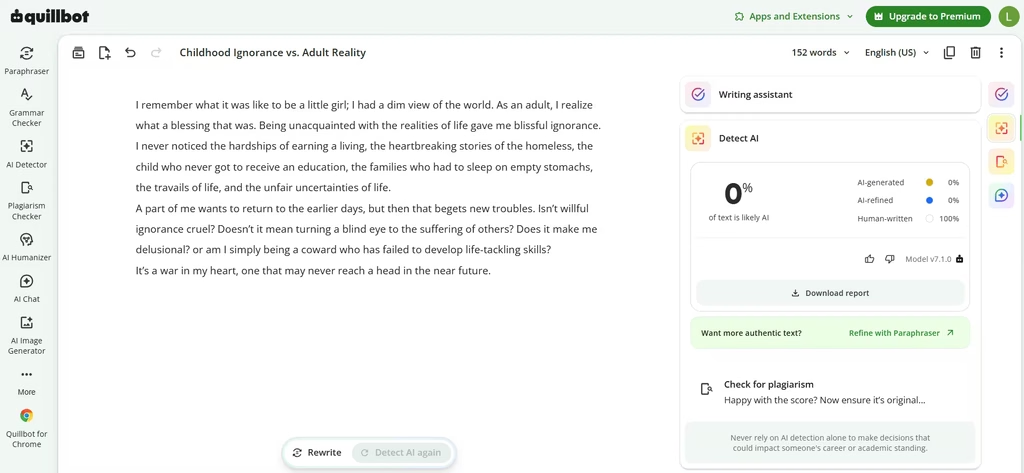
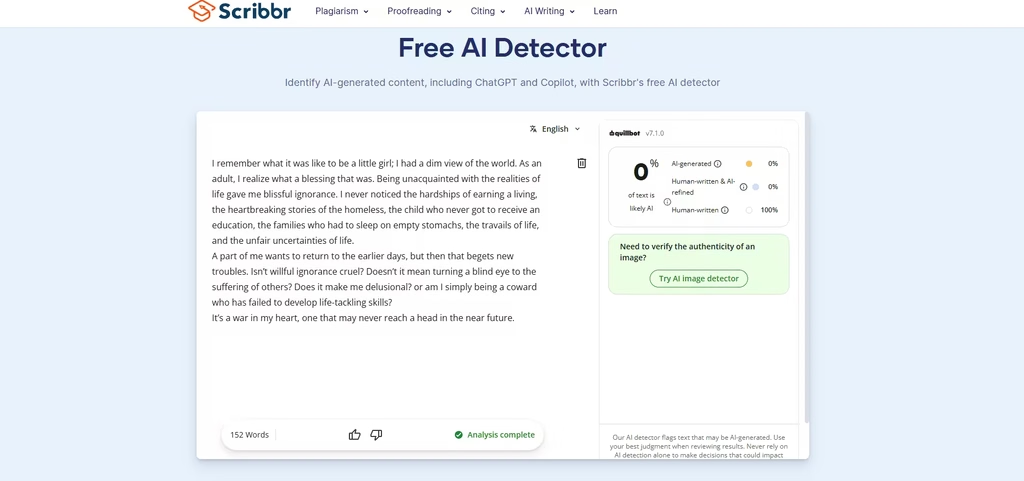
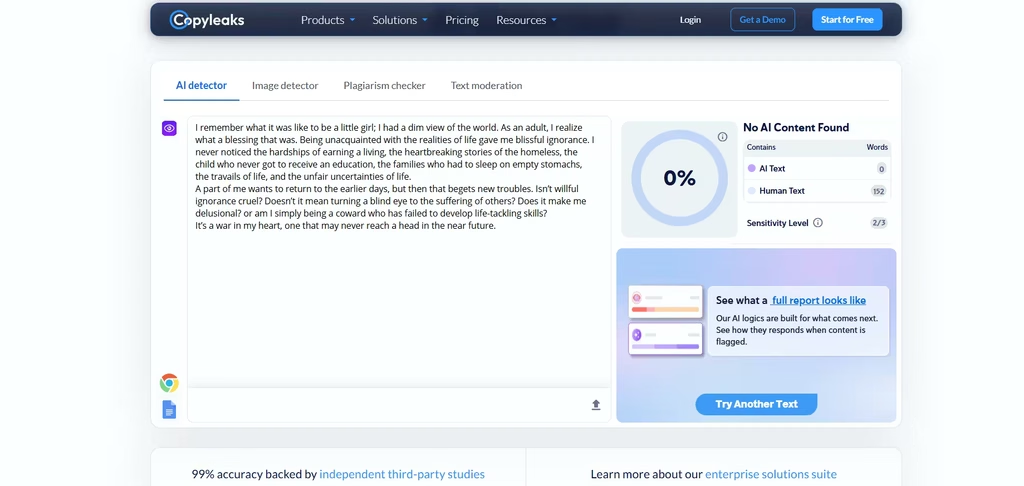
But then, my writing followed the classic human writing pattern: heavily nuanced, emotionally laden, complete with highly varied sentences.
More strict, formal writing may yield different results.
It’s not uncommon for AI detectors to struggle. Even OpenAI’s own classifier correctly identified only 26% of AI-written text, and it wrongly labeled human writing as AI-written 9% of the time. As a result, OpenAI made the classifier unavailable as of July 20, 2023, due to its low accuracy. So, if a detector flags you unfairly, your saved drafts become your best defense.
FAQ
1. Do I Need to Cite AI?
Usually, yes. If you quote or paraphrase AI output, cite it. For journals, follow the disclosure rules. Note that some publishers exempt basic copy editing.
2. Can AI Write My Essay?
Technically, yes. Ethically, no, unless your instructor explicitly allows it. Submitting AI-written work as your own counts as academic misconduct in most courses.
3. Is ChatGPT Good for Academic Writing?
Using ChatGPT for academic writing works well for outlining, rephrasing, and grammar. However, it fails as a source. It can invent citations and state errors with confidence. Consequently, treat it as an assistant, not an authority.
4. Will I Get Caught?
There is a high chance that you will. Detectors may be unreliable, but instructors notice other signs. These include fake references, a sudden change in voice, or an inability to explain your own argument. It’s best to be honest upfront about AI’s involvement.
