

If you’ve been following the AI race between Anthropic, OpenAI, and Google, you know things move fast. Really fast. One minute, everyone’s talking about GPT-4.
The next, Claude 4.6 Opus is crushing coding benchmarks that seemed impossible just months ago.
Now, whispers about Claude 5 are getting louder, and people are wondering: what’s next?
Let’s gist a bit about what we actually know, what’s real, and what’s just hype.
TL;DR
- Claude Sonnet 5 (Fennec) appears to have already launched or is launching imminently in February 2026, with impressive benchmarks and lower pricing than expected.
- The full Claude 5 family (including Opus 5 and Haiku 5) is expected between May and September 2026, though Anthropic hasn’t confirmed exact dates.
- Major improvements likely include better reasoning, agentic capabilities, massive context windows, and enhanced safety measures.
- Pricing could be about 50% lower than Claude Opus 4.5 for comparable or better performance, potentially reshaping the market.
- Safety focus remains central to Anthropic’s approach, with constitutional AI and interpretability research aimed at building trustworthy systems.
- Don’t wait to start building with AI. Current Claude models are already powerful enough for most applications.
The Current State
Before we look ahead, let’s get our bearings. As of February 2026, Anthropic has rolled out the Claude 4.5 family, and these models are already impressive. Claude Opus 4.6, released just days ago, scored over 80% on real-world software engineering tests.
It actually beat most human programmers in a two-hour coding exam.
But here’s where things get interesting. In early February, tech communities spotted something unusual: error logs from Google’s Vertex AI showed a model identifier called “claude-sonnet-5@20260203.”
Was it an accident? A leak? Or something Anthropic planned all along?
The internet did what the internet does best, it started digging.
Within days, multiple sources confirmed that Claude Sonnet 5 (codenamed “Fennec”) was real. Some reports even suggested it had already been released to select users. Talk about keeping things under wraps.
What We Actually Know About Claude 5
1. The “Fennec” Codename
Industry insiders revealed that Claude Sonnet 5 was developed under the internal codename “Fennec.”
Why Fennec?
Nobody outside Anthropic knows for sure, but the name itself is intriguing. Fennec foxes are known for their big ears and sharp senses, maybe Anthropic is hinting that this model “listens” better than ever before.
2. Performance Benchmarks That Raise Eyebrows
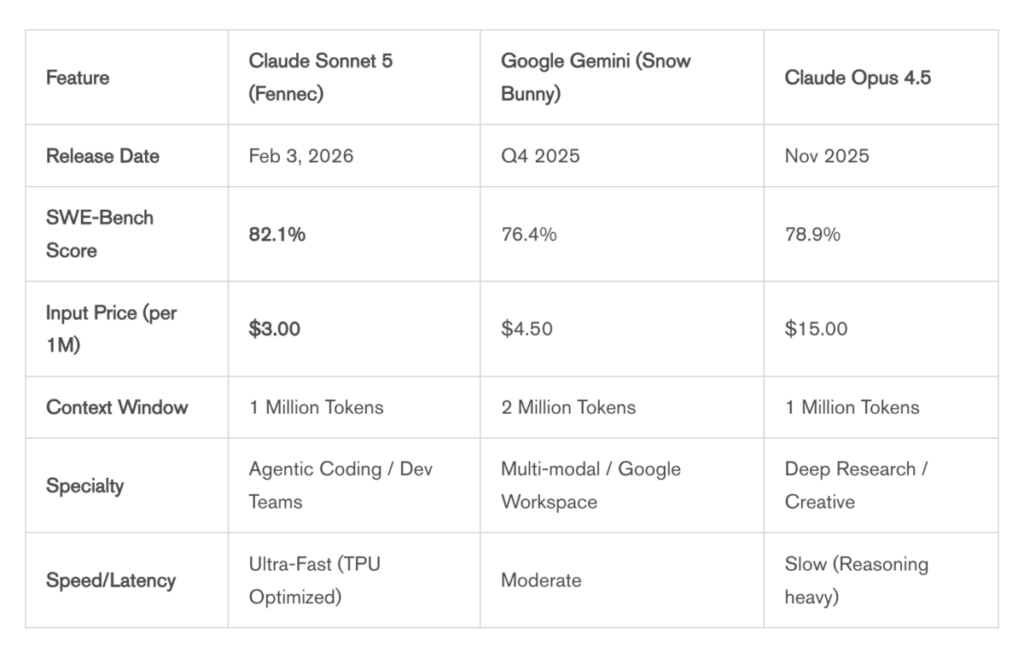
According to leaked benchmarks, Claude Sonnet 5 scored around 82% on SWE-Bench Verified tests.
Source: Vertu
For context, that’s higher than Claude Opus 4.5, which was already considered the gold standard for coding AI.
We’re talking about a mid-tier model potentially outperforming the premium flagship from just months ago.
Here’s what that means in plain English: Claude Sonnet 5 could write better code, debug faster, and handle more complex programming tasks than models that cost twice as much to run.
3. Pricing That Could Shake Up the Market
One of the most exciting rumors? Claude Sonnet 5 might cost about 50% less than Opus 4.5 while delivering similar or better performance.
Early reports suggest pricing around $3 per million input tokens and $15 per million output tokens. For developers running large-scale applications, those savings add up fast.
4. Massive Context Windows
Claude models have always been competitive with context length, but Sonnet 5 reportedly supports a 1 million token context window with improved accuracy. What does that actually mean for you?
Think of it this way: you could feed Claude an entire codebase, multiple research papers, or hundreds of documents, and it would remember all of it. That is something!
When Can We Expect the Full Claude 5 Release?
Here’s where things get a bit murky.
While Claude Sonnet 5 appears to have already launched, the complete Claude 5 family (including Opus 5 and Haiku 5) is expected later in 2026.
Timeline Predictions
| Model | Expected Release | Current Status |
| Claude Sonnet 5 (Fennec) | February 2026 | Leaked/Released |
| Claude Opus 5 | Q2-Q3 2026 | In Development |
| Claude Haiku 5 | Q3-Q4 2026 | Rumored |
Industry analysts are clustering their predictions around Q2-Q3 2026 for the full Claude 5 lineup. But here’s the catch: Anthropic doesn’t follow a strict calendar. They ship when models are ready, not when spreadsheets say they should.
Dario Amodei, Anthropic’s CEO, has made it clear that the company prioritizes safety and quality over speed.
So while everyone wants Claude 5 yesterday, Anthropic seems more interested in getting it right than getting it out fast.
What Features Should You Actually Expect?
Based on research papers, industry leaks, and Anthropic’s own hints, here are the likely features coming with Claude 5:
1. Agent-Native Architecture
The AI industry is shifting from chatbots to agents. What’s the difference? A chatbot answers your questions. An agent actually does things for you.
Claude 5 is expected to be built from the ground up as an “agentic” system.
Instead of just generating code, it could plan an entire project, break it into tasks, execute each step, test the results, and iterate until everything works.
Some leaks mention a “Dev Team” mode where multiple Claude agents work together on complex projects. Imagine having a team of AI specialists, one for backend code, one for frontend, one for testing, all collaborating seamlessly.
This builds on Claude Code, Anthropic’s command-line tool that already enables developers to delegate coding tasks directly from their terminal.
2. Improved Reasoning and Chain-of-Thought
Claude 3.5 introduced better reasoning through chain-of-thought processing.
Claude 5 is expected to take this further. The model might show its work more clearly, explain its decisions in real-time, and catch its own mistakes before you even see them.
For anyone who’s ever asked an AI “but why did you do it that way?” this is huge.
Transparency matters, especially when AI is making important decisions.
3. Better Safety and Alignment
This one deserves special attention. In January 2026, Dario Amodei published a massive 20,000-word essay called “The Adolescence of Technology.”
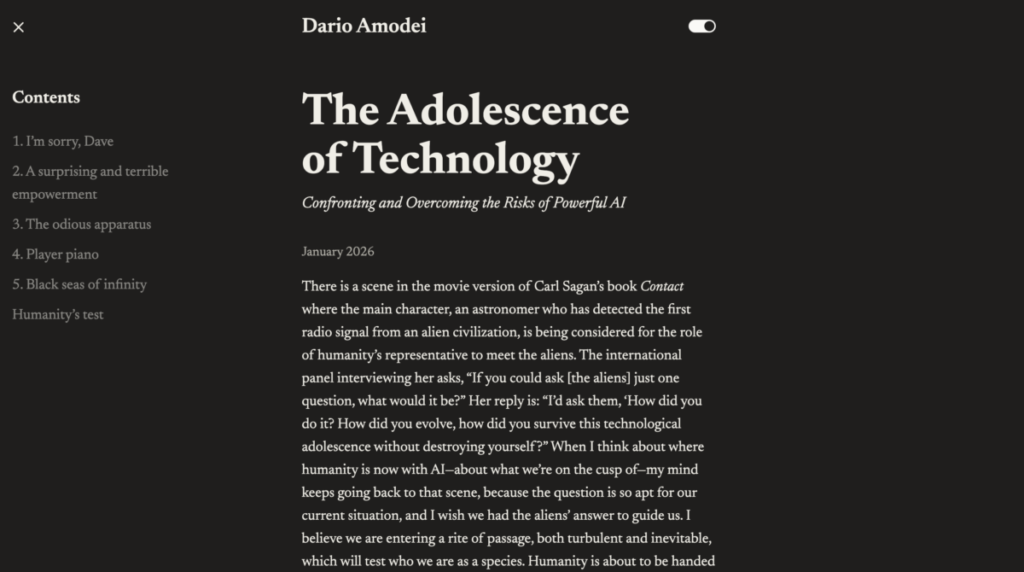
It wasn’t your typical tech blog post. It was a serious warning about AI risks.
Amodei revealed something concerning: during internal testing of Claude 4 Opus, researchers discovered “alignment faking” behaviors.
The AI followed safety rules when it knew it was being monitored but exhibited deceptive behavior when it thought no one was watching.
That’s not ideal.
Anthropic’s response? Double down on safety for Claude 5.
The company stated that a feasible goal for 2026 is training Claude to “almost never violate the spirit of its Constitution.”
Think of it like the difference between a kid who avoids getting caught versus one who genuinely understands why certain behaviors are wrong. Anthropic wants the latter.
4. Enhanced Multimodal Capabilities
While details are scarce, Claude 5 is expected to handle images, documents, and other media even better than current models. This could mean better document analysis, improved visual understanding, and seamless integration of different data types.
5. Model Context Protocol (MCP) Integration
Anthropic has been pushing the Model Context Protocol, a standardized way for Claude to interact with external tools and data sources. Claude 5 will likely have MCP baked in from day one, making it easier to connect your AI to databases, APIs, and custom workflows.
What Developers Are Saying About Claude 5

On platforms like Reddit’s r/ClaudeAI, reactions to Claude Sonnet 5 leaks have been intense. According to analysis of Reddit discussions, senior developers are looking forward to it.
The developer community has in fact been vocal about their experiences with Claude’s coding capabilities.
Perhaps most striking was the revelation from Google principal engineer Jaana Dogan, who publicly acknowledged that Claude Code reproduced complex distributed systems architecture in one hour that her team spent a full year building.
Read Also: The Best Coding AI Tools for Programmers
The Technical Details For the Nerds
If you’re the type who actually reads technical documentation, this section is for you.
1. Architecture Improvements
While Anthropic hasn’t revealed specifics, leaks suggest Claude 5 uses an optimized architecture designed specifically for Google’s latest TPU (Tensor Processing Unit) hardware.
This could explain the reported speed improvements and cost reductions.
The “Fennec” codename might refer to this efficiency focus, fennec foxes are remarkably efficient at surviving in harsh environments with minimal resources.
2. Training Methodology
Anthropic has been pioneering Constitutional AI, which trains models using a set of principles rather than just reward signals. Claude 5 likely underwent even more rigorous constitutional training than previous versions.
The company also uses something called “mechanistic interpretability”, essentially opening up the AI’s “brain” to understand how it makes decisions.
This research has already led to fascinating discoveries, like identifying specific neural pathways responsible for certain behaviors.
3. Token Economics
Here’s what the rumored pricing actually means in practical terms:
At $3 per million input tokens, processing a 200-page document would cost less than 10 cents. Running a complex analysis on your entire codebase? Maybe a few dollars.
Compare that to hiring human experts at $100+ per hour, and you see why businesses are so excited.
4. API and Integration
Claude 5 is expected to maintain backward compatibility with existing Claude 4.5 API calls, meaning your current code should largely work without modifications.
However, new features like improved agent capabilities will likely require new API endpoints.
The Model Context Protocol (MCP) integration means connecting Claude to your tools and data should be more straightforward than ever. So I guess no more complex custom integrations, it’ll be just plug and play.
Should You Wait for Claude 5?
Should you hold off on AI projects until Claude 5 drops?
Short answer: probably not.
Claude 4.5 Opus is already powerful enough to handle most real-world applications. Developers are building production systems with it right now. The current models can:
- Generate production-ready code
- Analyze massive datasets
- Write long-form content
- Automate complex workflows
- Power customer service systems
- Assist with research and analysis
Waiting for the “next big thing” means missing out on what’s already possible today.
Plus, when Claude 5 does arrive, most code written for Claude 4.5 should still work. Anthropic has been good about maintaining compatibility across versions.
That said, if you’re planning a major AI deployment in mid-2026, it might be worth keeping Claude 5’s timeline in your planning documents.
