


Google announced a new beta feature that delivers real-time translations directly through headphones.
At the same time, Google is adding advanced Gemini-powered translations and expanding its built-in language learning tools.
Together, these updates will make communication across languages faster, clearer, and more natural.
Live Translations
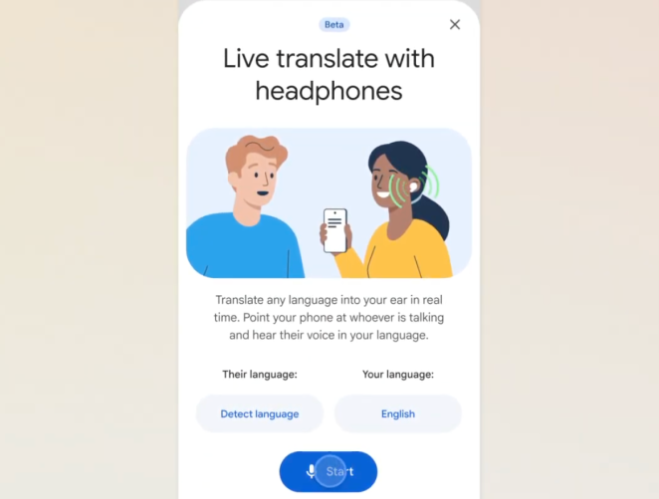
The new beta feature allows users to hear live translations in their headphones. It works inside the Google Translate app, and any pair of headphones can be used.
To start, users open the app and tap ‘Live Translate’. The app listens to spoken language and plays a Live translation in the user’s preferred language.
Google says the experience preserves tone, emphasis, and cadence. This helps users follow conversations more easily. It also makes it easy to identify the speaker.
The feature functions as a one-way translation tool. Users listen to translated speech while the original speaker talks naturally.
Rose Yao, Vice President of Product Management for Search Verticals at Google, said the feature is designed for everyday situations.
These include conversations abroad, listening to lectures, and watching foreign TV shows or films.
Availability
The real-time headphone translation feature is rolling out now in beta. It is available in the Google Translate app on Android.
The rollout currently covers the United States, Mexico, and India. The feature supports more than 70 languages.
Google plans to expand the feature further as support for iOS and additional countries is scheduled for 2026.
No special hardware is required. The feature works with standard wired and wireless headphones.
Accuracy
Google is also integrating advanced Gemini capabilities into Google Translate. These upgrades focus on improving accuracy and context.
The updated system delivers smarter translations. It handles nuanced phrases more effectively. This includes slang, idioms, and regional expressions.
For example, English idioms such as “stealing my thunder” are no longer translated word-for-word. Instead, Gemini analyzes context to convey the intended meaning.
This results in translations that sound more natural. It also reduces confusion caused by literal phrasing.
This Gemini-powered update is rolling out now in the United States and India to provide translations between English and nearly 20 languages.
These include Spanish, Arabic, Chinese, Japanese, and German. The update is available across Android, iOS, and the web.
Also read: Disney Accuses Google of Massive AI Copyright Infringement
Language Learning Tools
Google is also expanding its language learning features within the Translate app.
These tools are now available in nearly 20 additional countries. Newly supported regions include Germany, India, Sweden, and Taiwan.
More language pairings are also being introduced. English speakers can now practice German.
Speakers of Bengali, Mandarin Chinese (Simplified), Dutch, German, Hindi, Italian, Romanian, and Swedish can practice English.
The app now provides improved feedback during speaking practice. Users receive helpful tips based on how they speak. This allows learners to adjust and improve more efficiently.
Google has also added a streak tracking feature. Users can now see how many days in a row they have practiced. This makes it easier to track progress and stay consistent.
The addition brings Google Translate closer to dedicated language learning apps. However, the tools remain integrated within a translation platform.
