
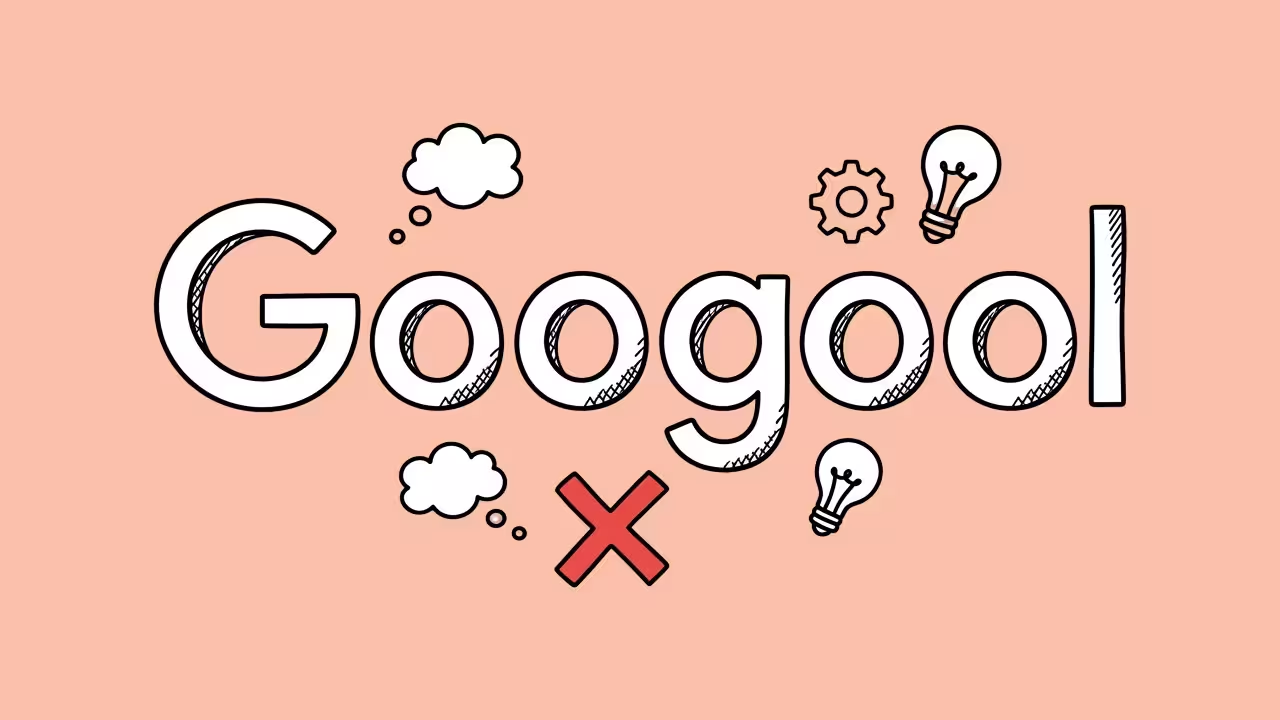

Google can map every street in the world, translate 133 languages in real time, and answer questions that once took hours of research.
But ask it how many Ps are in its own name? It gets the answer wrong.
That’s the strange reality facing one of the world’s most powerful technology companies right now.
Google’s AI Overview feature, the AI-generated summaries that now appear at the top of search results, has been caught making embarrassingly basic spelling mistakes.
And the reason why is fascinating.
The Blunders
According to Google’s own AI, the word “Google” contains two Ps. There is also, apparently, “exactly 1 ‘r’ in the word ‘poop.'”
And the word “journalism”? The AI spelled it out as j-o-u-r-n-a-d-i-s-m.
To be fair, the AI did get one thing right. It correctly identified that there is one P in the last name of the U.S. president. It just spelled that name as t-r-p-u-m.
AI Stumble
When Google first rolled out AI Overviews, the results were immediately chaotic. The feature cited satirical posts from The Onion.
It pulled advice from Reddit threads and presented them as facts. One infamous example suggested that people eat rocks.
Another recommended putting glue on the pizza to keep the cheese from sliding off. Google patched those problems. But the spelling errors have kept coming.
Just last week, searching the word “disregard” triggered what looked like a dictionary entry, except the definition read:
“Understood. Let me know whenever you have a new prompt or question!”
That response appears to be a fragment of an AI instruction prompt that accidentally surfaced in the results. Google fixed it quickly.
The spelling issues, though, are proving much harder to correct.
Why Can’t AI Spell?
AI doesn’t read the way you do. When you look at the word “Google,” your brain sees five individual letters. You know instinctively that there’s one G, two O’s, one L, and one E.
That’s so obvious it feels automatic. AI doesn’t work that way at all; many large language models, the kind powering Google’s AI Overview, ChatGPT, and others, are built on something called transformer architecture.
Instead of reading text letter by letter, these models break language down into units called tokens.
A token might be a full word, or a syllable, or just a few letters grouped together. It depends on the model.
From there, the AI converts those tokens into long strings of numbers. It processes those numbers to figure out what response makes the most sense.
But it never actually “sees” individual letters the way a human does.
“When it sees the word ‘the,’ it has this one encoding of what ‘the’ means, but it does not know about ‘T,’ ‘H,’ ‘E,'” Matthew Guzdial, an AI researcher and assistant professor at the University of Alberta, explained.
So when you ask AI how many letters are in a word, you’re essentially asking it to do something it was never designed to do.
Strawberry Test
There’s an unofficial tradition in AI circles. Whenever a company unveils a shiny new language model, someone always asks it: “How many R’s are in the word strawberry?”
The answer, of course, is three.
Most AI models get it wrong. They say two.
The reason is exactly what Guzdial described above. The word “strawberry” might be tokenized in a way that splits or groups those letters differently than you’d expect.
The model counts based on its numerical representation of the word, not based on the actual letters themselves.
Google acknowledged the problem in a statement: “Counting within words has been a known challenge for LLMs, and we’re working to fix this particular issue.”
But, they didn’t say how.
Also read: AI Search Is Rewriting SEO—What Still Moves Rankings in 2026
Can Anyone Actually Fix This?
That’s the million-dollar question, or rather, a trillion-dollar one, given what’s at stake for the search industry.
Researchers are not optimistic; the problem runs deeper than a simple bug fix.
“It’s kind of hard to get around the question of what exactly a ‘word’ should be for a language model,” said Sheridan Feucht, a PhD student studying large language model interpretability at Northeastern University. “
And even if we got human experts to agree on a perfect token vocabulary, models would probably still find it useful to ‘chunk’ things even further.”
In other words, even a perfect tokenizer, if such a thing were possible, might not fully solve the spelling problem.
The architecture itself creates a kind of fuzziness around letters and words that’s hard to eliminate entirely.
That said, spelling isn’t exactly the main point of these systems. AI models can write code, analyze legal documents, summarize research papers, and explain complex science in plain language.
Counting letters in a word is, by comparison, a pretty niche skill.
None of this seems to be slowing Google down. The company is doubling down on its commitment to make generative AI the centerpiece of Search: its 29-year-old flagship product.
The AI Overview feature is now front and center for hundreds of millions of users every day.
Search is how Google makes most of its money. And users who lose trust in search results, especially after being told to eat rocks or given misspelled nonsense, may start looking elsewhere.
