


IBM has launched a new consulting service aimed at helping enterprises scale agentic AI with greater speed and control.
The service, called IBM Enterprise Advantage, was announced on January 19, 2026. The offering combines IBM’s consulting expertise with proven AI tools.
Together, they help organizations build, govern, and operate internal AI platforms at scale through rogue execution, not just experimentation.
The AI Scale Problem
Many organizations invest heavily in AI. However, few achieve results on the enterprise level.
Projects often stall after early pilots, governance gaps appear, and sometimes, systems fail to connect.
Enterprise Advantage is designed to close this gap. It helps companies redesign workflows and also connects AI tools to existing systems.
Most importantly, it enables AI applications to scale across teams and functions.
Existing Technology
IBM has positioned the service to work within current environments. Organizations do not need to replace their cloud providers or switch AI models. Core infrastructure remains unchanged.
As a result, companies can continue using platforms such as Amazon Web Services, Google Cloud, Microsoft Azure, and IBM WatsonX.
Both open- and closed-source models are supported, which protects prior investments and reduces disruption.
The Architecture
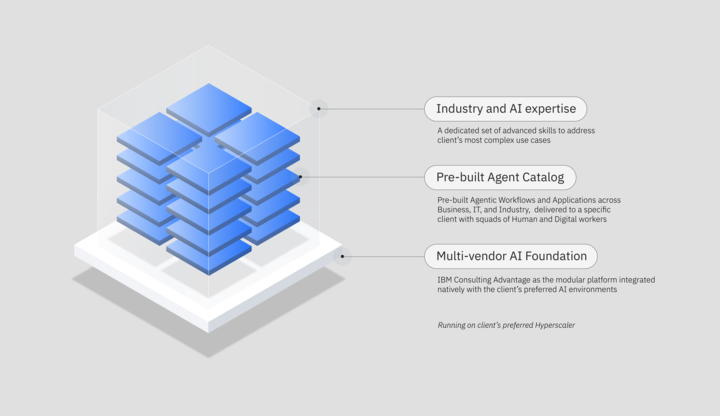
Enterprise Advantage is based on IBM Consulting Advantage. This is IBM’s internal AI-powered delivery platform.
IBM has already applied this platform in more than 150 client engagements. Internally, it has helped increase consultant productivity by up to 50%.
These gains came from standardized processes, reusable AI assets, and strong governance controls. Now, IBM is extending these same capabilities to its clients.
Built-In Governance
AI programs often fail due to fragmentation. Different teams adopt different tools, and therefore, standards vary, which increases the risk of failure.
Enterprise Advantage introduces a shared platform model. It includes common standards, secured environments, and reusable AI components.
As a result, organizations can deploy AI faster while maintaining oversight. Over time, this structure supports expansion without added complexity.
Practical Impact
Several organizations are already using the service. Pearson, a global learning company, is building a custom AI platform with Enterprise Advantage.
The system combines human expertise with agentic assistants. Together, they support daily work and decision-making.
In another case, a manufacturing company used the service to implement its generative AI strategy.
The process began with identifying high-value use cases. Targeted prototypes followed, and leadership alignment came next.
Today, the company is deploying AI assistants across the organization. These tools operate in a secure, governed environment. The platform also supports future expansion.
IBM’s Perspective
According to Mohamad Ali, Senior Vice President and Head of IBM Consulting, the issue is not interest in AI. Scale is.
IBM faced similar challenges internally. Over time, it developed a repeatable framework that delivered measurable results. That framework now underpins Enterprise Advantage.
By combining people, processes, and ready-to-use AI assets, IBM aims to help clients scale AI with confidence.
