
Every marketing team is trying to add AI to their stack right now. There are AI-written emails, AI-scored loyalty tiers, AI-flagged reviews. But a model can’t act on data it was never shown. A model that only sees reviews can only ever be a reviews model. A model that sees the entire customer journey can act on it.
Fragmented stacks bolt AI features onto individual point tools like Yotpo, while consolidated, all-in-one platforms like Maestra build AI on top of one shared customer dataset from the start. Both can put “AI-powered” on a feature list, but only one gives that AI enough context to act on the full customer journey.
This article details what “AI-native” really means versus “AI with a chatbot bolted on.” It also details why more e-commerce brands are considering Yotpo alternatives that were built AI-first around a single data layer.
How a Fragmented Marketing Stack Limits What AI Can Do
A fragmented setup runs on separate dashboards that don’t talk to each other: Yotpo for reviews and loyalty, a separate ESP for email, another tool for SMS, all stitched together with integrations and manual syncing. Every AI feature living inside one of these tools is boxed in by whatever data that tool happens to collect.
The AI powering your loyalty feature can’t personalize a reward offer based on email engagement it never sees. Nor can the AI scoring your reviews factor in a customer’s browsing behavior or cart abandonment history; that data lives in a different system entirely. Each tool’s “smart” feature only ever sees its own slice of the customer: a partial, often stale picture.
There are blind spots by design. Any AI model scoped to one channel’s data can’t reason across channels; it doesn’t know what it wasn’t given. A model trained only on reviews doesn’t just underperform outside that lane; it has no way of knowing a lane exists. That means a “smart” recommendation engine can miss that a customer already complained about shipping delays in an SMS thread it never had access to.
That blind spot compounds into a second problem: no shared signal. Without a singular, unifying dataset, one tool’s AI can’t inform another’s; a loyalty insight never reaches the email-send-time model, and vice versa.
And then there’s the operational cost: manual glue instead of live inference. Synchrony becomes an aftereffect rather than something built into the system, so teams end up exporting and re-importing data between tools just to approximate what a unified model would do automatically. The more data relocation steps there are, the higher the chances of human error.
Of the three limits here, this is the one that costs teams the most time day-to-day. Blind spots and disconnected signals are structural, but manual glue is the one marketers have to personally babysit every week.
In my opinion, this is the most underestimated cost of a fragmented stack: on one project, it would take two people roughly six hours a week manually re-exporting data into other systems just to keep segments current.
Why Businesses Choose an AI-Native, Consolidated Marketing Stack
A consolidated platform changes the starting point. AI features do not sit on top of separate databases; rather, every channel (email, SMS, on-site personalization, pricing, loyalty) reads from and writes to one customer dataset.
That means the AI making a send-time decision for email and the AI deciding a loyalty reward are working from the exact same data signals, synced live. This is the core difference between AI-native and bolted-on AI.
An AI-native system is all about sharing a brain. That means every AI decision, offer, message, price, and timing draws from one consistent view of each customer. Model outputs from one channel become inputs for another in a continued loop, instead of staying trapped in a silo. There is no need for manual reconciliation just to give AI models the context they need to be accurate.
Maestra: An AI-Native Marketing System
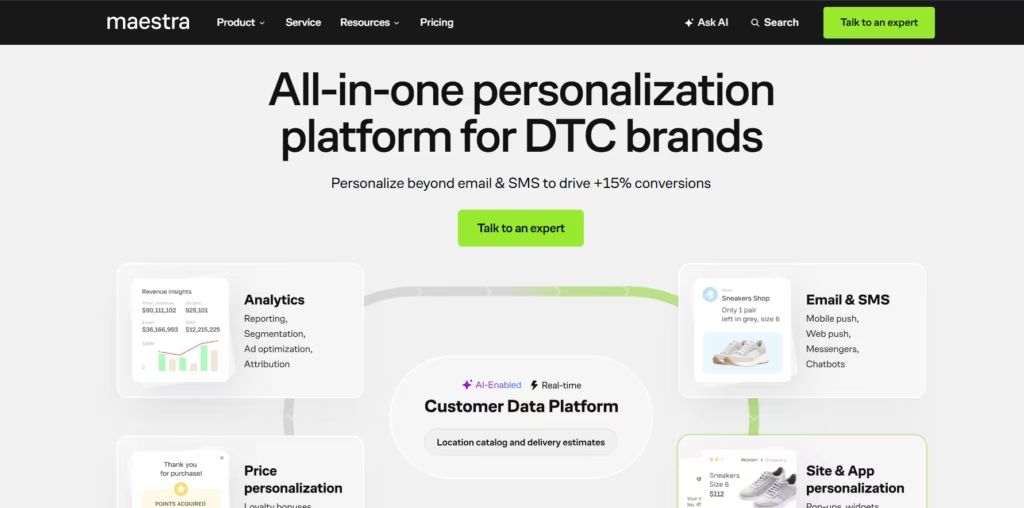
Maestra is built around a single live customer dataset; segmentation can combine loyalty tier, browsing recency, and channel engagement into a single rule, and customization lets teams edit referral, review, and loyalty workflows without opening a support ticket for every change.
The builder is powerful, but it has a steeper learning curve than Yotpo’s one-click widgets. So, expect to spend time upfront to get it right. Because the data isn’t fragmented, the AI running on top of it isn’t either: brands don’t need to bolt a separate AI tool onto a small-scale system like Yotpo to get intelligent personalization, and that shows up in four concrete ways:
1. AI Response Timing
Because Maestra’s models see SMS, email, product browsing, and purchase history together, they can decide not just what to say, but when and where to say it. A bolted-on AI tool watching only one channel can optimize wording; an AI-native platform watching every channel can optimize timing and channel too, based on the customer’s behavior across the whole journey.
2. Loyalty and Segmentation
Here’s a failure mode most teams never diagnose: a loyalty tool bumps a customer’s tier while a marketing tool, unaware, sends them a discount for something they’d already redeemed with points. That’s two systems guessing independently, quietly eroding trust in whatever AI sits on top of them.
Maestra avoids it by keeping loyalty status and behavioral segments in the same dataset, so its AI can adjust rewards and offers the moment a customer’s segment changes. There are no manual exports or lag between systems.
3. Model Tuning
Even a fully AI-native setup still needs tuning against real data to perform well. Maestra pairs consolidation with a dedicated support member who helps configure segmentation logic, personalization rules, and migration from existing systems, so both new and experienced marketers get to accurate output faster than guessing at model behavior alone.
4. Lower Costs
Where’s the real cost of a fragmented AI stack? Not in the sticker price. Separate AI systems for loyalty, UGC, or personalization can look cheap individually, but each add-on requires separate integration work and separate data pipelines just to make its AI features function at all. Consolidating onto one dataset removes that duplicated integration cost, because there’s only one model context to maintain instead of several disjointed ones.
Yotpo vs. Maestra
If I’m being blunt about it: Maestra is the better platform for stores building full-funnel AI. Yotpo still has a place, but only for a narrower job: a store that mainly wants an AI system focused on reviews and trust signals, plus visibility tracking in AI shopping engines, and that has the bandwidth to stitch review data into broader marketing decisions manually.
Everywhere else, Maestra wins the comparison. Yotpo’s AI is niched down to reviews and visibility tracking, while Maestra’s models draw on unified data from every channel, so decisions in one area reflect what’s happening everywhere else.
Maestra also bundles dedicated support for integrations and troubleshooting, runs loyalty, rewards, and discount logic on the same data as every other channel, and gives one consolidated view of customer data with nothing to reconcile manually.
Moving Forward
Before it’s a features question, AI performance is a data question. An AI feature bolted onto a single-purpose tool can only ever be as smart as the slice of data that tool holds. That’s the difference between Maestra and Yotpo: not which one has more AI branding, but which one gives its AI a full picture of the customer. In my opinion, teams are better off with Maestra than fragmented AI like Yotpo.
