

Five million people now use Codex every week. One in five of them isn’t a developer. And that second group is growing three times faster than the first.
That’s the stat OpenAI led with on Tuesday when it dropped a batch of enterprise features designed to turn its coding agent into something much broader – a work platform for analysts, designers, salespeople, and bankers.
The company also published an internal report documenting how Codex is being used for knowledge work, and the findings clearly shaped what got built next.
Six Plugins for Six Jobs
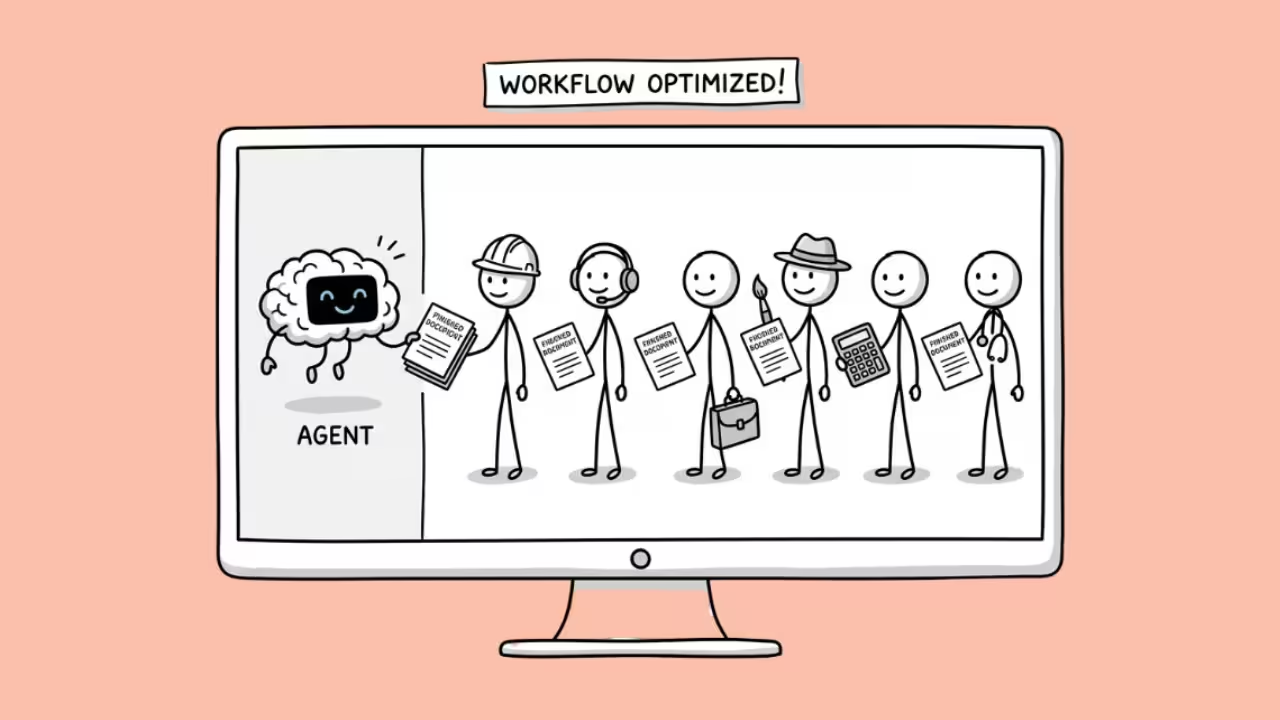
The centerpiece is a set of role-specific plugins -prepackaged bundles of apps, instructions, and workflows aimed at specific professions.
The initial six cover data analytics, creative production, sales, product design, equity investing, and investment banking. Collectively, they pull together 62 enterprise apps and 110 automated skills out of the box – tools like Snowflake, Figma, Salesforce, Tableau, and Databricks.
OpenAI says more are coming. Corporate finance, private equity, marketing strategy, strategy consulting, and legal are all on the roadmap. The end goal is an open ecosystem where partners build and deploy their own plugins directly inside Codex and ChatGPT.
Each plugin works immediately without heavy setup, though they’ll sharpen with customization. Think of them as starter kits – a financial analyst gets connected data tools and report-building skills from day one, then tunes things as they go.
Sites Turn Codex Output Into Shareable Apps
The other major launch is Sites. Instead of Codex spitting out a local file you have to share manually, it can now publish its work as a hosted interactive website with a shareable URL. A dashboard. An internal tool. A client-facing prototype. Whatever the task calls for.
OpenAI is partnering with Wix, Base44, Replit, Lovable, Figma, and Emergent to power the feature, with plans to expand the ecosystem. Sites is rolling out in preview for Business and Enterprise plans first.
There’s also a new Annotations feature. It lets you highlight a specific section of a document or file and give Codex instructions about just that piece – no more hoping the AI figures out which paragraph you’re talking about.
Catching Up to Anthropic
OpenAI is playing from behind here, and they know it.
Anthropic launched its enterprise agents program in February with similar profession-specific tooling. Finance-focused agents followed in May.
Claude Code and Cowork have been pulling in knowledge workers aggressively, and Reuters reported in April that pressure from Anthropic led OpenAI to redirect resources toward Codex and enterprise tools.
OpenAI only added plugin support to Codex in March. Four months late is a lot in this market.
The timing of Tuesday’s announcement is also interesting. It landed right as Microsoft – OpenAI’s biggest investor and increasingly its competitor – kicked off its annual BUILD developer conference, where competing enterprise tools are expected.
The $4 Billion Bet Behind It
This push isn’t isolated. Three weeks ago, OpenAI launched the OpenAI Deployment Company – a joint venture backed by more than $4 billion from global investment firms. Its whole purpose is getting OpenAI tools embedded deeper into how businesses actually work.
“AI is becoming capable of doing increasingly meaningful work inside organizations,” chief revenue officer Denise Dresser said at that launch. “The challenge now is helping companies integrate these systems into the infrastructure and workflows that power their businesses.”
Tuesday’s features are the follow-through on that promise.
Plugins give Codex job-specific skills. Sites give it a way to deliver finished work. Annotations give users more precise control.
And Codex is coming to the ChatGPT app everywhere in the next few weeks – bringing these capabilities to the hundreds of millions of people who already use ChatGPT but have never opened Codex.
Whether that’s enough to close the gap with Anthropic in the enterprise race depends on execution. But OpenAI isn’t hinting at ambition anymore. It’s building the infrastructure.
