
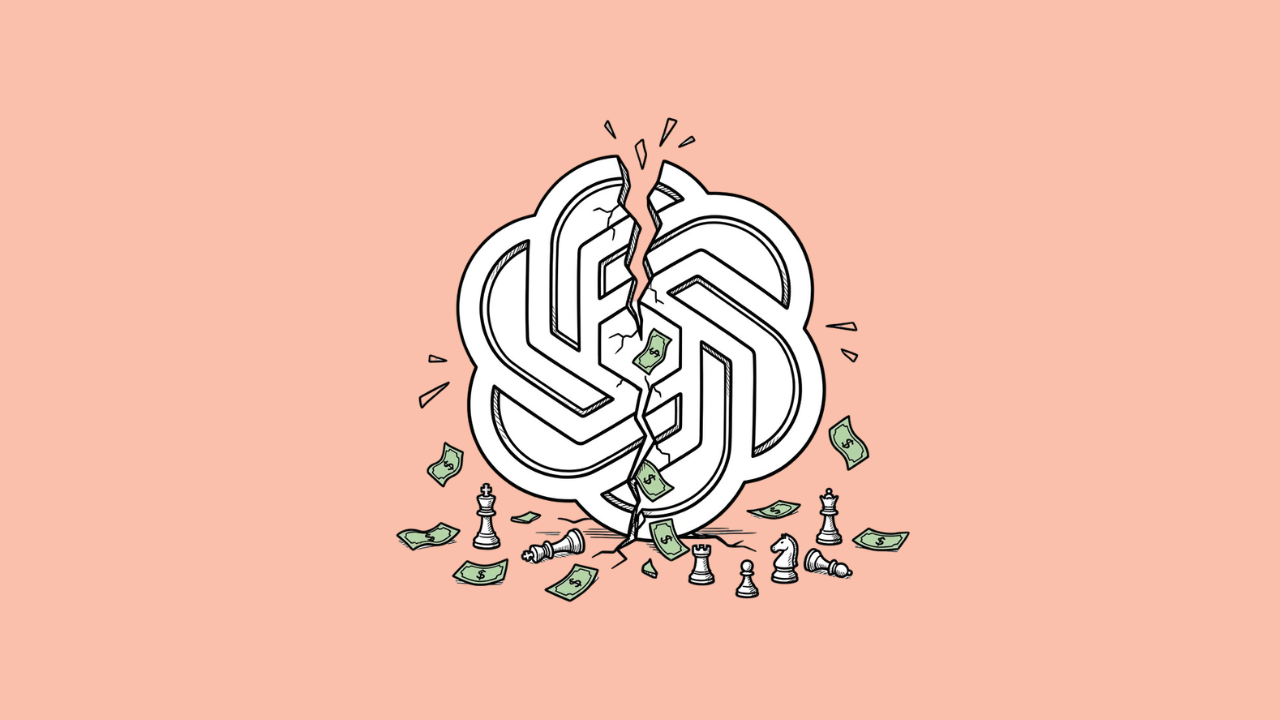

Something feels off at OpenAI right now. The company that made ChatGPT a household name is stumbling. Hard.
Sure, the money keeps rolling in.
OpenAI just closed a jaw-dropping $122 billion funding round. Its valued at $852 billion. An IPO might even happen this year. But look past the flashy numbers, and cracks are showing everywhere.
Let’s break it down.
A Pentagon Deal That Backfired
Earlier this year, OpenAI signed a controversial deal with the Pentagon.
Its rival Anthropic had already turned down the same contract. Why? Concerns about autonomous weapons and mass surveillance.
OpenAI took the deal anyway.
The backlash was swift – both inside and outside the company.
Even CEO Sam Altman admitted the move looked “opportunistic and sloppy.” Not exactly the kind of quote you want on your company’s highlight reel.
Sora Goes Dark – and Takes Disney With It
Remember Sora? OpenAI’s flashy AI video tool? It’s gone now.
OpenAI shut it down in late March 2026 after the economics simply didn’t work out.
Reports suggest the app cost roughly $15 million per day to run. Its total revenue’s about $2.1 million.
That’s like running a lemonade stand that costs $15,000 a day but only earns $2.
Even worse, the shutdown killed a massive partnership with Disney.
The two companies had reportedly been working together just 30 minutes before Disney found out Sora was being shelved.
A planned $1 billion Disney investment deal? Dead on arrival. No money ever changed hands.
| Sora by the Numbers | |
|---|---|
| Peak monthly downloads | 3.3 million (Nov 2025) |
| Downloads by Feb 2026 | 1.1 million (down 66%) |
| Daily inference cost | ~$15 million |
| Total lifetime revenue | ~$2.1 million |
| Disney deal outcome | Collapsed |
“No More Side Quests”
OpenAI’s leadership has been trying to refocus.
Fidji Simo, the company’s CEO of AGI Deployment, reportedly told employees they couldn’t afford to be “distracted by side quests.”
The company is now pivoting hard toward enterprise tools and coding – areas where Anthropic already has a strong foothold.
Other shelved plans include:
- AI-generated romantic chat – OpenAI dropped plans to let users sext with ChatGPT
- The Stargate data center project – the massive $500 billion build-out has reportedly stalled
- Sora integration into ChatGPT – gone with the app’s shutdown
Musical Chairs in the C-Suite
Last Friday brought a wave of leadership changes that raised even more eyebrows.
| Executive | What Happened |
|---|---|
| Fidji Simo | Stepping away for medical leave |
| Greg Brockman | Taking over product and “super app” efforts |
| Kate Rouch (CMO) | Leaving to focus on health |
| Brad Lightcap (COO) | Shifting to “special projects” under Altman |
When multiple top leaders exit or shift roles at the same time, it sends a signal. And that signal isn’t “everything is fine.”
The New Yorker Drops a Bombshell
As if things weren’t messy enough, a deep-dive piece in The New Yorker this week revisited years of reports about Altman.
The story explored claims that he may have misled OpenAI’s board, former executives, and even colleagues from before he co-founded the company.
Is it all true? That’s up for debate. But it’s not a good look when your CEO is the subject of that kind of long-form investigation – especially with an IPO on the horizon.
Elon Musk’s Lawsuit Looms
Later this month, OpenAI heads to court to face co-founder Elon Musk.
His fraud lawsuit alleges that Altman and others steered the company away from its original nonprofit mission. Musk is seeking up to $135 billion in damages.
The trial has already forced the release of internal communications from OpenAI’s early days. Expect more uncomfortable revelations when proceedings begin on April 27 in Oakland.
Buying a Media Company Won’t Fix This
In a move that left many scratching their heads, OpenAI announced it was buying TBPN – a small but buzzy daily tech talk show.
The deal is reportedly valued in the low hundreds of millions.
Why would an AI company buy a podcast?
Simo wrote that TBPN would help OpenAI have a “real, constructive conversation about the changes AI creates.” She also said the “standard communications playbook” doesn’t work for them.
Translation? They know the narrative is slipping away from them.
TBPN will report to Chris Lehane, OpenAI’s chief global affairs officer – a political operative known for shaping narratives. The show’s hosts say they’ll keep editorial independence.
But when your parent company is also the subject of your coverage, that’s a tough promise to keep.
The Money Problem No One Can Ignore
Here’s the elephant in the room. OpenAI is losing money at an almost unbelievable rate.
- The company lost an estimated $12 billion in just one quarter (July–September 2025)
- Total projected losses from 2023 to 2028 could reach $44 billion
- HSBC analysts have said profitability is unlikely before 2030
- OpenAI has committed to roughly $1.4 trillion in infrastructure spending over the coming years
Even CFO Sarah Friar has reportedly expressed concerns that the company isn’t ready to go public as soon as Altman wants.
Altman once sounded patient about profits. At a 2024 event, he said OpenAI was “confident and patient” about becoming very profitable. But by December 2025, he was declaring a “code red” to fight off competitors.
When an investor pressed him about how a company with $13 billion in revenue could justify $1.4 trillion in commitments, Altman snapped back.
He interrupted the host and offered to find him a buyer for his shares. That’s not the reaction of someone who feels comfortable.
Rivals Are Gaining Ground Fast
OpenAI’s market share is shrinking. Its share of the enterprise AI market dropped from about 50% in 2023 to around 27% today, according to Menlo Ventures.
The competition is fierce:
- Anthropic has become the go-to choice for many developers, especially in coding
- Google’s Gemini is deeply baked into the apps millions of people already use every day
- DeepSeek showed the world that competitive AI models don’t need OpenAI-sized budgets
ChatGPT still has massive reach – roughly 900 million weekly active users. But reach alone doesn’t pay the bills. Only about 5% of those users actually pay for a subscription.
So What Happens Next?
OpenAI isn’t dead. Far from it. But the company is juggling more problems at once than at any point in its history.
It’s burning cash. Its leadership is in flux. Rivals are closing in. A major lawsuit is about to go to trial. And the pressure to go public is building every day.
Can Sam Altman pull it all together? Maybe. He’s done it before. But right now, the vibes at OpenAI are about as far from “smooth sailing” as you can get.
The next few months will tell us a lot about whether OpenAI can stay the king of AI – or whether it’s about to be dethroned.
