
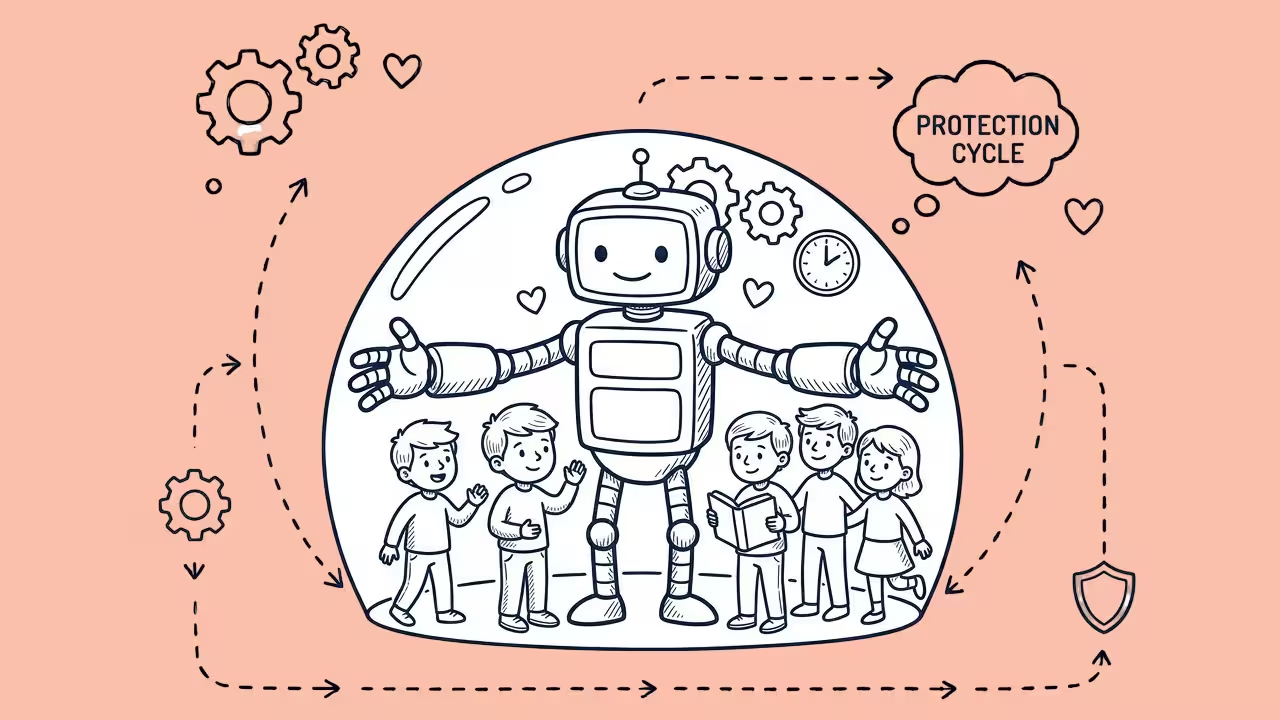

Child safety online has never been more urgent. And now, one of the biggest names in AI is stepping up with a Child Safety Blueprint, released on Tuesday, April 8, 2026.
The goal is to fight the alarming rise in AI-generated child sexual abuse material, and to do it faster and smarter than ever before.
The Statistics
Let’s start with the numbers, because they’re hard to ignore. The Internet Watch Foundation (IWF) found more than 8,000 reports of AI-generated child sexual abuse content in just the first half of 2025.
That’s a 14% jump from the year before. Think about that. In six months. Over 8,000 reports.
Criminals are using AI tools to create fake explicit images of children. They’re also using AI to write convincing messages to groom real kids.
OpenAI’s Child Safety Blueprint
The blueprint is a detailed action plan built with some serious partners. OpenAI worked alongside the National Center for Missing and Exploited Children (NCMEC) and the Attorney General Alliance.
North Carolina Attorney General Jeff Jackson and Utah Attorney General Derek Brown also gave feedback during development.
So this wasn’t just a tech company working alone in a room. Real law enforcement and child safety experts helped shape this plan.
The blueprint targets three main areas: First, it pushes for updated laws. Current legislation often doesn’t cover AI-generated abuse material. OpenAI wants that to change.
Second, it calls for better reporting systems. Right now, getting information to law enforcement takes too long. The blueprint aims to fix that and get actionable data to investigators faster.
Third, it wants safety built directly into AI systems. Not as an afterthought. Right into the technology from the start.
The Timing
OpenAI isn’t releasing this blueprint in a vacuum. The company has faced serious scrutiny lately.
Last November, seven lawsuits were filed in California state courts. The Social Media Victims Law Center and the Tech Justice Law Project brought the cases.
They allege that OpenAI released GPT-4o before it was safe. The case mentions four individuals who died by suicide after extended interactions with the chatbot.
Three others experienced severe, life-threatening delusions. The suits argue that the product had a psychologically manipulative nature.
These cases put enormous pressure on OpenAI, and on the entire AI industry, to take user safety more seriously.
Earlier Teen Safety Work
The Child Safety Blueprint isn’t OpenAI’s first move in this space. The company previously updated its guidelines for users under 18 to block the generation of inappropriate content.
They also prevent the AI from encouraging self-harm or giving advice that helps young people hide unsafe behavior from parents or caregivers.
OpenAI also recently released a dedicated safety blueprint for teens in India. The new U.S.-focused blueprint builds on that momentum.
