

OpenAI just made a bold move for developers who live on macOS.
The company has launched a brand-new desktop app for Codex, its AI coding tool, with a strong focus on agentic workflows.
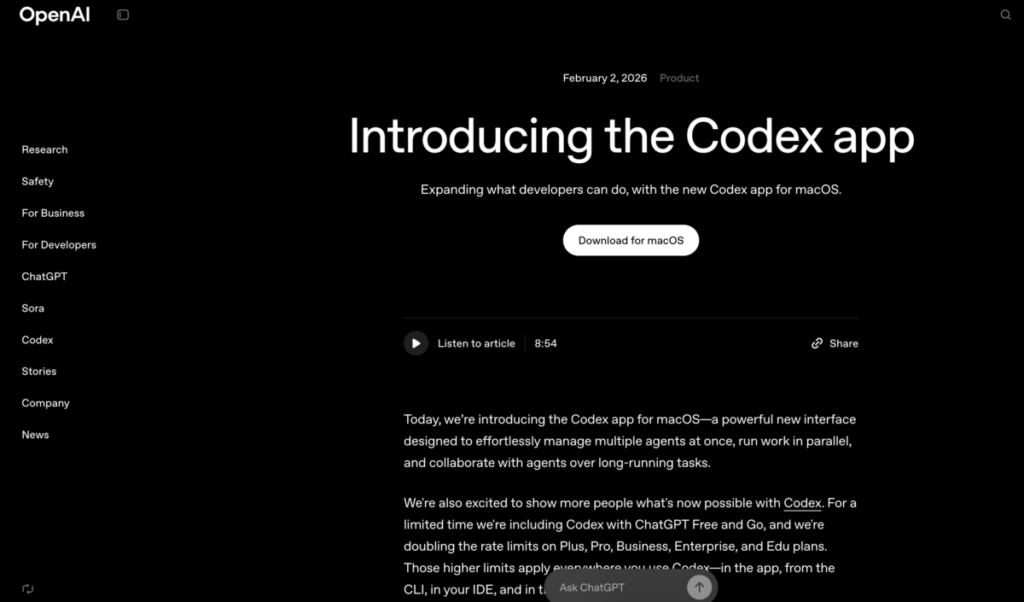
In simple terms, this app lets multiple AI agents work on coding tasks at the same time. Less busywork. More momentum.
Why Agentic Coding Is Taking Over
Coding no longer looks the way it did a few years ago.
Today, many developers rely on AI agents to:
- Write boilerplate code
- Refactor messy files
- Debug stubborn errors
- Test features in the background
Tools like Claude Code and Cowork pushed this shift forward. They showed what happens when AI doesn’t just assist, but acts.
OpenAI has been watching closely.
Codex’s Journey So Far
Codex didn’t start as a polished app. Here’s how it evolved:
| Timeline | What Changed |
|---|---|
| April (last year) | Codex launched as a command-line tool |
| One month later | A web interface followed |
| Now | A full macOS app with agentic features |
This new app is OpenAI’s clearest signal yet that it wants to compete head-on in agentic development.
What the New macOS Codex App Can Do
The macOS app brings several upgrades developers have been asking for.
Parallel Agents, Working Together
Instead of one AI doing one task, Codex can now run multiple agents at once. Each agent handles a different part of the job.
Think of it like a small dev team that never gets tired.
Background Automations
You can schedule tasks to run while you step away.
For example:
- Run tests every night
- Scan code for bugs every morning
- Generate reports while you’re in meetings
Results wait in a queue when you return.
Pick an Agent Personality
This one’s subtle but interesting.
Users can choose how the agent behaves:
- Pragmatic and direct
- Calm and empathetic
It’s a small touch, but it changes how work feels.
Powered by GPT-5.2-Codex
The app is built around GPT-5.2-Codex, OpenAI’s most powerful coding model to date.
During a press call, Sam Altman didn’t hold back.
He said the model shines on complex work, but admitted it hasn’t always been easy to use. The macOS app aims to fix that by pairing raw power with a more flexible interface.
In his words, speed is the real win.
What the Benchmarks Actually Say
Benchmarks tell a mixed story.
On TerminalBench, GPT-5.2-Codex currently ranks first. That test measures command-line programming skill.
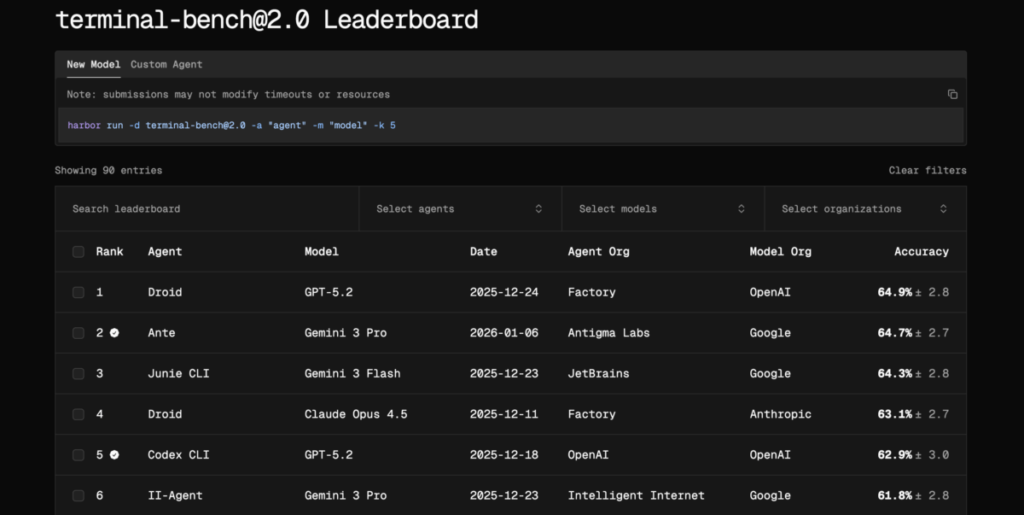
But the gap isn’t huge.
Agents from Gemini 3 and Claude Opus post similar scores, often within the margin of error.
SWE-bench, which tests real-world bug fixes, also shows no clear winner.
So what matters more than scores?
User experience.
Agentic systems are hard to measure, and small differences in workflow can feel massive in daily use.
Speed Is the Real Selling Point
OpenAI keeps coming back to one idea: speed.
Altman claims developers can now go from a blank file to a solid piece of software in just hours. The only real limit? How fast you can type ideas.
If you’ve ever stayed up late chasing momentum, you get why this matters.
How This Stacks Up Against Claude Tools
Does this mean Codex beats Claude tools?
Not exactly.
Claude apps still shine in:
- Long-form reasoning
- Collaborative workflows
- Polished user experience
Codex is betting on raw build speed and deep automation.
Different tools. Different strengths. And for developers, that choice is a good thing.
What This Means for Developers
If you code on a Mac, this release matters.
It signals:
- More competition in agentic coding
- Faster iteration cycles
- Less manual work
Most of all, it shows how fast AI-powered development is evolving.
Last year’s tools already feel old. And that tells you everything.
