
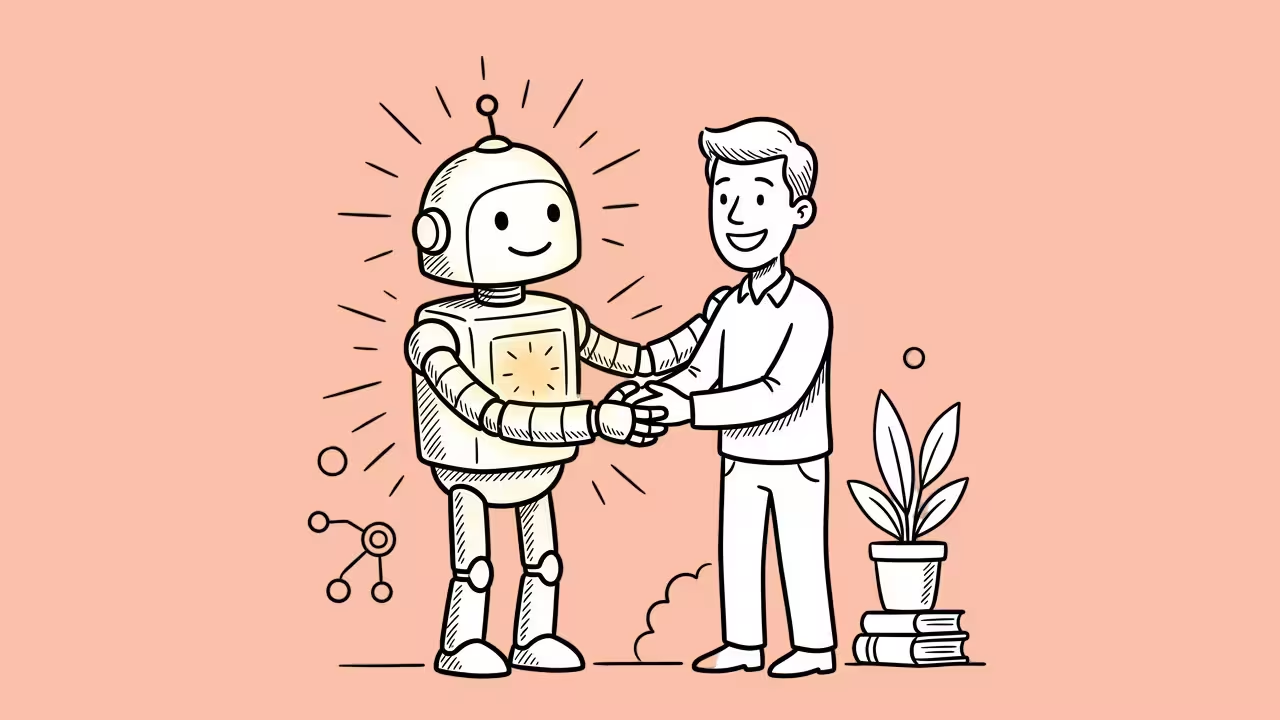
Something strange happened when a startup launched its new website
The landing page looked clean. Responsive. Loaded in under two seconds. It was built in forty minutes using an AI website generator – no designer involved, no agency briefed, no creative director consulted. And yet – something felt off. Visitors scrolled. Some clicked. Most left. The site was technically flawless and emotionally inert.
That tension – between what AI can now execute and what humans still need to feel – is at the heart of every web design conversation in 2026. AI-powered web design tools have genuinely changed the industry. But “changed” isn’t the same as “replaced.”
What AI can actually do in web design now (and it’s a lot)
There’s no point sugarcoating this: AI tools have become remarkably capable. Framer AI, Wix ADI, and Uizard can generate full responsive layouts from a short text prompt. GitHub Copilot accelerates front-end code so fast that junior developers can ship in hours what used to take days. Adobe Firefly handles hero images and visual assets from a single prompt. Tools like Hotjar and Microsoft Clarity now use AI-driven UX analysis to cluster session data, flag friction points, and suggest layout adjustments – automatically.
The numbers back this up. According to a 2026 DesignRush report, more than 81% of developers report increased productivity when using AI tools in their workflows. Separately, data from WifiTalents shows that 74% of web designers actively use AI for automated layout suggestions and coding tasks. Generative AI reportedly cuts preliminary design discovery time by as much as 70%.
Those are not marginal gains. That’s a workflow transformation. For startups needing an MVP site by Friday, for e-commerce brands testing landing pages weekly, for content sites that churn out dozens of pages a month – AI website builders make perfect economic sense.
So where’s the catch?
Where AI still stumbles – and why it matters for your brand
Here’s an uncomfortable fact: algorithms don’t understand embarrassment. They don’t know that a particular shade of red felt authoritative in 2019 and now reads as cheap. They can’t sense that a client’s brand voice is quietly irreverent in a way that a boilerplate tone setting won’t capture. They don’t have the conversation at 11am on a Tuesday where a founder says “actually, we don’t want to look like our competitors at all.”
Nielsen Norman Group noted in mid-2025 that while generative tools speed up tasks like asset generation and copy refinement, they still cannot replicate the insight that experienced human designers bring to complex user problems. John Maeda, well known for his Design in Tech reports, puts it plainly: AI transforms how design gets done – it doesn’t replace the creative judgment behind it.
The data on consumer perception is interesting here too. Research from PwC found that 52% of consumers stopped using a brand entirely after a single bad experience – and a significant share of bad experiences trace back to design that felt generic, confusing, or misaligned with expectations. Good UX design isn’t just about layout logic. It’s about trust signals, brand alignment, and the small moments – micro-interactions, typographic choices, whitespace breathing room – that only experienced humans currently calibrate well.
Consider what AI still struggles with in web projects:
- Brand strategy integration: aligning visual decisions with long-term market positioning
- Client interpretation: translating ambiguous briefs into design that actually fits
- Accessibility nuance: going beyond automated checks to ensure truly inclusive experiences
- Emotional resonance: the feeling a homepage gives someone in the first three seconds
- Original creative concepting: ideas that don’t look like the average of everything AI has trained on
By 2030, an estimated 80% of technical web design tasks will be automated or AI-assisted – but 100% of strategic creative direction will still require human expertise. That split matters enormously for anyone deciding how to build something, not just whether to build it fast.
How the best agencies use AI – without losing what makes them irreplaceable
Here’s where it gets genuinely interesting. The most capable design teams in 2026 aren’t choosing between AI and human creativity. They’re using AI as leverage – to compress timelines on the work that doesn’t need a senior designer’s attention, so senior designers can spend more time on the work that does.
A useful analogy: AI handles the scaffolding; humans design the experience inside it.
Practically speaking, this looks like:
- Using Figma’s Make to generate functional prototypes in minutes, then spending more time on user testing
- Running AI heatmap analysis to identify friction before the first revision round
- Generating multiple layout variations with generative design tools and curating the best candidate for human refinement
- Automating image compression, SEO metadata, and responsive formatting while focusing human effort on narrative and conversion logic
Agencies that have mastered this hybrid workflow produce faster, sharper, and more cost-efficient work than those operating either end of the spectrum alone. When evaluating who those agencies actually are, resources like the Clay ranking of best web design agencies offer a useful signal – many of the top firms listed there are precisely the kind of studios that have embedded AI into their process without sacrificing the creative direction that justifies their reputation.
That distinction – between AI-augmented craft and AI-replaced thinking – is what separates a website that converts from one that merely exists.
The question no AI tool will ask on your behalf
AI can generate a homepage. It cannot ask: What does this brand need to make someone feel in the first ten seconds? It cannot push back when a client’s instinct conflicts with what users actually respond to. It won’t notice that the brief was written for last year’s market position and quietly flag it.
Automated web design tools are productivity multipliers – extraordinary ones, getting better every quarter. But productivity without strategic intent produces a lot of very fast, very forgettable websites. The global AI design market is projected to reach $7.8 billion by 2028. That’s not a signal that human designers are disappearing. It’s a signal that the value of design strategy – the kind that requires conversation, context, and judgment – is about to become more concentrated in the hands of fewer, better-equipped people.
The future of web design isn’t a competition. It’s a workflow. AI sets the pace; humans set the direction. The businesses and brands that understand that distinction in 2026 will build digital experiences that don’t just load fast – they actually land.