
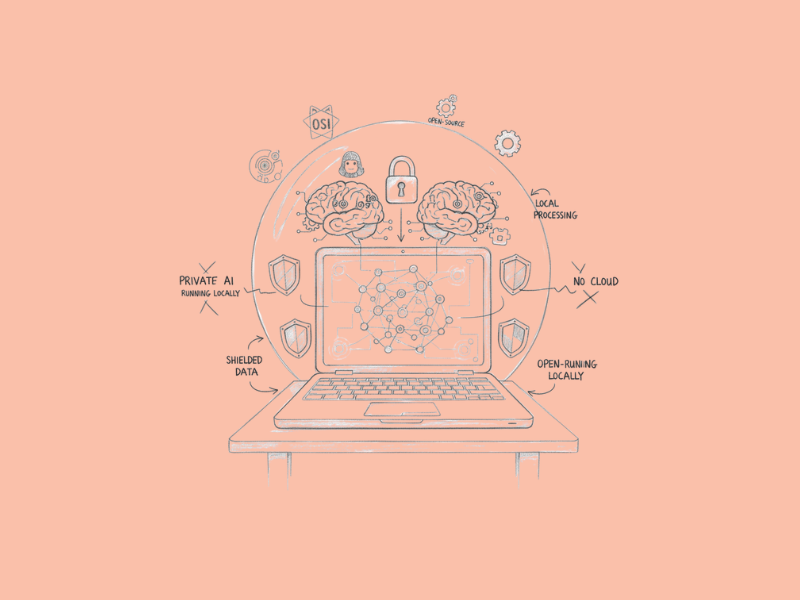

Venice AI is gaining attention for one massive reason: privacy.
While most AI tools log your prompts, store conversations, and quietly train on your ideas, Venice AI takes a very different path.
It is designed to keep your chats and creations secured on your device and not on company servers.
That single decision transforms the narrative.
As the number of privacy scares pile up and censorship complaints get louder, more people are concerned about why an AI remembers everything they say.
Venice AI is an option for people who want intelligent AI tech, but not Big Tech spying on them.
Most mainstream AI platforms feel helpful… until you remember that all of your prompts, ideas, and half-baked thoughts are stored somewhere.
Maybe it is reviewed, maybe it has been used in training or it is accessed across systems, you don’t really know, and that’s the problem.
Venice AI directly attacks that discomfort.
It is a system designed not to store anything remotely by default but instead your prompts stay on your device and your outputs stay with you, unlike other AI tools that send conversations to centralized servers.
With Venice AI, there’s no silent data hoarding or long-term chat history sitting on someone else’s system.
That’s a big deal.
The Increasing Demand for Private AI
People are not switching to private AI because it sounds trendy.
They’re switching because trading convenience for surveillance is starting to feel uncomfortable. Customers are tired of selling their personal data for convenience.
Besides this, censorship has become a growing frustration, most AI responses are highly censored and this may be quite limiting.
Many mainstream AI tools filter responses so heavily that even harmless creative or technical prompts reach a dead end. For writers, developers, and artists especially, those boundaries can feel stifling.
Trust plays a role too. Big Tech hasn’t exactly built a reputation for transparency, and that history makes people wonder how their data is processed in the background.
Venice AI is the solution to this. It provides powerful AI, minimal regulation, and total user control.
Why Venice AI Actually Stands Out
Many AI tools promise privacy and freedom, but once you dig a little deeper, the fine print tells otherwise.
Venice AI stands out because its core features aren’t add-ons or marketing fluff, they shape the core functionality of the tool.
1. Zero Server Storage
The biggest win of Venice AI is how it handles your data.
When you have a conversation with Venice AI, your prompts are not sent to a company server to remain there indefinitely. They remain on your device, encrypted and local.
That means there’s no growing archive of your thoughts, ideas, or experiments living somewhere you can’t see.
This is a relief to those that have become uncomfortable with AI tools storing all their memories. You do not have to worry about the people who will see your ideas, you can discuss sensitive issues, or even simply think aloud and not feel embarrassed about it.
That local-first approach is a big reason Venice AI is still frequently discussed in conversations about private AI options.
2. Fewer Filters
Another reason people tilt towards Venice AI is its use of uncensored open-source models.
You would only need to spend a moment with an AI shutting you down in the middle of your prompt or failing to proceed with a harmless creative idea to understand the appeal this feature gives.
Venice AI doesn’t jump in with blocking or moral lectures. Writers use it to explore darker or more adult themes. Developers use it for technical prompts that other tools won’t touch. Some users simply want straightforward answers without heavy content policing.
3. High Resolution AI Art
Venice AI makes a strong case for itself in image generation.
Instead of heavily restricted outputs or watermarked results, Venice provides high-resolution image creation which can be used.
On the Pro plan, users can generate up to 1,000 images per day, and those images come clean with no logos stamped on them.
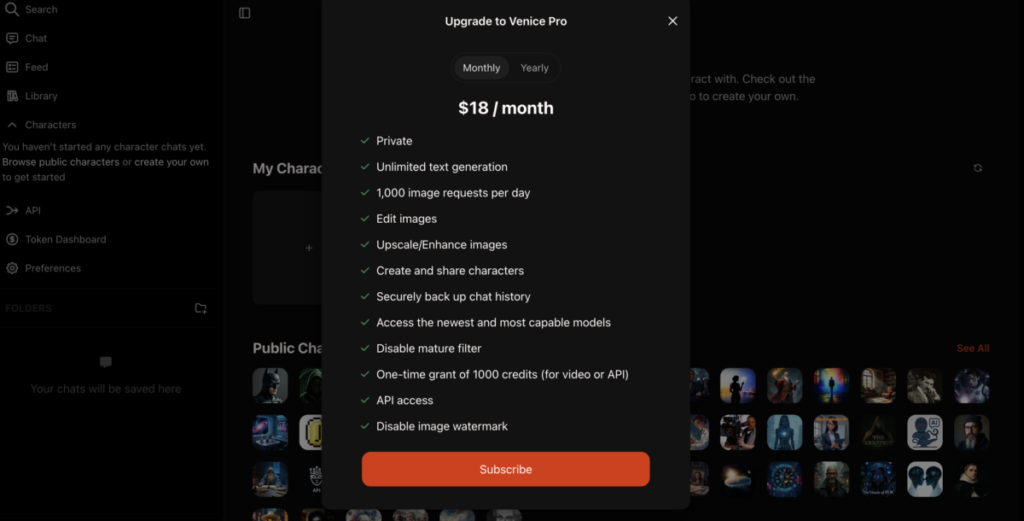
For creatives, that freedom is important. You can experiment, rework, and scrap ideas without feeling like you’re burning through a tiny monthly allowance or creating art you can’t really use.
4. Developer-friendly API
Venice AI is particularly refreshing when you are building with AI.
It has an open and permissionless API, which allows developers to build agents, tools, or full applications without navigating layers of approval or content restrictions.
You get access to powerful models and decide how they’re used.
While many AI APIs feel tightly regulated, the message of Venice is simple: this is a tool that should be built with, and not merely consumed.
What Powers Venice AI
Privacy alone would not have been significant if the AI was weak.
Venice AI uses massive open-source AI models rather than building proprietary models in secret, just the type of models that are used by state-of-the-art research and enterprise applications.
Here’s a quick look at what’s doing the heavy lifting:
| Model | What It’s Used For |
| DeepSeek R1 671B | Complex reasoning, long-form thinking, technical tasks |
| Llama 3.1 405B | Natural conversation, writing, analysis |
| FLUX | High-quality AI image generation |
That lineup puts Venice AI in a high position.
Bottom Line
Venice AI hits a rare sweet spot. It works with strong open-source models, It has a local-first privacy architecture with minimal censorship and low commitment to get started.
And that feeling of wanting room, control, and privacy is exactly why more people are looking at private AI options in the first place.
Is Venice AI for everyone? Probably not.
But for people actively considering private AI alternatives, it makes a compelling case.
