
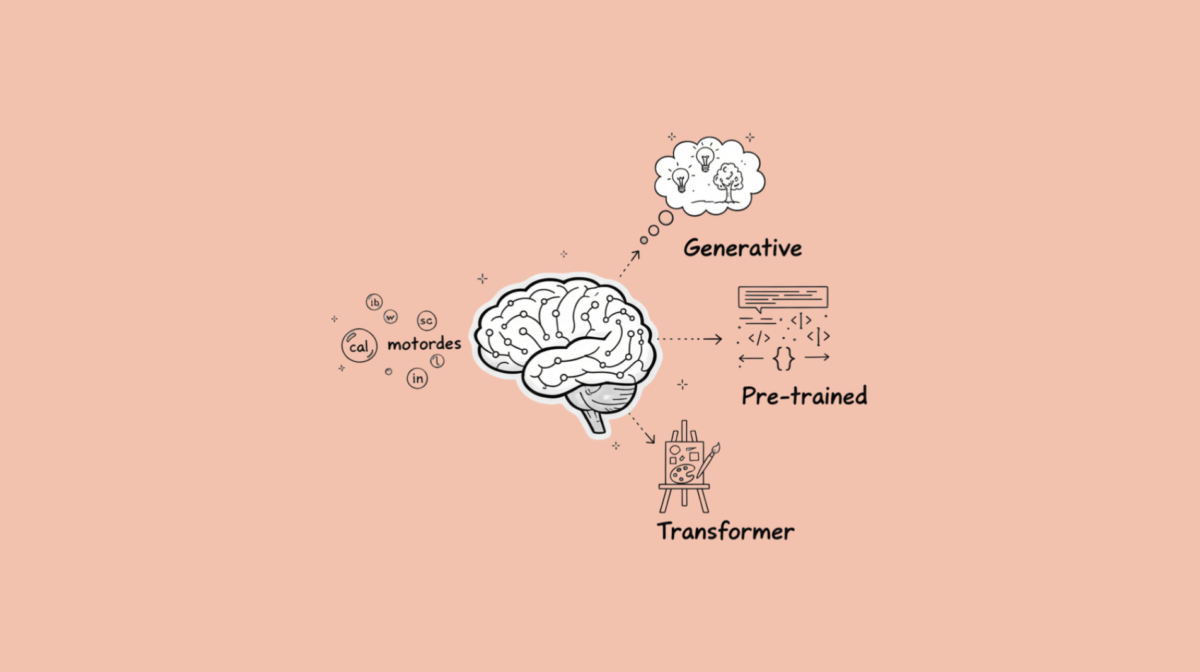
GPT is an acronym for Generative Pre-trained Transformer. It is the engine behind ChatGPT, DALL·E, and numerous other AI tools that are growing exponentially in 2026.
That’s the short answer.
However, getting into the actual story is where things get interesting.
GPT AI did not start flashy. It started as a quiet lab experiment. Researchers were trying to teach machines how to understand language.
Few years later, that same technology now chats like a human, writes essays, generates art, summarizes meetings, and even helps build applications. All in seconds.
In this guide, we’ll break it all down, plain and simple.
What GPT Really Means
GPT AI stands for Generative Pre-trained Transformer. Each word matters. And jointly, they explain why this AI feels smart, fast, and surprisingly human.
Generative: It creates, not copies
Generative means GPT AI doesn’t just pull answers from a database. Every time, it creates new content.
Think of GPT like a DJ.
A DJ does not play the same song over and over. They remix previously heard sounds to come up with something fresh and new. GPT AI works the same way. It takes patterns from language and turns them into novel creations.
This is why GPT can write an email from scratch, draft a poem that has never been seen, and create a product description that didn’t exist five seconds ago.
Nothing is copied verbatim. Everything is generated in real time.
Pre-trained: It studies before it speaks
Before GPT ever chats with you, it learns first.
Pre-trained means that the model is trained on extensive text: books, articles, websites, and public data before it is released to users.
GPT AI learns grammar, facts, tone, and structure. It detects the relationship between words and gets an idea of how humans communicate.
It is then fine-tuned to perform tasks like chatting, writing, or coding. That’s why GPT doesn’t sound clueless when you ask a question.
Transformer: The brain behind the magic
A Transformer is a model architecture created by Google researchers in 2017. GPT took it and pushed it to the next level.
Imagine a robot skimming through an entire sentence at once instead of reading word by word. That’s what a Transformer does. It looks at context, not just individual words.
So when you say:
“That movie was sick.”
The AI understands that you most likely mean amazing, not that the movie needs medical help.
The Transformer allows GPT understand context in real time, draw relationships between ideas spread across long text, and respond fast without losing meaning.
The 3 Key Traits of GPT AI
- Natural human responses – conversations feel natural, not robotic
- Unlimited creativity – writing, ideas, stories, code, art prompts
- Blazing speed – Useful answers in seconds, not minutes
Now that you know what GPT is actually about, the following question is obvious: How did it evolve into the powerhouse we use today?
GPT Timeline
In 2015, OpenAI was an ambitious project by a few tech insiders who believed artificial intelligence could either help humanity or cause a great harm if left unchecked. The goal was to build powerful AI and make sure it benefits everyone.
When GPT-1 quietly arrived in 2018, hardly anyone outside research circles noticed. No flashy product, no viral demos. Only a research paper showing that a Transformer model, trained at scale, could generate readable text.
It wasn’t perfect, it wasn’t chatty, but it worked. It had 117M parameters. And that alone changed the conversation around GPT AI.
A year later, things got interesting.
In 2019, GPT-2 appeared and suddenly, OpenAI had an issue. The model was too good at generating human-like text. It could write articles, stories, and fake content with alarming ease.
OpenAI hesitated. They did not release it fully. Why?
There were real concerns about the fake news, scams, and misinformation taking over the internet.
For the first time, the world saw that GPT AI wasn’t just impressive, it was powerful enough to cause harm.
By 2020, caution met confidence.
GPT-3 dropped, and everything exploded. With 175 billion parameters, it didn’t just generate text, it showed creativity.
Developers built apps overnight, writers experimented, and so many more possibilities were explored.
Following this was the jump from written to the lived.
With GPT-4 and later GPT-4o, GPT AI learned to recognize images, understand voice, and respond in real time. You could speak to it, show it a picture or ask it to reason.
And now, in 2026, we have GPT-5!. At the same time, competitors like xAI’s Grok and other frontier models are pushing hard. GPT AI is not the sole leader in the pack, but it’s still setting the pace.
Bottom Line
GPT stands for Generative Pre-trained Transformer, but in real-world applications, it’s the engine powering today’s AI boom.
It’s not flawless. GPT AI can be confident in its errors, and bad prompts yield bad results.
That’s why humans stay in the loop.
This technology has changed how people work, learn, and build, and it keeps growing in capability.
So next time someone asks what GPT means, you’ll know the acronym and the impact.
