

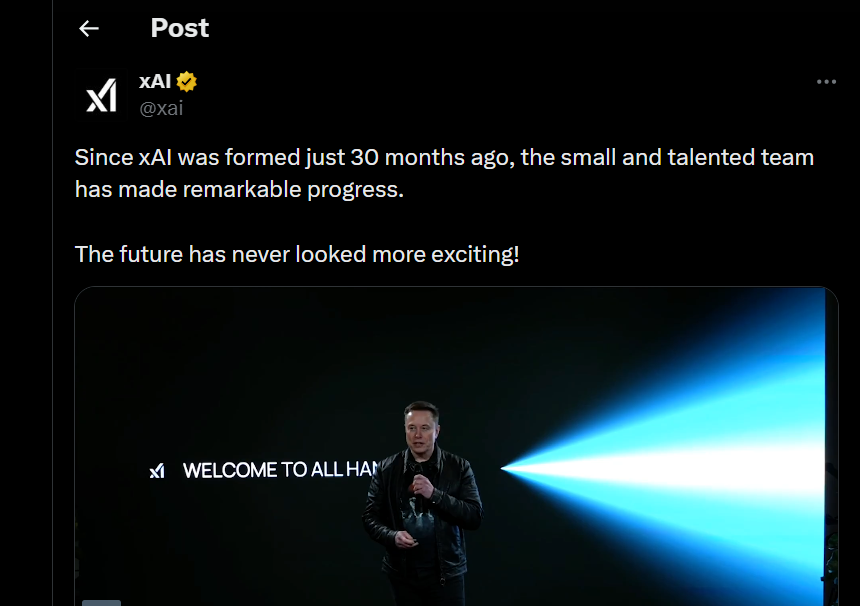
On Wednesday, xAI released a full 45-minute internal all-hands meeting to the public on X.
The meeting took place on Tuesday night, and details had already been reported by The New York Times. That earlier reporting may have influenced xAI’s decision to publish the full video.
Once released, the footage showed how xAI plans to organize its teams. It also detailed its product roadmap and its deep ties to X.
Most notably, it laid out Elon Musk’s long-term vision for artificial intelligence that stretches well beyond Earth.
Major Reorganization
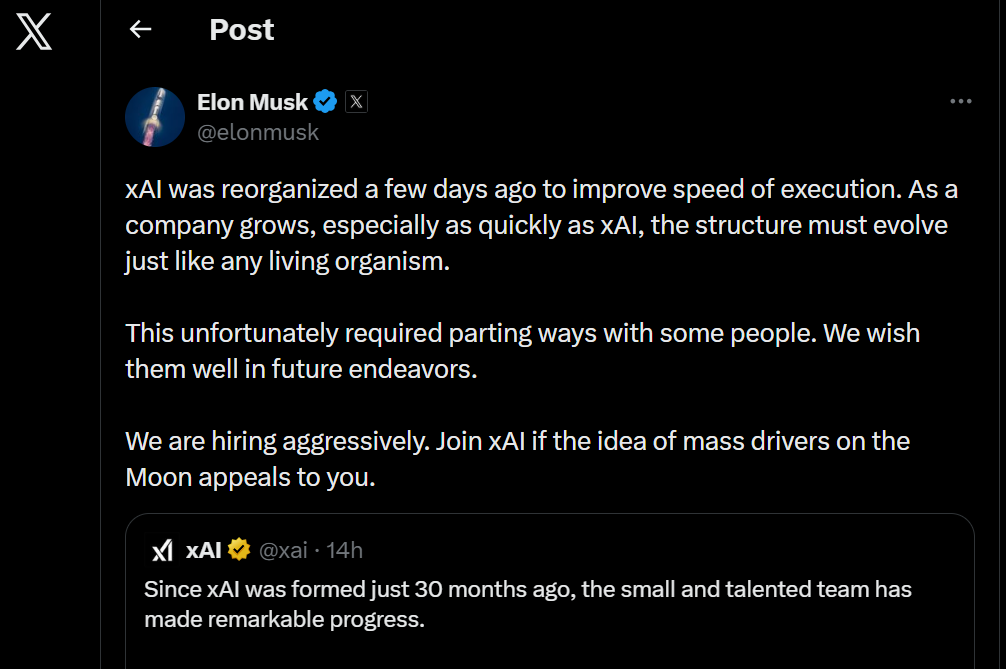
One of the most immediate revelations involved staffing changes. Musk confirmed that xAI has recently laid off a number of employees.
He described the departures as a result of organizational restructuring. According to Musk, the company’s rapid growth required a new structure.
“As a company grows, especially as quickly as xAI, the structure must evolve,” Musk said in a post on X.
He added that the company regretted the outcome but wished former employees well.
However, the nature of the departures stood out. The changes included a significant portion of xAI’s founding team.
While reorganizations are common in fast-growing startups, the scope of these layoffs caused confusion. For an AI lab still defining its identity, the loss of early contributors is notable.
Four Core Teams
Under the new system, xAI is now divided into four primary teams, and each team focuses on a distinct product area.
Grok And Voice AI Development
One team is dedicated to Grok and includes both text-based chat and voice capabilities. Grok remains closely tied to X and draws heavily from content on the platform.
Coding Systems and Developer Tools
Another team focuses on coding systems to help users write and manage software.
Imagine and Large-Scale Video Generation
A third team works on the Imagine video generator. And according to internal metrics, Imagine now generates about 50 million videos per day.
The tool also produced more than 6 billion images over the past 30 days. These figures were presented without external verification.
Macrohard And Full Computer Simulation
The fourth team works on a project called Macrohard. Macrohard aims to simulate basic computer use and model entire corporations.
Toby Pohlen, who will lead the project under the new structure, explained its scope. “Macrohard is able to do anything on a computer that a computer is able to do,” he told employees.
Pohlen added that AI systems should eventually be able to design rocket engines entirely on their own.
Revenue and Platform Growth
The all-hands also included updates on usage and revenue. These updates covered both xAI and X.
Nikita Bier, X’s head of product, said the platform had “just crossed” $1 billion in annual recurring revenue from subscriptions.
He attributed the milestone to a strong holiday marketing push. The figures point to growing demand for paid features on X.
However, they also coincide with a surge in platform activity tied to AI-generated content.
Deepfake Content
During the same period, X experienced a sharp rise in engagement, and much of that growth came alongside a flood of AI-generated explicit images.
Deepfake pornography became widespread on the platform. Over just nine days, an estimated 1.8 million sexualized images were generated.
As a result, it is difficult to separate legitimate usage from misuse. The reported image and video totals likely include large amounts of this controversial content.
Also read: xAI Fixes Grok 4 After Alarming Behavior Online
Beyond Earth
The most striking moment came at the end of the meeting when Musk returned to a long-standing idea.
He emphasized the importance of space-based data centers and acknowledged the technical challenges involved.
Then he went further. Musk described a future moon-based factory designed to build AI satellites.
He also mentioned a lunar mass driver. This system would function as an electromagnetic catapult to launch satellites into space.
With enough infrastructure, Musk said, it would be possible to launch AI clusters at an unprecedented scale.
Such systems could capture a significant portion of the sun’s total energy output. They could even expand beyond the Milky Way.
“It’s difficult to imagine what an intelligence of that scale would think about,” Musk said.
He described the idea as exciting.
