

OpenAI has begun testing advertisements in ChatGPT for Free tier and the Go subscription plan users in the United States.
The company made the announcement on Monday, after an earlier disclosure that advertising would become part of ChatGPT’s product strategy.
However, the company says it is proceeding cautiously and with clear safeguards.
Also read: OpenAI Faces Backlash After ChatGPT Suggests “Ads”
Target Audience
Ads will appear exclusively for users on the Free tier and the Go plan ($8 per month in the U.S.)
The Go plan launched globally in mid-January and is positioned as a low-cost option between the free experience and higher-tier subscriptions.
OpenAI emphasized that users on Plus, Pro, Business, Enterprise, and Education plans will not see ads. These paid tiers will remain fully ad-free.
Conflict of Interest
OpenAI sought to address concerns about how ads could influence responses. In a blog post, the company stated clearly that ads will not shape or alter ChatGPT’s answers.
It also said advertisers will not gain access to user conversations. OpenAI noted that it keeps chats private from advertisers and does not sell user data.
According to the company, advertising is meant to support broader access to more powerful ChatGPT features while maintaining user trust, especially for personal and sensitive use cases.
Rival Mockery
Last month, OpenAI confirmed that ads were coming; it quickly became a point of criticism among rivals.
During the Super Bowl, Anthropic ran a series of commercials mocking AI chatbots that include advertising.
The ads portrayed glassy-eyed chatbot characters delivering advice alongside poorly placed and irrelevant ads.
The aim of the critics, as it seemed, was to highlight how disruptive advertising could feel inside conversational AI.
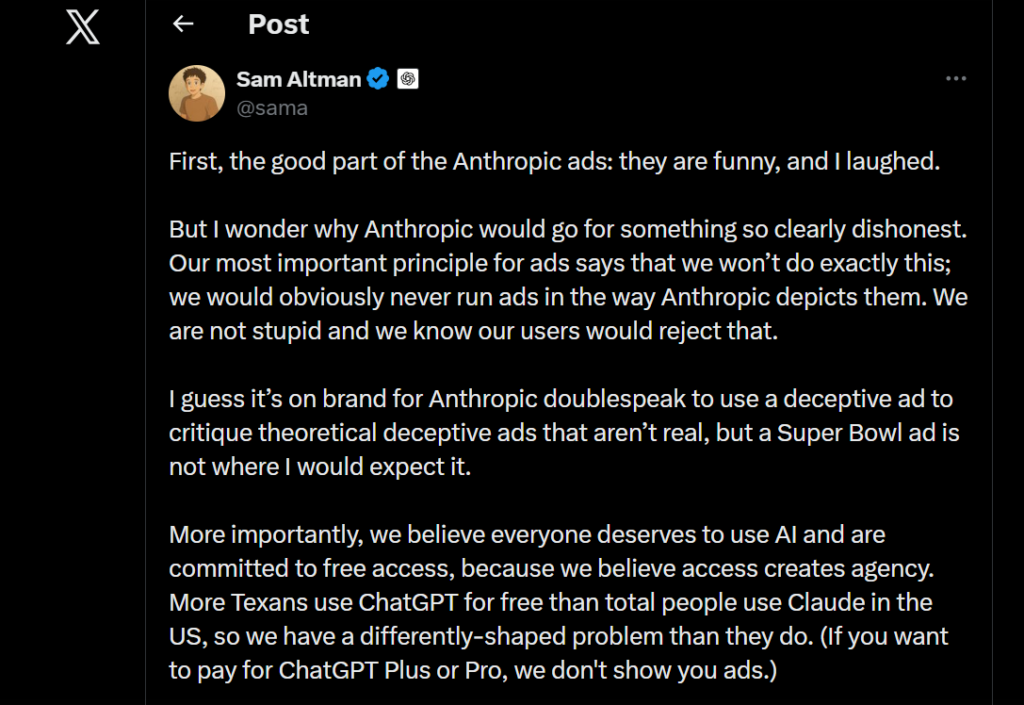
OpenAI CEO Sam Altman reacted by calling the ads “dishonest” and referring to Anthropic as an “authoritarian company,” escalating tensions between leading AI firms.
Users’ Opinions
Consumer resistance to ads in AI tools is well-documented. Late last year, OpenAI faced backlash when it tested app suggestions that users felt resembled unwanted advertising.
Despite this pushback, OpenAI faces pressure to increase revenue. Operating and improving large AI models is expensive.
ChatGPT’s growth demands new ways to fund development and scale its infrastructure.
The Works
OpenAI said ads will be optimized based on what is most helpful to users. In testing, the company has matched ads using several signals.
These include the subject of a user’s conversation, past chats, and previous ad interactions.
For example, users researching recipes may see ads for grocery delivery services.
However, OpenAI stressed that advertisers will only receive aggregated data. This includes metrics such as ad views and clicks.
Advertisers will not receive personal or identifiable user information.
User Controls
OpenAI said all ads will be clearly labeled as sponsored. They will also remain visually separated from organic ChatGPT responses.
Users will have multiple controls over their ad experience. They will be able to view their ad interaction history and clear it at any time.
They can also dismiss ads, share feedback, and see explanations for why a particular ad was shown.
In addition, users will be able to manage ad personalization settings directly within ChatGPT.
Guardrails
OpenAI confirmed that ads will not be shown to users under the age of 18. The company also said ads will not appear near sensitive or regulated topics.
These restricted areas include health, mental health, and politics. OpenAI said these safeguards are designed to reduce harm and preserve trust in high-risk contexts.
