


Code reviews tool have been a breath of fresh air for developers especially since code reviews can feel like the least exciting part of the job.
These tools use AI to automatically review your code and help you catch errors early, keeping your codebase healthy without the back and forth.
But with a number of code review tools out there, which ones(s) should you actually be using?
In this article, we’ll explore the best AI code reviewers you can use today. We’ll break down what each one does and who it’s best for.
Comparison Table
| Tool | Review Depth | Best Strength | Integrations | Best For |
| Code Rabbit | PR-focused, inline comments | Real-time fix suggestions inside Git workflows | GitHub, GitLab | Small teams and solo devs that need quick quality checks |
| Bito AI | Deep, full-codebase analysis | It understands logic across files | IDEs, GitHub, PRs | Large teams, complex repos, security-focused devs |
| Aikido | Quality & readability | Enforces consistent quality standards | CI/CD, PR pipelines | Teams with strict coding guidelines |
| Greptile | PR-focused, contextual reviews | Clear PR summaries and risk detection | GitHub, GitLab | Small teams wanting faster, cleaner reviews |
| Snyk by DeepCode | Security focused | Finds real vulnerabilities with fix guidance | IDEs, GitHub, CI/CD | DevSecOps teams and security first organizations |
| Qodo | PR and testing intelligence | AI test generation alongside reviews | GitHub, CI/CD tools | TDD teams, low test-coverage projects |
| Zencoder | Architectural & structural | Flags design and scalability issues | PR tools, IDEs | Senior devs, architects, long-term systems |
1. CodeRabbit
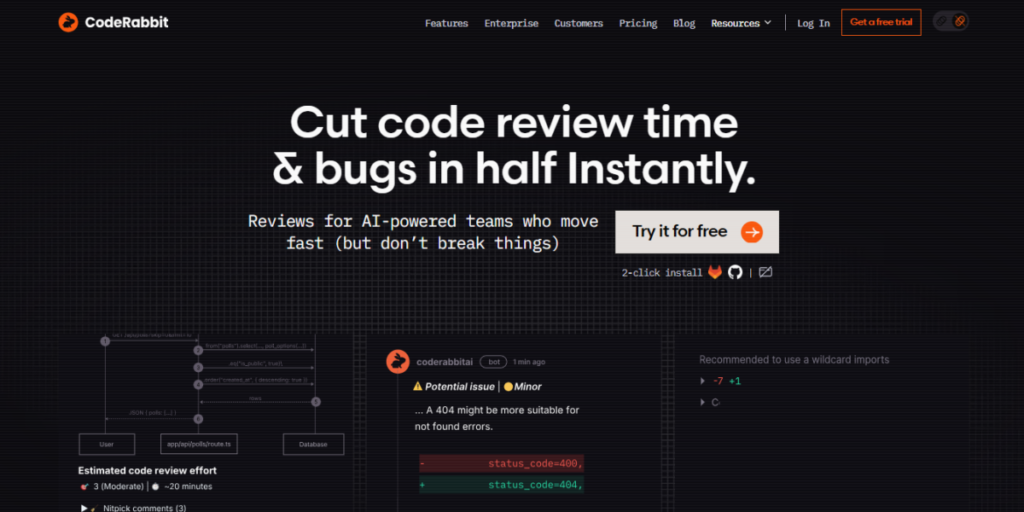
CodeRabbit is like your chatty coding buddy living right inside your GitHub or GitLab workflow.
With CodeRabbit, you don’t have to wait hours or days for feedback, it drops real-time comments on your pull requests, pointing out issues, suggesting improvements, and even offering quick fixes you can apply with one click.
CodeRabbit feels very natural. It understands context across files, explains why something might be risky, and summarizes what actually changed in a pull request.
For fast-moving teams, this alone can shave hours off review, making it one of the best AI code review tools. You move faster, reviewers stay sane, and quality doesn’t drop.
Key Features
- Real-time pull request comments with context-aware suggestions
- Auto-generated PR summaries for large or multi-file changes
- Chat mode to generate tests, ask questions, or flag potential risks
- Engineering metrics tracking, including time-to-merge and review speed
Pros and Cons
| Pros | Cons |
| Cuts review time a lot with inline, one-click fixes | Its enterprise-level support is still maturing |
| Works seamlessly inside GitHub and GitLab workflows | Best used as a helper, not a replacement for deep architectural reviews |
| Learns from your codebase for smarter, more relevant feedback | Pricing increases as team size grows |
Best For
- Agile startups
- Mid-sized engineering teams
- Solo developers
2. Bito AI
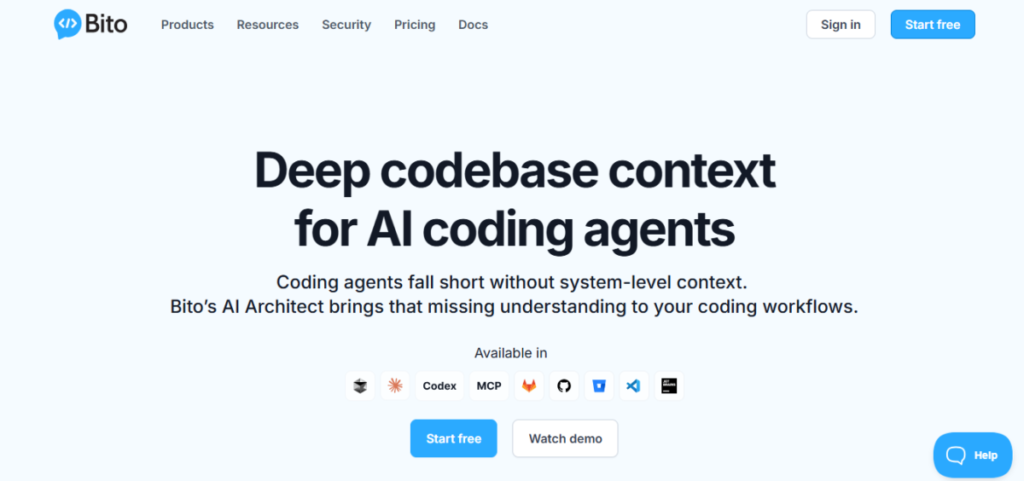
Bito AI is an AI code reviewer that doesn’t just scan your code. It reads between the lines.
Bito analyzes whole codebases, uncovers logic issues, and identifies performance or security weak spots that often slip past human reviews.
Instead of only calling out problems, it suggests thoughtful fixes, making it feel like a coaching partner.
It integrates with your IDE and pull requests, so you get feedback where you write code without extra context switching.
Key Features
- Context-aware analysis
- Security and performance scans with fix suggestions
- Supports over 50 languages in IDE plugins
- Pull Request summaries and pattern learning
Pros and Cons
| Pros | Cons |
| Cuts PR review time significantly | Takes time to customize for team coding styles |
| Understands deep logic relationships | Pricing is not always transparent |
| Great multi-language support | Needs tuning for edge cases |
Best For
- Large teams with complex, interconnected repositories
- Security-driven engineering organisations
- Developers who want inline help in IDE
3. Aikido
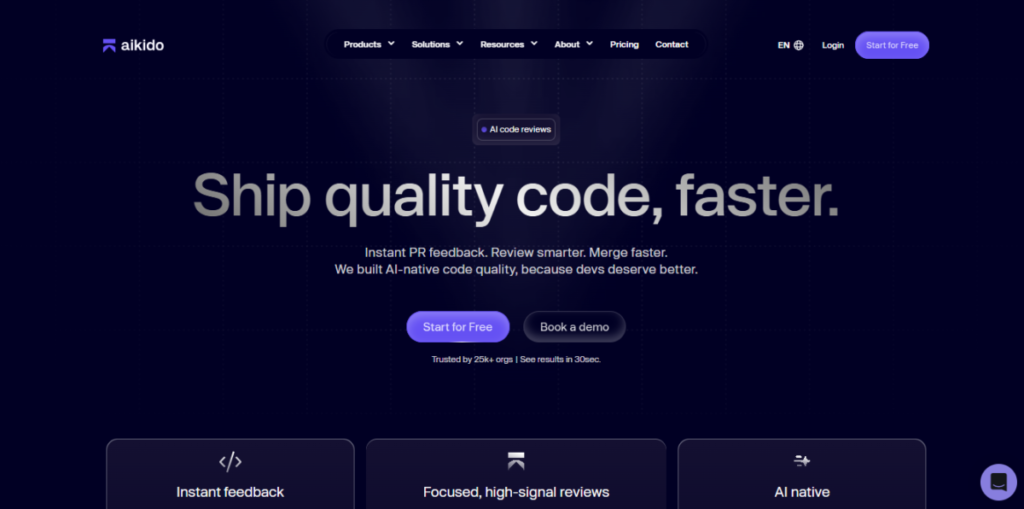
Aikido is a top AI code reviewer that focuses entirely on quality enforcement. Most developers often underestimate consistent code quality at scale, but Aikido focuses on that.
It does not only point out coding style issues, it uses AI to understand whether code meets quality, readability, and performance expectations.
It works across pull requests, but instead of flooding pull requests with noise, Aikido highlights issues that actually affect long-term health and performance red flags.
It integrates well with standard CI/CD pipelines, making quality checks automatic and hard to ignore.
Key Features
- AI-enhanced quality and readability analysis
- Style, maintainability, and performance checks
- Detailed reports for pull requests
- CI/CD integration
Pros and Cons
| Pros | Cons |
| It helps enforce consistent quality | It sometimes flags subjective issues |
| It integrates well with pipelines | Configuration may take some time and efffort |
| Good readability guidance | Less focus on deep logic bugs |
Best For
- Teams enforcing quality standards
- Maintainers of widely shared libraries
- Organizations with strict coding guidelines
4. Greptile
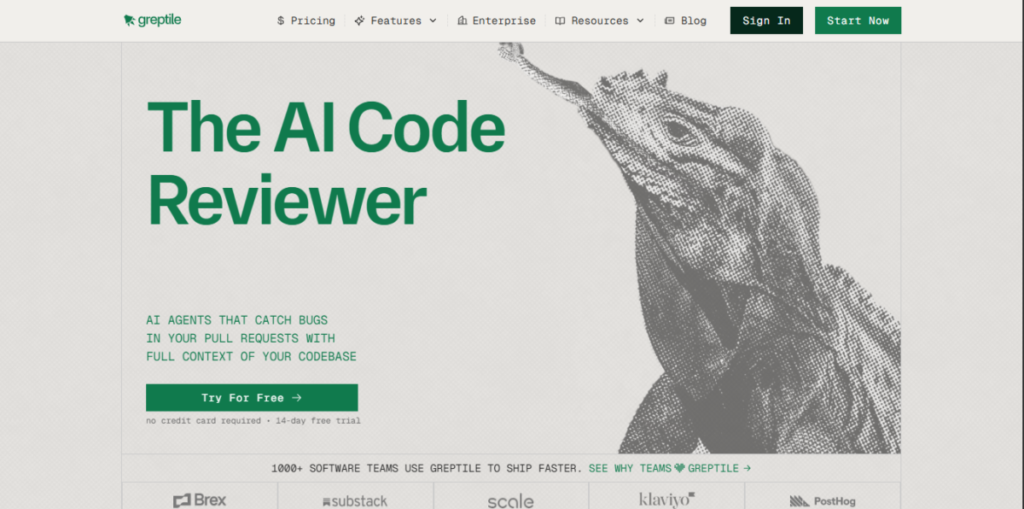
Greptile is built specifically for modern Git-based workflows. It is that AI that lives in your PRs and pull requests like a reviewer who knows context and not just syntax.
Greptile reads your code, generates human-friendly summaries, highlights risky changes, and suggests improvements.
It is designed to make AI code reviews feel natural and actionable.
Greptiles insights are readable and that’s one of its unique selling points. Its suggestions are very easy to understand.
Key Features
- AI-generated summaries for pull requests
- Inline comments and contextual suggestions
- Risk detection for logic bugs and unsafe patterns
- GitHub and GitLab integration
Pros and Cons
| Pros | Cons |
| Easy-to-read recommendations | It can bring up so many suggestions at the same time |
| It improves reviewer efficiency | Advanced customization options are limited |
| Works naturally inside PR workflows | It is less powerful on very large monorepos |
Best For
- Teams using GitHub or GitLab
- Developers who want clear, concise feedback
- Agile squads optimizing review cycles
5. Snyk by DeepCode AI
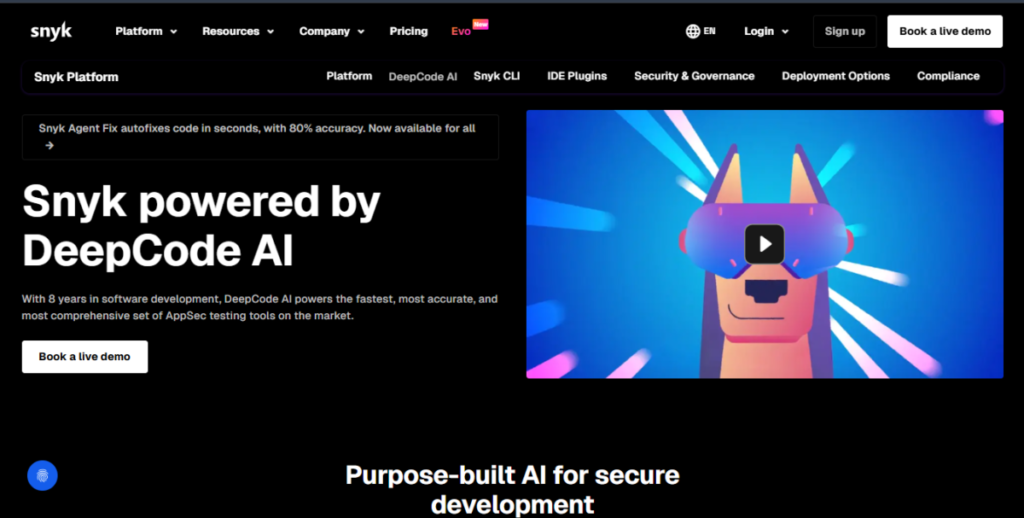
Snyk is a developer-focused, AI-powered static application security testing (SAST) and code analysis tool that helps you catch bugs, logic errors, and security vulnerabilities early, before code ever reaches production.
It combines smart pattern recognition with semantic code understanding, so it doesn’t just flag issues but explains why they matter and how to fix them right in your workflow.
Snyk is built to support rigorous code quality and security at scale. It integrates with your editor, repository, and CI/CD pipelines, scanning code as you type, during commits, and across pull requests.
Key Features
- AI-powered static code analysis
- Real-time vulnerability detection in IDEs and pull requests
- AI-guided remediation suggestions with auto-fix options
- IDE and CI/CD integration with VS Code, IntelliJ, PyCharm, and others
- Security-focused alerts for vulnerabilities like SQL injection, weak crypto, and unsafe data handling
- Contextual explanations
Pros and Cons
| Pros | Cons |
| It has a strong focus on security and code quality | The pricing can be high for teams who need the full platform features |
| It integrates directly into IDE and pipelines | Some users find the UIand workflow complexity challenging |
| Ii reduces false positives compared to traditional SAST tools | It is not tailored for non-security issues alone |
Best For
- Security-focused teams
- DevOps and DevSecOps workflows with automated CI/CD gates
- Teams using AI code generators
- Developers and architects who want inline security feedback while coding
6. Qodo AI
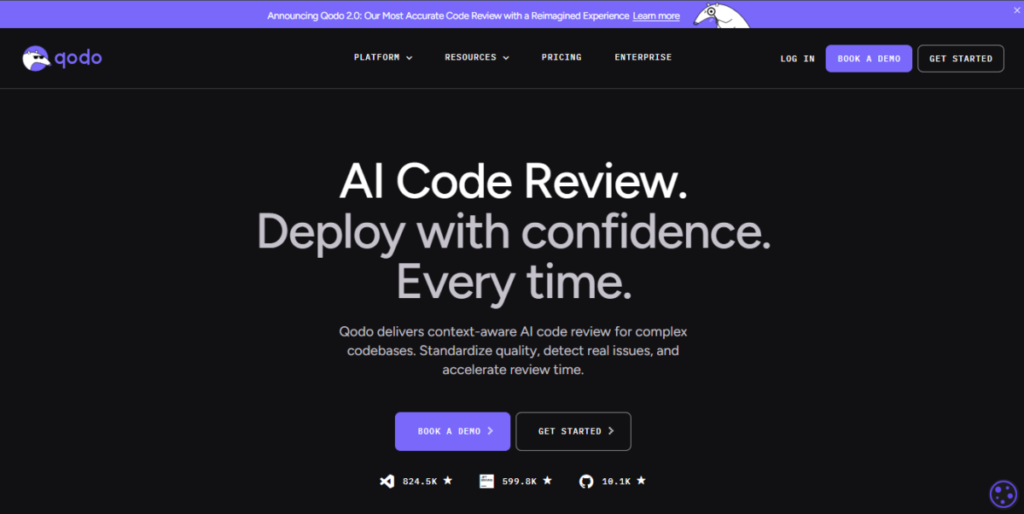
Previously known as CodiumAI, Qodo is one of the best AI code review tools that elevate code reviews by combining review feedback with test generation.
Qodo doesn’t just tell you something is wrong, it helps you build tests to defend against similar issues next time. This combination is rare in the AI code reviewer space.
It is especially helpful to anyone serious about improving code quality and test coverage at the same time.
Key Features
- Automatic test generation suggestions
- In-PR review feedback
- Merges suggestions based on review results
- Smart context understanding
Pros and Cons
| Pros | Cons |
| It generates tests not just comments | Test suggestions may need refinement |
| It helps improve code coverage | It is a learning curve for new users |
| Works well with CI/CD | You get the best results when configured carefully |
Best For
- Test-driven development teams
- Developers struggling with low test coverage
- Those who want review and testing in one workflow
7. Zencoder
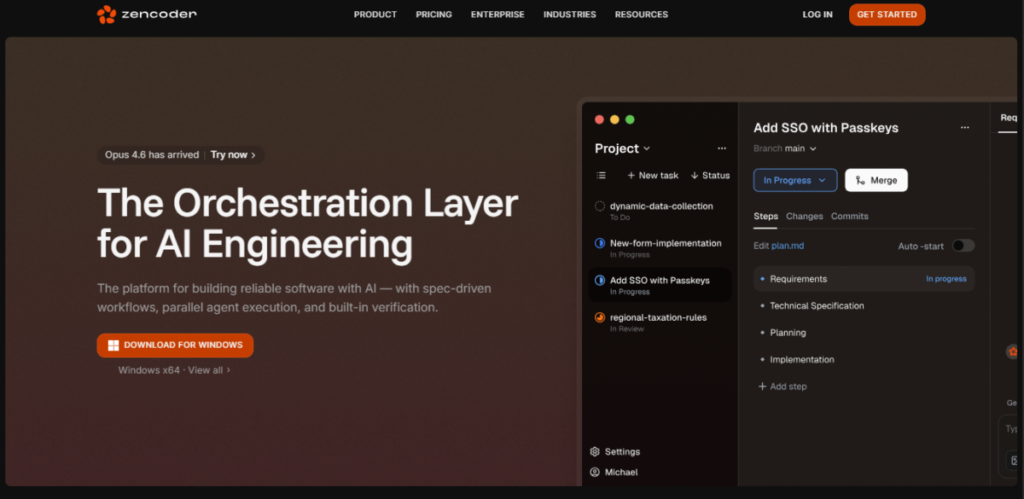
Zencoder is one of the more intelligent AI code reviewers. It is focused on deeper design and architectural feedback.
It deeply understands your codebase and helps you write, review, test, and refine code across the entire development lifecycle.
It works directly inside popular IDEs like VS Code and JetBrains, so feedback and automation happen right where you’re writing code.
What makes it unique is its system of specialized AI agents that handle specific tasks like generating tests and docstrings, providing targeted code review feedback and implementing larger feature changes.
Key Features
- AI Code Review Agent
- Multi-Agent Architecture
- Deep codebase comprehension across files and repositories, giving context-aware insights that simple tools miss.
- Unit Test and Doc Generation
- IDE Integration: Seamlessly integrates into VS Code and JetBrains environments
- Extensive Tool Integrations: Connects with Jira, GitHub, GitLab, Sentry, and other DevOps platforms for smoother workflows.
Pros and Cons
| Pros | Cons |
| Deep architecture insights | Can be too detailed for lightweight projects |
| Helps long-term maintainability | Not the fastest for quick PR cycles |
| Great at spotting design errors | It is less focused on performance metrics |
Best For
- Enterprise teams maintaining large systems
- Architects and senior developers
- Projects prioritizing clean structure
Bottom Line
There’s no single best AI code reviewer, only the one that works for how you build.
If you want deep, whole-codebase intelligence, Bito AI stands out. If fast, readable pull-request feedback matters most, Greptile and CodeRabbit work just fine.
For teams serious about testing, Qodo adds real value, while Zencoder is ideal for long-term architecture health.
Aikido delivers reliable, standards-driven checks at scale.
The real win is to let AI handle the routine reviews so you can focus on writing great code and actually enjoy yourself while at it.
