
Mental health apps promise you everything: no stress, transcendence, a better social life, productivity… A better life in general. But can they actually make a difference?
The problem with mental health apps is that most people download them, use them for a few days, and then forget they exist. Maybe because an app was generic, or they misused it.
In this list, you’ll find mental wellness apps that support well-being from different sides: physical health, self-discovery, education, etc. Don’t know how to use them? Not a problem with our tips on how to use mental health apps to make the most out of them.
Top 7 Mental Health Apps
1. Breeze Wellbeing: Best Self-Discovery App
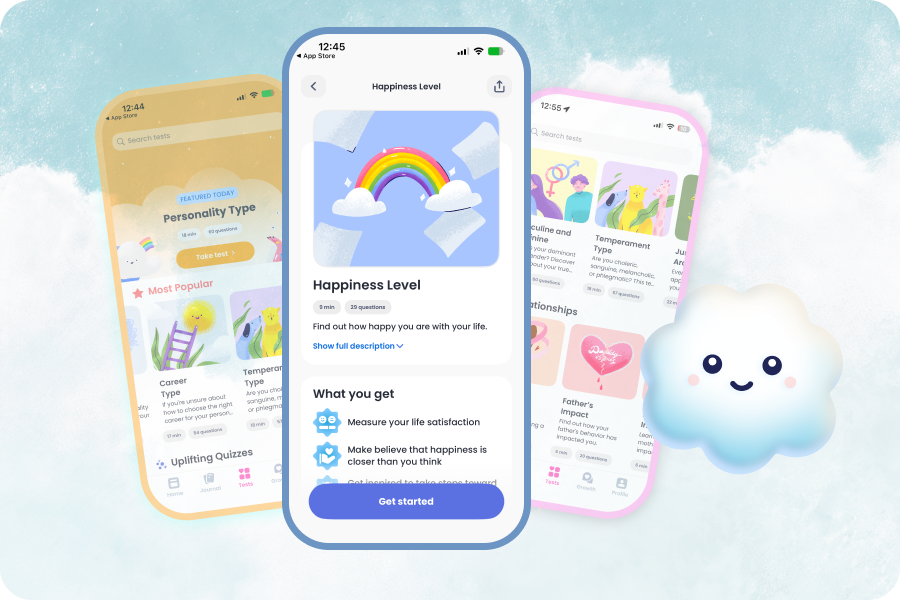
Breeze Wellbeing is a mental health app that focuses on comprehensive care. Its main focus is self-understanding. Hence, Breeze offers more than 30 quizzes, self-growth courses, and community support.
More than 14 million people downloaded the app, and it has an average ranking of 4.8/5.0. Here’s what users of Breeze Wellbeing say about the app:
- “They deserve 10 stars for helping customers,” a Breeze review from Trustpilot.
- “Why doesn’t everyone use this app? It has literally everything you need,” a user on the App Store.
- “The app is very easy to use and clearly structured, which makes it intuitive even if you’re using it for the first time,” someone wrote in Trustpilot.
If you don’t know where to start with the Breeze app, we recommend trying tests. Choose the one from the extensive collection that feels the most relatable: ADHD evaluation, charisma test level, past relationships impact, etc. Not only can the test results help you to treat yourself with kindness, but they can also be used to assist therapy.
Breeze Self-Discovery also offers traditional mental health interventions, such as journaling, mindfulness exercises, a mood tracker, and affirmations. Thanks to the nice design, they may be easier to try for some users who previously found these features boring.
2. FineMind: Best Mental Health App for CBT
FineMind is a mental wellness app designed to address negative beliefs. It’s rooted in the principles of Cognitive Behavioral Therapy (CBT), one of the most researched and effective approaches for managing anxiety.
The app is completely free. All you have to do is fill out the CBT cards and answer the app’s questions:
- Describe a situation in which you felt worthless or insecure.
- What emotions did you feel?
- What were your automatic negative thoughts?
- What are rational arguments for these thoughts?
- What are rational arguments against these thoughts?
- How will you adapt your thoughts based on the rational arguments above?
The downside is that it can feel too rationalizing.
3. BetterHelp: Best App for Remote Therapy
BetterHelp is one of the most popular platforms for accessing licensed therapists remotely. Due to its popularity, it has one of the most extensive choices of therapists who work with various requests.
The app allows you to connect with professionals via text, video, and voice calls. This is especially helpful if you have a busy schedule.
Be careful when choosing a therapist: check their credentials carefully and collect reviews from their previous clients. There were cases where therapists on BetterHelp were insincere about their experience and credentials.
4. Apple’s Journal: Best Journaling App
There are numerous journaling apps out there, but journaling works best with minimal distractions. Apple’s native journaling app has enough tools to make your journaling creative and easy, but not too many for you to overthink your writing.
Here’s what you can do in Apple’s Journal:
- Type
- Handwrite or paint
- Change the formatting and color of the text
- Add photos
- Add voicenotes
- Attach location
- Connect to Apple’s Health features
The limitation is that it lacks deeper psychological tools, but as a daily reflection app, it does its job well.
5. PUSH: Best Mental Health App for Exercise
Mental health apps are effective, but self-care should also extend to other areas of life. PUSH app focuses on one of them: movement.
It’s an AI-powered gym helper. It automatically adapts your reps, sets, and volume based on previous activity. You can also create personalized workout plans based on your exercise goal: gaining muscle, losing weight, training for a marathon, etc.
PUSH would be a great help for those who can’t keep physical exercises consistent. The downside is that it’s not a full mental health app but a fitness program that doesn’t take emotional well-being into account.
6. SAM: Best Mental Health App for Psychoeducation
SAM app (Self-Help for Anxiety Management) is a nonprofit, community-backed, evidence-based mental health app. It was developed by a group of scientists from the University of the West of England. Because of this, the app is completely free.
In SAM, you can find a mood tracker, mental health exercises, community support, and relaxing games to play. The app’s content constantly updates because the community is active and open to sharing what worked for them personally.
7. Daily Yoga: Best App for Yoga and Mindfulness
Daily Yoga combines physical movement with mindfulness practices. In this app, you can choose yoga training based on your level of physical preparation and the time you have.
Yoga and breathwork are evidence-based interventions proven effective for mental well-being. However, starting with mindfulness practices may be challenging. Daily Yoga was created to overcome this barrier for beginners.
While some content is locked behind a subscription, Daily Yoga remains a strong option for building a consistent routine.

How to Choose Mental Wellness Apps
There is no correct mental wellness app. Every person has unique mental health challenges and, hence, requires unique support. In order for the app to work, consider this before downloading/buying the app:
- What is your goal for a mental health app? Name clearly what bothers you: overthinking, anxiety, stress, self-doubt, lack of routines, etc. If you want support, a journaling app is unlikely to help.
If you have trouble defining your goal, try a comprehensive mental wellness app first. Breeze Wellbeing is such an app. When you determine something that works personally for you, you can look for niche apps for it.
- Is the app created by mental health professionals? Apps grounded in approaches like CBT, mindfulness, or behavioral tracking tend to be more effective than those built purely for engagement or distraction. If an app feels overly gamified or stuffed with unneeded features, it may initially try to keep your attention.
- Give apps trial periods. Sometimes, no amount of preparation and research can show whether an app is for you, as well as actually trying it. The main criterion is how the app makes you feel. Does it help you understand yourself better, or does it create pressure to “perform”?
Figuring out what works for your mental well-being, built on past experiences, health, routine, and dreams, isn’t straightforward. It’s totally okay to try, switch, quit, and return to the apps that make you good.
How to Use Mental Health Apps to See the Results
Many mental health apps are criticized for “not being effective.” But not only the features and drawbacks of the app should be considered. Improving mental health means facing uncomfortable realities and stepping outside your comfort zone.
In order for mental health apps to work, efforts are required. At least take small steps to actually see the changes. Here’s how you can use mental wellness apps to see the results:
- Do a bit every day. You don’t need to spend hours journaling or tracking every detail of your day. Even 5 minutes daily is enough. Starting small also prevents burnout, which is the main reason people quit mental health apps.
- Make a mental health app part of your routine. The main aim is to add small tasks related to mental health, not change your whole lifestyle. To make a mental health app stick, use it at the same time every day, for example, before bed or before starting work.
- Don’t rely on motivation. Some days you’ll feel inspired, but most days you won’t, which is okay. The same advice works here: attach the app to an existing habit. This makes it easier to stay consistent.
- Take your mental health outside apps. To see the best results, mental health habits should include healthy eating, physical exercise, and meetings with friends.
Finally, remember that apps are support tools, not solutions on their own. Real change happens when you apply what you learn in everyday life.