
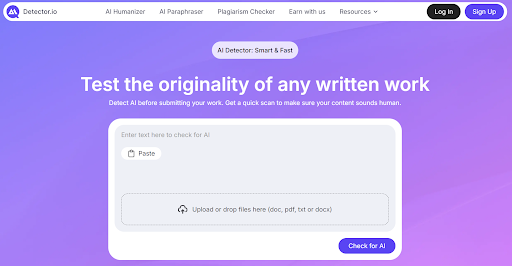


Detector.io helps users spot text that may have been generated or heavily shaped by AI.
The tool looks for patterns often found in AI writing, such as predictable phrasing, repetitive sentence rhythm, overly polished flow, and generic wording. Then, it gives users a result they can work with.
A useful AI text detector should help users understand where the risk appears in the text. Detector.io does this by highlighting sections that may need review.
The interface is also simple. You do not need to create a complicated project, adjust advanced settings, or decode a technical report. Paste the text, run the check, and review the result.
That simplicity makes Detector.io feel more practical than many tools in this category. It is not trying to become a full academic platform or a heavy enterprise content system. It is built for fast, focused AI detection.
Key Features
AI Detection
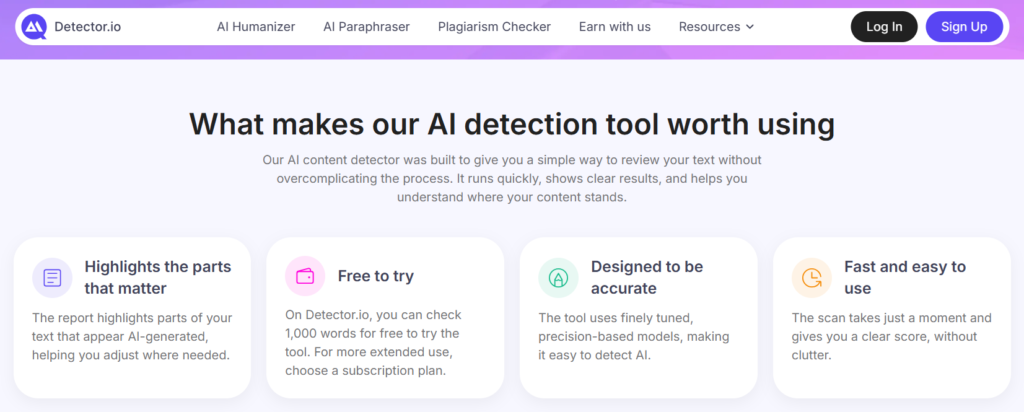
Detector.io’s core feature is its AI detection scan. Users can paste text, run a check, and see whether the writing may contain AI-generated patterns. The tool looks for signals such as repetitive phrasing, overly regular sentence flow, and wording that feels too predictable.
The result is easy to read, which is important for students, teachers, editors, and content teams that need a quick review. Detector.io also gives sentence-level feedback, so users can see which parts of the text may need a second look.
AI Humanizer
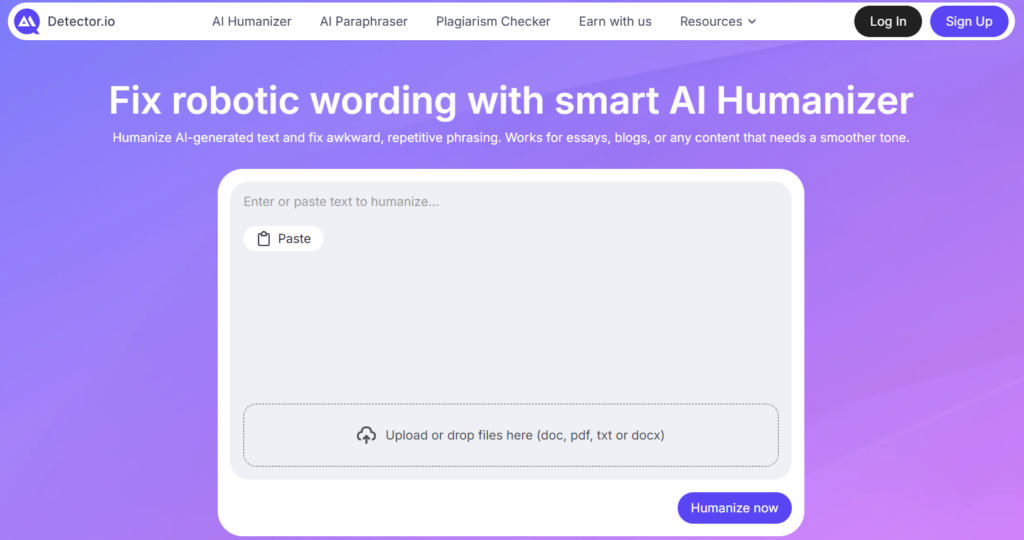
Detector.io also includes an AI Humanizer for users who want to revise text that sounds stiff, robotic, or too machine-made. This feature helps reshape awkward AI-assisted writing into something smoother and more natural while keeping the original meaning.
If the AI detector scan flags a section, users do not have to leave the platform and rewrite everything from scratch. They can use the humanizer to improve tone, flow, and readability.
AI Paraphraser
The AI Paraphraser helps users reword text, get rid of awkward phrasing, or adjust AI-assisted drafts. It works for both AI-generated content and regular writing that needs a clearer version.
A sentence may be accurate and original, yet still clunky. The paraphraser gives users a faster way to create a higher-quality draft without changing the core idea.
Plagiarism Checker
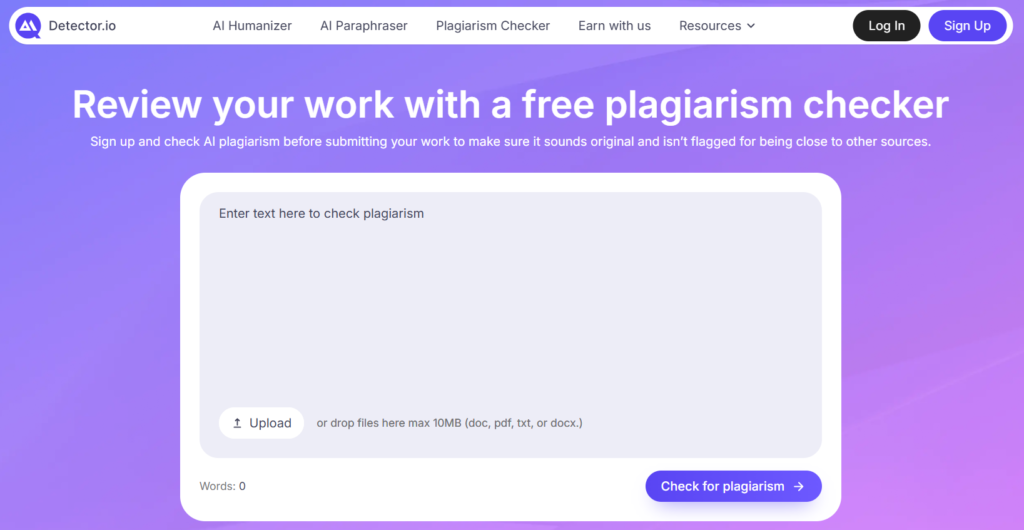
Detector.io’s plagiarism checker adds another layer of content review. It helps users check whether a piece of writing may contain copied or too-closely paraphrased text. The tool is positioned for different types of content, including short, long, casual, and academic writing.
This makes the platform more complete than a standalone AI detector tool. Users can review AI risk, improve the flagged text, rephrase weak sections, and check originality in one place.
Simple Review Workflow
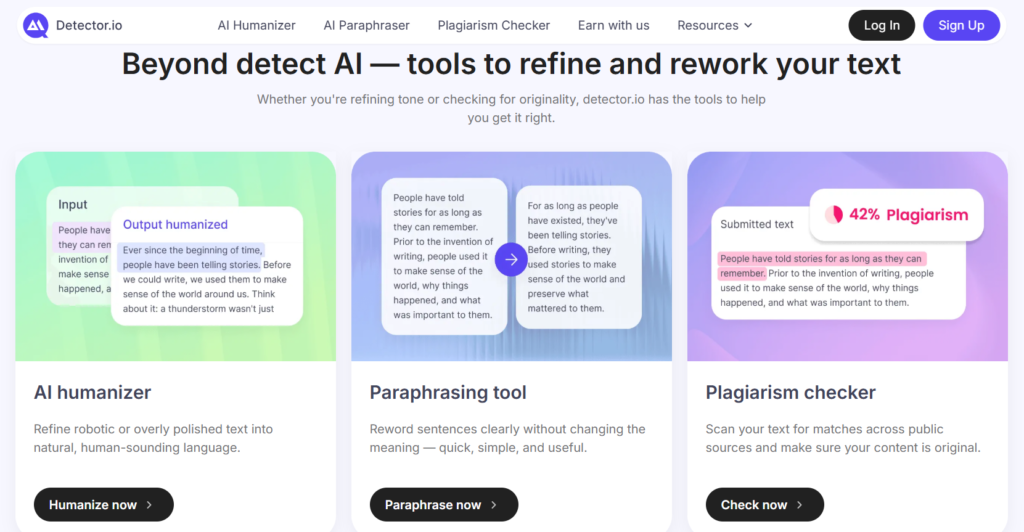
The strongest feature is the way the tools work together. Detector.io can help users move from detection to revision to originality review without building a complicated process around it.
That is where it has an advantage over many single-purpose tools. A typical AI detector can tell users that something looks risky. Detector.io gives them more ways to decide what to do next.
Competitor’s Comparison
| Tool | Best For | Main Strength | Main Limitation |
| Detector.io | Students, teachers, editors, content teams | Fast checks, clear score, highlighted sections, simple interface | Free use has word limits |
| GPTZero | Teachers and academic users | Strong education-focused reputation | Reports may feel heavier than needed for quick checks |
| Originality.ai | Publishers and agencies | Good fit for professional content review | Better suited to teams than casual users |
| Turnitin | Schools and universities | Built into many academic workflows | Usually requires institutional access |
| Copyleaks | Business and education users | Broad AI and plagiarism detection features | Interface can feel more complex |
| ZeroGPT | Casual quick checks | Easy to access | Results may feel less detailed |
| QuillBot | Students using QuillBot tools | Convenient inside a writing toolkit | Less focused than a dedicated detector |