

When a US Vice President and a newly elected pope agree on something, people notice.
That’s exactly what happened this week, as JD Vance publicly praised Pope Leo XIV’s landmark encyclical on AI.
The Pope had called it “profound” and a sign of exactly the kind of moral leadership the world needs right now.
The timing couldn’t be more interesting. Vance and the Vatican have been at odds over immigration policy. Yet on the subject of AI, the two find surprising common ground.
Pope Leo XIV
Pope Leo XIV, the first American-born pope, made headlines Monday when he released “Magnifica Humanitas,” which translates to “Magnificent Humanity.”
The document lays out a series of serious concerns about how AI could change society. It also says AI could lead to what he called “new forms of slavery.”
That’s a statement that caught the attention of people far beyond the Catholic Church.
Vance’s Reaction
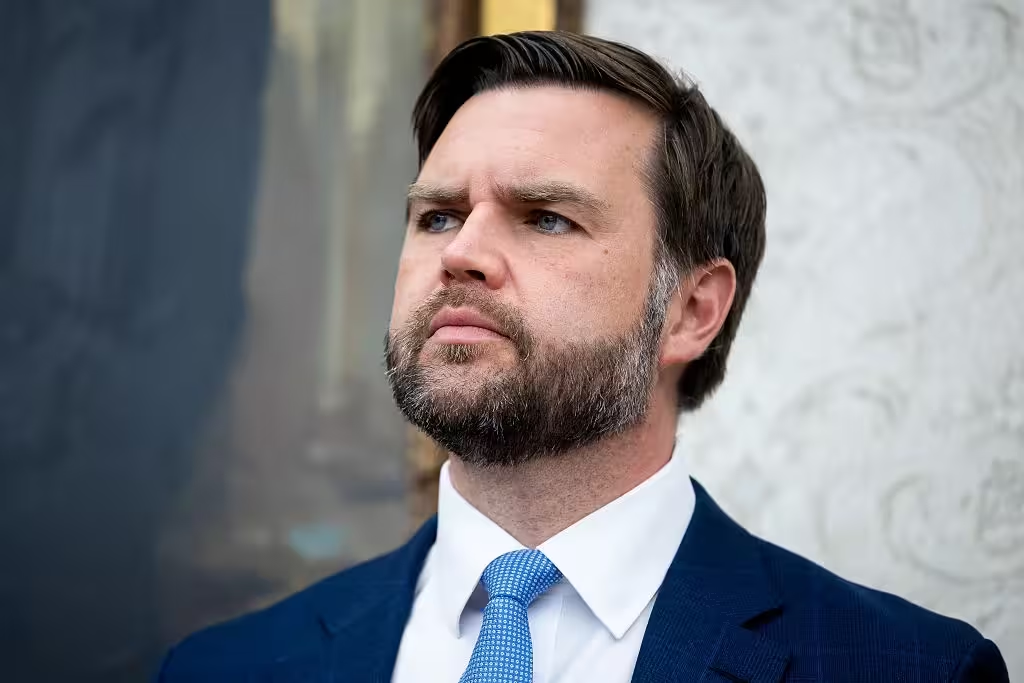
Before entering politics, JD Vance worked as a venture capitalist. He has deep ties to the tech industry. And some of his biggest supporters include Elon Musk, the CEO of Tesla and SpaceX.
“What I read of it sounds very profound,” Vance told NBC News, “and the sort of thing that you would expect and hope from a leader of the church.”
Vance also said he believes the Catholic Church is uniquely positioned to help guide humanity through this moment.
“I think we really need moral leadership to think through those questions,” he said, “and that’s exactly what the church is the best leader to do.”
Also read: Pope Leo Calls for AI to Be “Disarmed”
History Comparison
Vance pointed to Pope Leo XIII, the pope who led the Catholic Church at the dawn of the Industrial Revolution.
That pope issued his own warnings about how rapid technological and economic change could harm ordinary people.
Now, more than a century later, we find ourselves at a similar crossroads. And Leo XIV chose that same name deliberately.
“I think it was very much a nod to Leo XIII,” Vance said, “who became pope at the beginning of the Industrial Age” and similarly warned about technology’s impact on humanity.
History, it seems, has a way of rhyming.
Morality
One of Vance’s most thoughtful comments touched on principles of morality. He believes they stay the same over time, but how we apply them must change as the world changes.
“The thing about morality is that the principles never change,” he said, “but the way you apply those principles does, because the world changes, right?”
That’s a nuanced point. And it cuts to the heart of why many people believe religious institutions still have a role to play, even in deeply technical debates about AI.
JD Vance
Vance converted to Catholicism in 2019. So his interest in the pope’s message isn’t purely political. He says he was genuinely pleased when the new pope chose the name Leo XIV.
He also expressed hope. If humanity navigates the AI era successfully, Vance suggested, the church’s moral guidance may deserve part of the credit.
“I suspect that if we make it through this successfully,” he said, “it will be in large part because the pope and the church are able to provide the kind of moral leadership that we need.”
