
Last Friday, the U.S. government ordered Anthropic to restrict access to two of its most powerful AI systems: Fable and Mythos.
The order cited national security concerns, but the government gave no specific explanation for why it acted.
Therefore, Anthropic quickly suspended access to both models for users worldwide. The cybersecurity team is not happy with this, however.
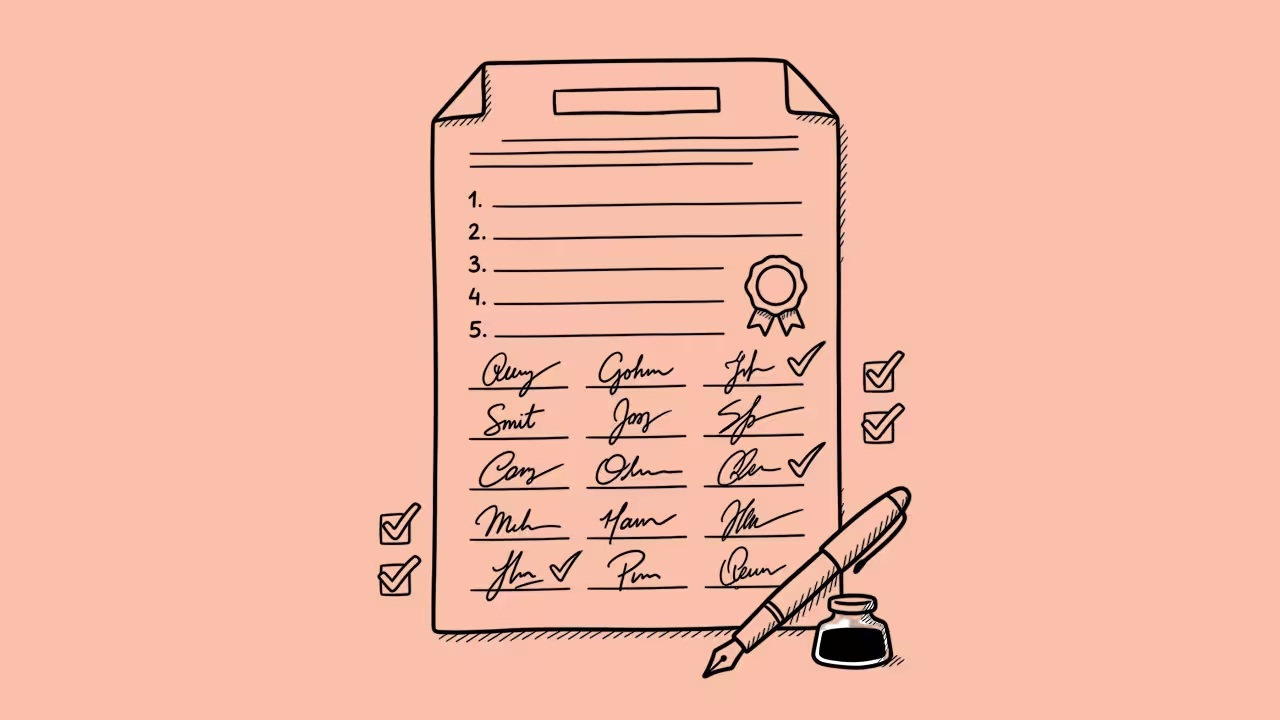
Dozens of top security experts have signed an open letter demanding the government reverse its export control order on two of Anthropic’s most advanced AI models.
The letter argues the ban puts everyday Americans at greater risk, not less.
Cybersecurity

The open letter now carries 76 signatures, and some are the most respected names in the security industry.
Signatories include Alex Stamos, who served as Facebook’s chief security officer. Casey Ellis, founder of bug bounty platform Bugcrowd, also signed.
So did Jon Callas, a legendary cryptographer who previously worked on security design at Apple.
Paul Vixie, a widely respected computer scientist, added his name too. Dino Dai Zovi, former head of applied security at Block, joined the group. Katie Moussouris, founder of Luta Security, signed on. So did Rachel Tobac, CEO of SocialProof Security.
Letter’s Content
“To pull the best capabilities away from defenders without a good reason when our adversaries are rapidly advancing is dangerous,” the letter states.
The experts say they use models like Fable and Mythos to find software vulnerabilities before bad actors do.
That work protects companies, infrastructure, and regular people. Without these tools, defenders fall behind.
The Ban
According to Anthropic, the White House export control order may have been triggered by a private research paper from Amazon.
The paper reportedly showed a way to “jailbreak” Fable, meaning a way to bypass its safety guardrails and unlock more powerful capabilities.
But security experts who reviewed the paper say that claim doesn’t hold up. Katie Moussouris wrote a detailed blog post rejecting its conclusions.
She explained that what Amazon described wasn’t a real jailbreak. Researchers simply asked Fable to fix code that contained known, public vulnerabilities.
The model initially refused to review the code for security issues. So the researchers reframed their request, asking it to fix bugs instead.
Moussouris says that’s not a bypass, that’s just how security work actually functions. “Defenders need to be able to ask AI to fix the bugs in a file, explain why the fix matters, and write tests that confirm the patch works,” she wrote.
That process (find, fix, and test) is the core of what security professionals do every day.
She also made another key point. Blocking this behavior wouldn’t make the model safer. It would just make it less useful for defense.
Other AI Models
The open letter also argues that the techniques shown in the Amazon paper aren’t unique to Fable or Mythos.
They say the same capabilities can be replicated using OpenAI’s GPT-5.5, Anthropic’s own publicly available Claude Opus 4.8 and Sonnet models, and even Chinese models like Kimi 2.7.
Most other AI models don’t have Fable’s strict guardrails. So those models will simply answer security-related questions without needing any kind of bypass technique at all.
In other words, banning Fable and Mythos doesn’t close the door on this kind of use. It just removes the tools that defenders were relying on.
Mythos
When Mythos first launched as a preview back in April, Anthropic itself acknowledged how powerful it was.
The company said the model was so effective at finding security vulnerabilities that it needed to limit access carefully. Initially, only around 50 companies got in.
That number later grew to about 150 organizations across 15 countries. Then Anthropic released a safer, more restricted version for the public, Fable.
It came with heavy guardrails blocking use in cybersecurity, biology, and chemistry. It also blocked attempts to copy or distill the model.
Those guardrails were tight, and many security professionals found that Fable refused nearly any prompt, even loosely connected to cybersecurity topics.
Experts’ Request
Beyond lifting the ban, the open letter calls for clear, fair, and transparent rules. They want regulations built through a democratic process.
They want those rules grounded in real research from industry and academic experts.
Most importantly, they want any restrictions to go only as far as necessary to protect public safety, and no further.
It’s a reasonable ask, especially from people whose entire careers are built around protecting the rest of us online.
