
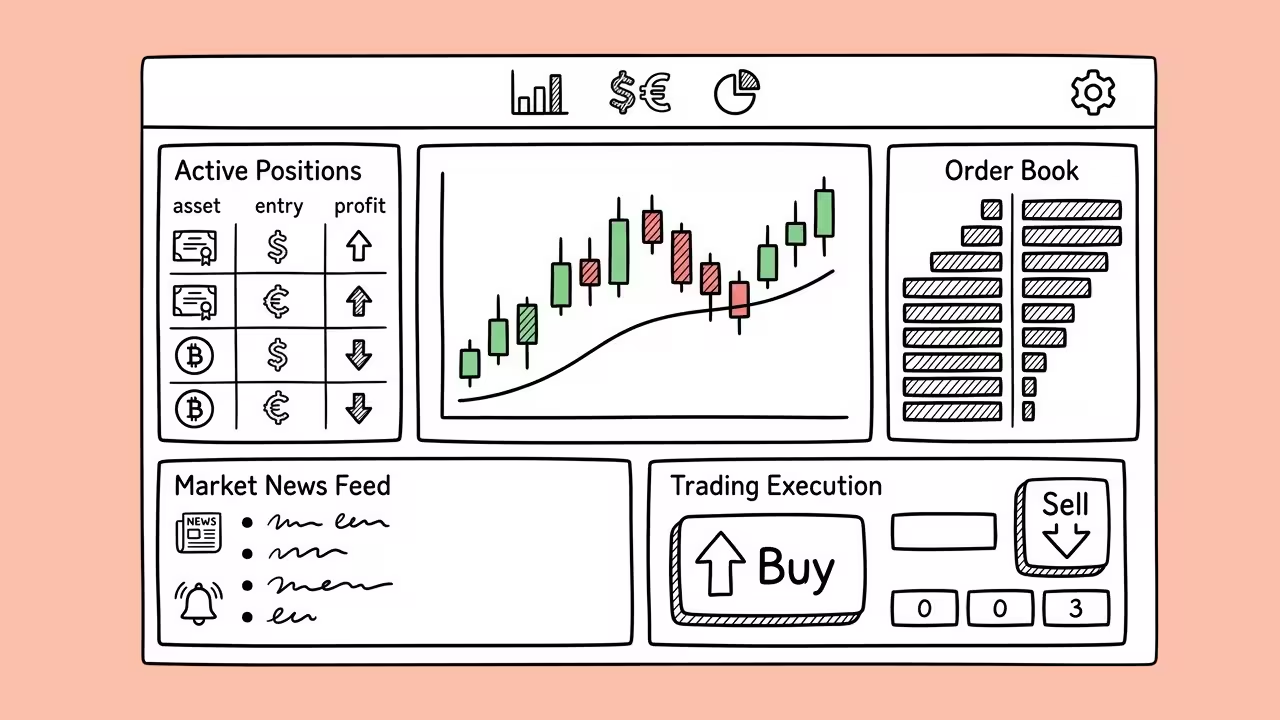

AI-enhanced forex bots use a combination of Machine Learning (ML), extensive neural networks and Natural Language Processing (NLP) to analyze large amounts of data. Having evolved far beyond the fixed, rule-based systems of the past, the advanced bots are continuously learning from historical data, market sentiment and live economic news to predict currency movements and optimize risk management in real-time.
In today’s world, AI-enhanced forex trading bots are no longer exclusive institutional tools and have become the mainstream engines of retail trading that have completely redefined how automated systems approach decision-making.
Instead of solely relying on inflexible, hard-coded rules that quickly crumble when market conditions change, modern AI bots are using advanced Machine Learning (ML), Natural Language Processing (NLP) and multi-agent systems that enable them to learn, adapt and optimize their strategies instantaneously.
Why AI-Enhanced Forex Bots Have Revolutionized Retail Trading
The democratization of corporate-grade technology is probably one of the most significant changes in 2026. As a retail trader, you don’t need advanced server infrastructure to run these high-utility machine learning models because they are now integrated directly into the traditional trading systems.
The intelligence-enhanced metatrader plugin applying machine learning to automated forex execution is a prime example of this. By retrofitting widely used software like MetaTrader 4 or 5 with cognitive modules, every day traders have access to predictive model pipelines directly on their broker feeds.
These plugins also act as local neural networks that:
- Observe a trader’s historic slippage
- Analyze execution speeds across different currency pairs
- Optimize order routing in real time
If the algorithm detects that a certain broker’s liquidity leads to high slippage during the London-New York session crossover, it alters its execution parameters and uses TWAP (Time-Weighted Average Price) or iceberging algorithms to protect your entry price.
How Strategic Adaptation Has Evolved
The most prominent vulnerability that was faced by the historical trading software was strategy decay. A system that was optimized for a highly trending market would routinely suffer severe drawdowns when the market transitioned into a tight, volatile consolidation phase. Modern machine intelligence has successfully managed to overcome these limitations through the implementation of continuous and flexible learning loops.
Deep Reinforcement Learning (DRL)
FXProBot’s AI bots don’t just blindly follow strict mathematical formulas; instead, they interact with the live stream of price action as an environment. The algorithm receives positive rewards in response to maximizing risk-adjusted returns and negative penalties for any unexpected drawdowns.
This allows the bots to continuously learn from their mistakes and tweak its own parameters.
Multi-Agent Systems
The top corporate systems launch networks of specialized sub-agents. One agent might be tasked with monitoring structural order flow, while another evaluates institutional liquidity and a third tracks macro correlations.
These agents can simultaneously cross-examine data points to determine the best entries.
Regime Detection Models
Advanced neural networks are able to instantly classify the current market regime by analyzing:
- Market volatility
- Average True Range (ATR)
- Volume profiles
The bot then autonomously exchanges its underlying trading logic from a trend-following model to a mean-reversion strategy.
These advanced bots are far more intuitive than their predecessors, capable of responding to the current market as opposed to blindly following preset rules. This allows them to adapt to changing markets and eliminates the possibility of strategy decay.
Why Multi-Modal Data Fusion Works Beyond the Chart
Price action alone isn’t cutting it anymore, not when the algorithmic environment has become so saturated. That’s why the top AI forex bots in 2026, like those from FXProBot, are using multi-modal data processing to merge raw quantitative technical data with massive streams of unstructured qualitative information.
Modern bots use Natural Language Processing (NLP) to scrape thousands of data points every second.
They are able to analyze:
- Central bank policy statements
- Geopolitical news tickers
- Financial sentiment on institutional forums
Should an automated system identify a technically ideal setup on the EURUSD pair, but its central engine detects a sudden hawkshift in Federal Reserve communication, the system is able to instantly filter out or invalidate the technical buy signal.
This ability to grasp context prevents the astronomical losses that were common with the older, purely technical systems during major unexpected macroeconomic shifts.
The Hybrid Future of Currency Trading
There’s no denying that machine learning has significantly lowered the barrier to entry for currency trading in addition to heightening execution efficiency. Despite this, the financial markets are still inherently unpredictable. As such, you should ensure that you’re using the best possible AI-enhanced forex trading bot if you want to get the best of what this advanced software has to offer.
The best retail traders in today’s market don’t just rely solely on machine intelligence to manage their portfolios but, instead, implement a hybrid model. AI bots are tasked with high-frequency data synthesis, risk calculations and emotionless execution, while human oversight maintains control over high-level capital allocation and macro-economic strategy.
