
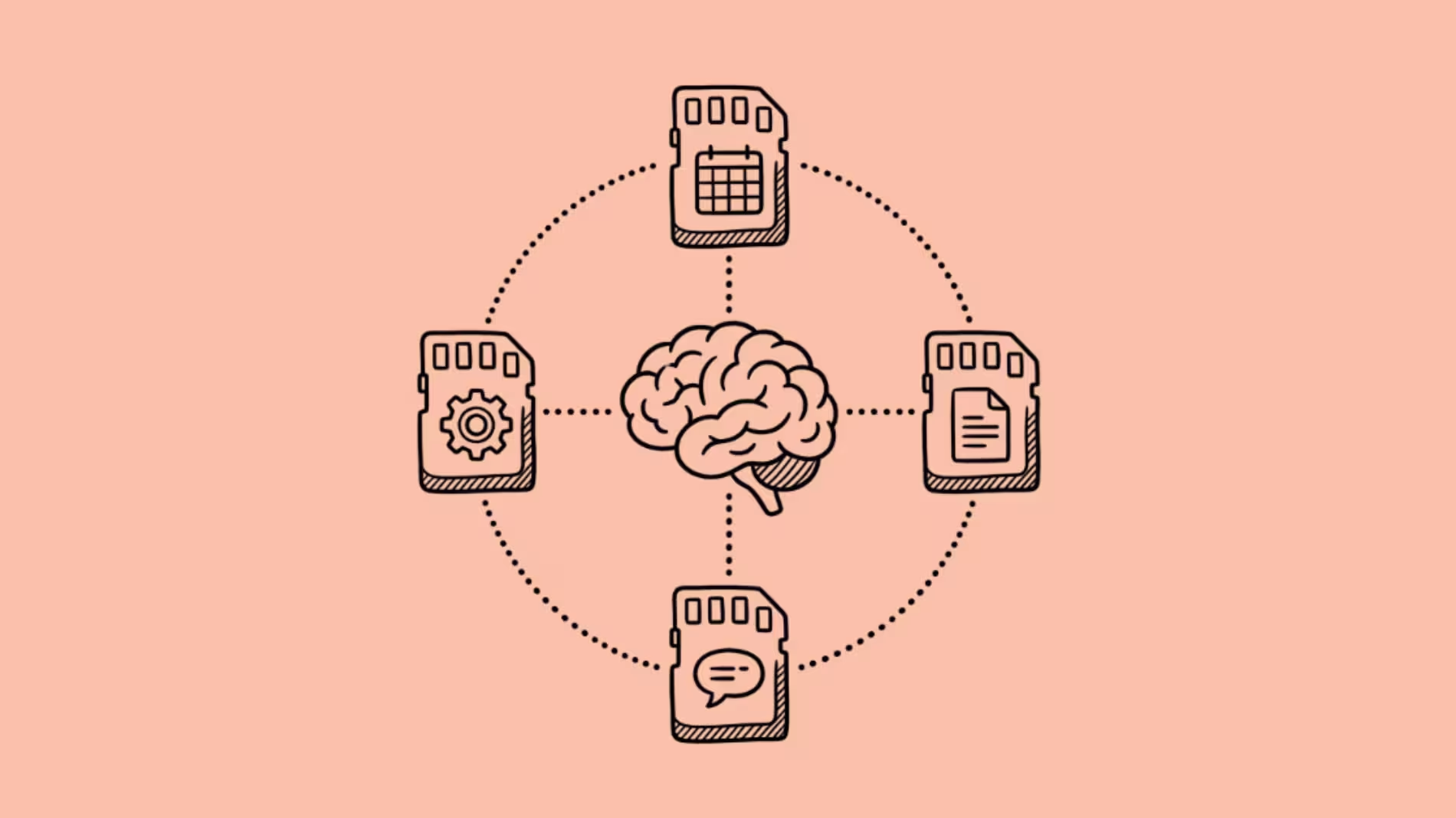

There has been a notable shift in how businesses are running their daily operations. Tasks that once required the effort of an entire team are now handled in seconds. Meetings get summarized before the call ends. Customer queries are resolved before a human logs in. Behind all this is a quiet revolution in which AI agents can perform work rather than make recommendations. They make decisions, take prompt action, and deliver results.
However, unlike basic automation tools that rely on predefined workflows, AI agents make decisions based on context. They process information, respond to shifting priorities, and complete multi-step tasks with less human involvement. For businesses of all sizes, that leads to fewer bottlenecks, reduced costs, and immediate results.
What is AI Automation?
AI automation is the use of artificial intelligence to perform daily business operations and processes that would normally require manual work and stepwise human intervention. It follows the same automation system that businesses have relied on for years. But instead of relying solely on fixed, predefined rules, it uses AI to analyze data, make decisions, and adapt to situations not explicitly programmed in advance.
Modern AI agents are powered by large language models and linked to real-world systems, including calendars, databases, CRMs, email platforms, and APIs. As these integrations become part of business operations, demand for AI agent development services is increasing. Firms today are seeking ways to automate their routine processes, enhance efficiency, and manage daily workflows effectively.
Where Are Businesses Deploying Them Today?
AI agents are becoming increasingly evident across business functions. So, here are the areas that are witnessing a growing impact:
Sales Development and Pipeline Management
Sales teams are using agents to manage repetitive front-end tasks such as scheduling calls, qualifying leads, and updating CRM records. This is beneficial for smaller sales teams that struggle with manual work. For this reason, AI automation tools for small businesses tackle this follow-up work automatically. This helps even a two- or three-person team remain as organized as a much larger sales department.
Key Automation Use Cases
- Lead qualification and pipeline prioritization
- Automatic CRM record updates
- Post-call summary and next steps
- Personalized outreach email drafting
Sales reps leave their meeting with follow-ups drafted and the pipeline already updated for the next step.
Customer Support and Service Routing
Customer support is another area where AI agents are increasingly being used to streamline operations. Businesses that choose it can effortlessly handle large volumes of customer queries consistently and promptly.
Reportedly, Gartner finds that 91% of customer service associates are under consistent pressure to adopt and use AI. The key focus is to achieve their initiatives for first-contact resolution and to reduce customer effort.
Key Automation Use Cases
- Instant ticket triage and routing
- Automated refund and order resolution
- Real-time query responses at scale
- Human escalation for complex cases
This helps teams manage a greater volume of queries without increasing headcount while maintaining consistent service quality.
Finance, Procurement, and Back-Office Processing
AI agents help streamline time-consuming accounting tasks that previously required manual effort and extensive review time. Today, these tasks are automated, maintain precision, and have built-in trails through AI agent development.
Key Automation Use Cases
- Automated invoice matching and processing
- Account reconciliation without manual input
- Anomaly detection and fraud flagging
- Automated financial summary generation
All month-end processes that previously took days are now completed overnight. This frees up finance teams to focus on better value analysis.
HR and Recruitment
HR departments are also using AI-powered recruitment automation. This helps in reducing the administrative workload of the hiring process. These automated systems manage the hiring pipeline right from candidate screening to scheduling. This enables recruiters to focus on building relationships and making final decisions.
McKinsey’s recent State of AI research found that 62% of firms are already piloting AI agents, and 23% are increasing the adoption of agent-based systems in one or more core business functions.
Key Automation Use Cases
- CV screening at high volume
- Interview scheduling without manual coordination
- Automated candidate follow-up emails
- Preliminary assessment and scoring tools
This helps to increase hiring speed and ensures that no candidate is lost due to administrative delays or issues.
IT Operations and Internal Tooling
AI agents are being widely deployed across the internal IT and software teams due to their structured, rule-driven work. Agents are now managing basic troubleshooting that earlier relied on human intervention.
Day-to-Day IT Applications
- Monitoring system health continuously
- Triaging internal support requests
- Drafting routine code changes
- Flagging unusual security activity
Tech firms across diverse sectors are now increasingly adopting AI agents since the existing technical framework makes integration extremely seamless.
The Real-World Benefits
The adoption of AI agents has brought about numerous advantages for businesses. These include:
Faster Execution Across Teams
Routine tasks that previously were handled manually consumed a lot of time. AI agents are getting the same tasks completed in minutes. This frees up a lot of time for internal teams to focus on high-value tasks.
Fewer Errors and Greater Consistency
Agents are never tired, do not shift their focus, and do not misinterpret data. Precision is built into the processes instead of relying on human attention.
Scalability Without Added Headcount
Only a single agent can effectively help manage a higher volume of workloads. Previously, these were managed by multiple employee interventions, especially during peak periods. Businesses using agents can now focus on their outputs instead of scaling their costs.
Final Thoughts
We are moving from automation that executes single tasks to agentic systems that manage entire workflows end-to-end. A customer complaint raised on a Monday morning can be logged, categorized, responded to, escalated if unresolved, and followed up on all before a human reviews the morning queue.
That level of operational continuity, running around the clock without breaks or handoff delays, is what gives early adopters a compounding advantage. The gap between businesses that have embedded AI agents in their operations and those that have not is widening and will continue to do so.
