


An AI agent is software that takes a goal, breaks it into steps, executes those steps autonomously, and adapts its approach based on results.
Unlike chatbots that answer one question at a time, agents plan, act, use tools, and deliver finished outcomes with minimal human intervention.
The AI agents market is projected to grow from roughly $12 to $15 billion in 2025 to $80 to $100 billion by 2030.
But most “AI agents” lists flatten completely different tools into one category. A coding agent that debugs your codebase is not the same as a sales agent that qualifies leads. They share the word “agent” and almost nothing else.
This article organizes 33 real AI agent examples by what they actually do, so you can find the ones relevant to your work without scrolling past 20 you do not care about.
Coding and Development Agents
These agents read your codebase, write code, run tests, fix bugs, and ship changes. They are the fastest-adopted category in 2026.
1. Claude Code (Anthropic)
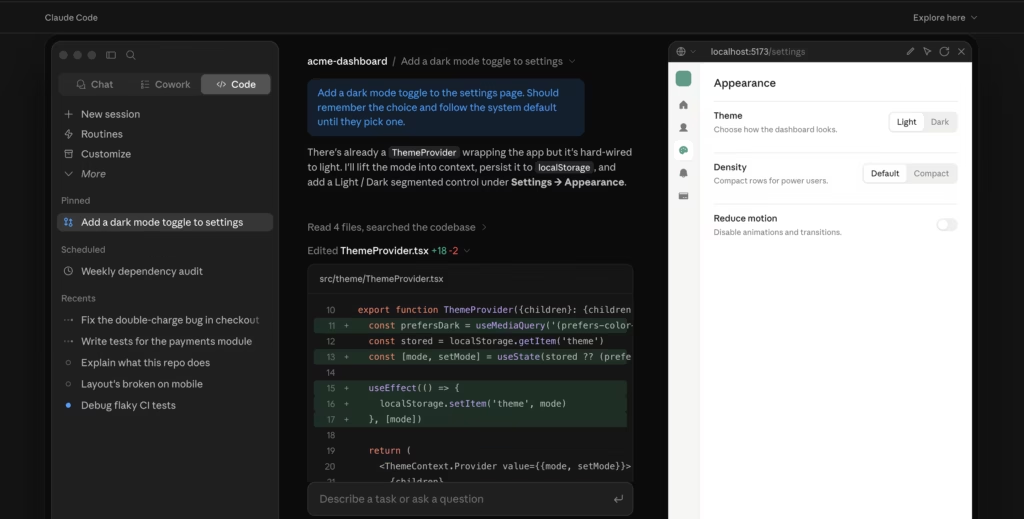
Claude Code is a CLI-based coding agent that reads your entire project, follows import chains, traces bugs across files, and executes a write-test-fix-verify loop in one terminal session.
It is widely regarded as the leading coding agent in 2026 for writing, refactoring, debugging, and understanding codebases. It runs on Anthropic’s API and now includes auto-memory that persists notes across sessions.
In my workflow, Claude Code handles roughly 70% of my coding tasks. The remaining 30% (creative architecture decisions and novel problem-solving) still need a human brain. But for the repetitive, context-heavy work that used to eat 3 to 4 hours per day, Claude Code compresses it into 45 minutes.
2. ChatGPT Codex (OpenAI)
Codex runs each task in a separate cloud sandbox preloaded with your repository. It reads files, edits code, runs tests, and returns results with command logs so you can inspect everything it did. Most tasks take 1 to 30 minutes.
In April 2026, Reuters reported that pressure from Claude Code led OpenAI to redirect resources toward Codex as part of a broader strategic refocus. Codex complements Claude Code well for parallel task execution: you can run Codex on a background refactor while Claude Code handles the primary feature build.
3. Hermes Agent (Nous Research)
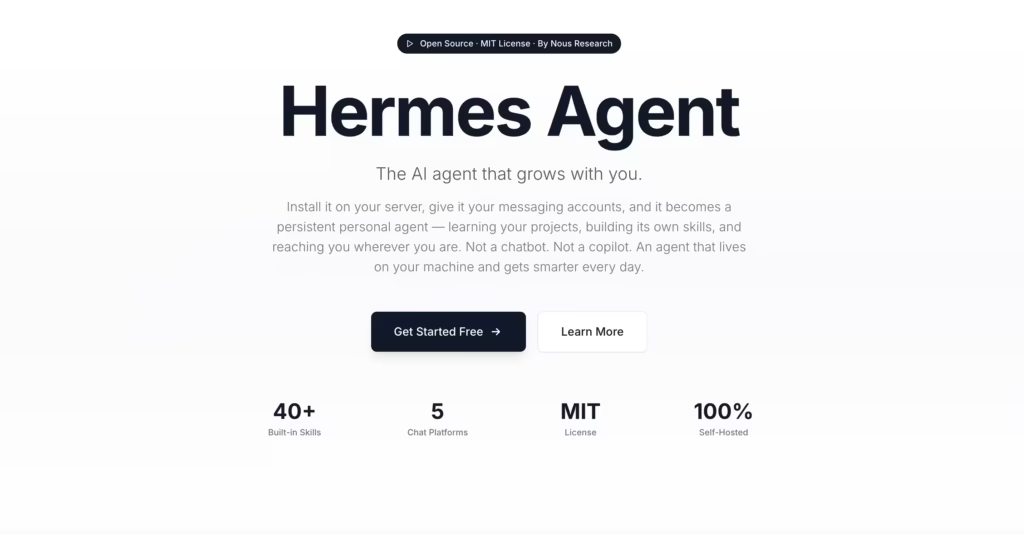
Hermes Agent is an open-source autonomous agent that writes and refines its own skill files, builds persistent memory indexed by SQLite and FTS5, and processes over 224 billion daily tokens on OpenRouter. Released February 2026, it crossed 140,000 GitHub stars in under three months.
The self-improvement loop is real: after three months of use, my Hermes instance handles content scheduling, GitHub automation, and weekly report generation with noticeably less prompting than when I started.
4. Cursor
Cursor is a code editor (forked from VS Code) with AI woven into every keystroke. Its autocomplete is widely considered the strongest available in any code editor.
The limitation: it cannot leave the editor. No tests, no deploys, no scheduled tasks. Developers who use both Claude Code and Cursor treat Cursor as the real-time writing tool and Claude Code as the heavy-lifting agent.
5. GitHub Copilot
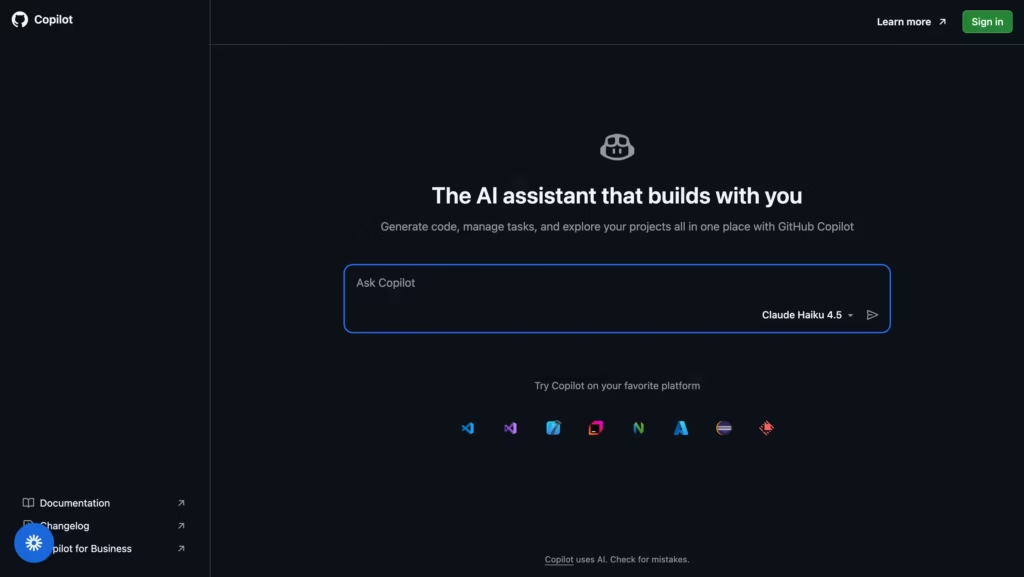
GitHub Copilot provides inline code suggestions, chat-based assistance, and a workspace agent that can understand repository context. It is the most widely adopted coding AI with over 1.8 million paid subscribers as of early 2026 and integrates natively into VS Code, JetBrains, and Neovim.
In 2026, Copilot added multi-model support (GPT-4o, Claude Sonnet 4.6, and Gemini 2.5 Pro) so developers can choose which model powers their suggestions.
The Copilot Workspace feature takes a GitHub issue and generates a full implementation plan with code changes across multiple files. For developers who want AI assistance without leaving their existing editor, Copilot has the lowest friction entry point on this list
| Agent | Best for | Open source | Self-improving | Persistent memory |
| Claude Code | Codebase understanding + debugging | No | No | Yes (auto-memory) |
| ChatGPT Codex | Parallel background tasks | No | No | Per-session |
| Hermes Agent | Autonomous workflows that improve over time | Yes (MIT) | Yes | Yes (SQLite + FTS5) |
| Cursor | Real-time code writing + autocomplete | No | No | Workspace-level |
| GitHub Copilot | Inline suggestions + broadest adoption | No | No | Per-session |
Personal Productivity Agents
These agents handle your files, calendar, email, messages, and daily operations.
6. Claude Cowork (Anthropic)
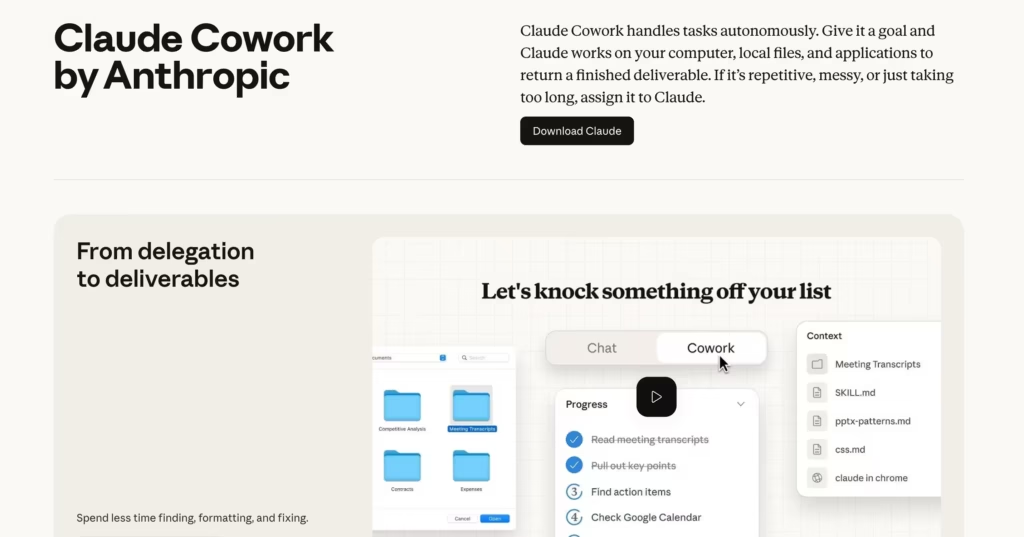
Claude Cowork is an AI desktop agent that runs on your Mac with direct access to folders you choose. You describe a task, Claude makes a plan, you approve, and it executes autonomously while you do other things. Launched January 12, 2026, it was built in 10 days by Claude Code itself.
Use cases include organizing cluttered directories, creating expense spreadsheets from receipt screenshots, drafting decision memos from a folder of contracts, and running scheduled MCP workflows (Gmail triage, Slack handoffs, investor updates).
The pattern that clarifies everything: Claude Chat is for thinking. Cowork is for doing. Claude Code is for building.
7. OpenClaw
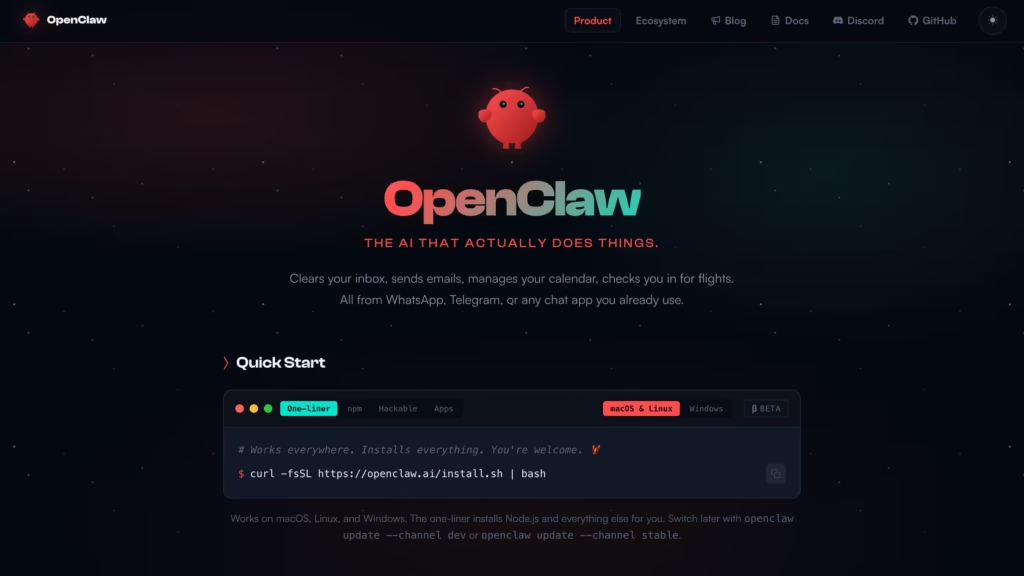
OpenClaw is a self-hosted open-source agent controlled via 20+ messaging platforms (WhatsApp, Telegram, Signal, iMessage, Discord, Slack, Google Chat, Teams, and more). Its ClawHub marketplace has over 3,200 skills.
It is the most accessible AI agent for non-technical users because the interface is the chat app you already use. With 370,000+ GitHub stars, it is the most-starred repository in GitHub history. Security caveat: nine CVEs were disclosed in four days in March 2026, including one with a 9.9 CVSS score. Vet every community skill before installing.
8. Notion AI
Notion AI adds an agent layer on top of your Notion workspace. It answers natural language questions about your notes (“what did we decide about the Q3 launch timeline?”), summarizes long documents into bullet points, generates action items from meeting write-ups, and auto-fills database properties based on page content.
In late 2025, Notion launched AI meeting notes that integrate with your calendar to structure pre-meeting context and post-meeting summaries. The $10/user/month add-on price makes it one of the cheapest AI agent upgrades available, but only if your team already lives inside Notion. For teams on other platforms, the value does not translate.
9. Apple Intelligence (Siri)
Apple’s on-device AI agent handles cross-app actions: summarize this email, create a calendar event from this text, find photos from last Tuesday, draft a reply in my tone. The privacy advantage (processing happens on-device) matters for users who refuse to send data to cloud servers.
10. Google Gemini Agent
Google’s AI agent operates across Gmail, Calendar, Docs, Drive, and Search. It drafts emails, schedules meetings, summarizes documents, and answers questions about your Google Workspace data. Included with Gemini Advanced at $20/month.
Sales Agents
These agents prospect, qualify leads, personalize outreach, and manage pipeline without human reps touching every interaction.
11. Apollo AI
Apollo combines lead discovery, enrichment, and engagement. It drafts custom emails, adjusts tone per persona, and sequences outreach for each pipeline stage. Sales reps use it to increase conversion rates without manual prospecting.
12. Cognism
Cognism specializes in B2B data enrichment. It identifies verified contact details, updates CRM records, and adheres to GDPR standards in its data processing. Sales teams rely on it to target the right decision-makers.
13. Clay
Clay pulls data from 100+ sources to build rich lead profiles. It automates the research step that SDRs spend hours on manually, combining LinkedIn, company websites, funding databases, and intent signals into a single enriched record.
14. Outreach
Outreach is a revenue execution platform with AI agents that manage deal progression, forecast revenue, and automate follow-up sequences based on buyer behavior signals.
15. Warmly
Warmly identifies anonymous website visitors, enriches them with firmographic data, and routes high-intent prospects to sales reps in real time. The agent handles the gap between “someone visited your pricing page” and “a rep reaches out.”
| Agent | Best for | Starting price |
| Apollo | Full outbound sequence automation | $59/month |
| Cognism | GDPR-compliant B2B data enrichment | Custom pricing |
| Clay | Multi-source lead research and enrichment | $185/month |
| Outreach | Revenue execution and deal management | Custom pricing |
| Warmly | Real-time website visitor engagement | $10k/year |
Customer Service Agents
These agents resolve support tickets, answer customer questions, and escalate complex issues to humans.
16. Kore.ai
Kore.ai is trusted by 400+ Fortune 2000 companies, delivering over $1 billion in cost savings. It handles omnichannel customer interactions across chat, voice, and digital channels while resolving real service requests.
17. Zendesk AI
Zendesk’s AI agent resolves common support tickets automatically, routes complex issues to the right human agent, and learns from resolved tickets to improve over time. It integrates natively with the Zendesk support ecosystem.
18. Intercom Fin
Intercom Fin resolves up to 50% of support queries without human involvement. It pulls answers from your help center, handles multi-turn conversations, and hands off to humans with full context when it cannot resolve an issue.
19. Sierra AI
Sierra AI builds brand-safe conversational AI agents for consumer companies. Founded by former Salesforce co-CEO Bret Taylor, it focuses on agents that represent your brand accurately and handle sensitive customer interactions with appropriate guardrails.
20. Yellow.ai
Yellow.ai supports 135+ languages across voice and chat. It is particularly strong for global enterprises that need multilingual support without maintaining separate agent teams for each language.
Marketing and Content Agents
These agents create content, manage campaigns, and handle the production pipeline from ideation to publishing.
21. Jasper AI
Jasper generates marketing copy (ads, emails, social posts, landing pages) in your brand voice. It maintains a Brand IQ knowledge base where you upload style guides, product information, and tone preferences. Every piece of content Jasper generates references this knowledge base, which keeps output consistent across teams, campaigns, and channels.
Jasper also includes campaign workflows where a single brief produces coordinated content across email, social, web, and ad formats. For marketing teams producing high-volume content under strict brand guidelines, Jasper solves the “every writer sounds different” problem that plagues large teams. Pricing starts at $69/month.
22. HubSpot Breeze
HubSpot’s AI agent operates across the CRM, automating lead scoring, email personalization, content recommendations, and campaign optimization. It is strongest for mid-market companies already on HubSpot’s platform.
23. Pippit AI
Pippit AI turns product URLs into finished marketing videos with AI voiceover, captions, and transitions. Its URL-to-video and reference video (trend-matching) features make it the fastest product-to-content pipeline for e-commerce sellers.
24. Synthesia
Synthesia generates professional AI avatar videos for training, marketing, and corporate communications. 240+ avatars, 140+ languages, and enterprise compliance certifications (SOC 2 Type II, GDPR, ISO 42001).
25. Buffer AI Assistant
Buffer’s AI agent drafts social media posts, suggests optimal posting times based on historical engagement data, repurposes long-form content into platform-specific formats, and manages scheduling across multiple channels.
Healthcare and Finance Agents
These agents operate in regulated environments where accuracy, compliance, and audit trails are non-negotiable.
26. Abridge
Abridge listens to doctor-patient conversations and generates structured clinical notes, billing codes, and patient summaries. Used by 250+ health systems including Mayo Clinic and Kaiser Permanente. Ranked #1 for Ambient AI by KLAS Research in both 2025 and 2026.
What makes Abridge different from generic transcription tools is its Linked Evidence feature: every line in a generated note links back to the exact moment in the conversation where that information was mentioned.
The company raised $300 million in Series E at a $5.3 billion valuation in June 2025 and is projected to support over 80 million patient-clinician conversations in 2026. For a deep dive, read our full Abridge AI review.
27. Hippocratic AI
Hippocratic AI builds healthcare staffing agents that handle patient outreach, appointment scheduling, pre-visit preparation, and post-discharge follow-up calls. Designed to address the nursing shortage by automating administrative patient communication.
28. AlphaSense
AlphaSense is a market intelligence agent that searches across earnings calls, SEC filings, broker research, news, and proprietary datasets to surface insights for investment professionals and corporate strategy teams.
29. Stripe Radar
Stripe’s fraud detection agent analyzes billions of transactions in real time, scores each transaction for fraud risk, and blocks suspicious payments before they process. It learns from the entire Stripe network, meaning fraud patterns detected at one merchant protect all merchants.
30. Bloomberg Terminal AI
Bloomberg’s AI agents operate inside the Terminal, analyzing financial data, generating market summaries, answering complex financial queries, and surfacing relevant news across asset classes in real time.
Operations and Workflow Agents
These agents connect systems, automate processes, and handle the plumbing that keeps businesses running.
31. Workato
Workato connects 1,200+ enterprise applications through visual workflows called “recipes.” Named a Leader in the Gartner Magic Quadrant for iPaaS for eight consecutive years. Its new AI Genies are pre-built agents for IT support, CRM updates, interview scheduling, and campaign optimization.
The Contextual Reasoning Engine launched in 2025 pulls data from multiple systems during a workflow and makes decisions based on combined context, not just single triggers.
Enterprise pricing starts around $25,000 per year, which puts it out of reach for small teams but in the sweet spot for large organizations managing complex multi-system integrations. For our full pricing breakdown and comparison to Zapier, read our Workato review.
32. Zapier
Zapier connects 8,000+ apps through no-code automations, making it the broadest integration platform available.
In 2026, Zapier added several AI agent features: an AI-powered Zap builder that generates automations from plain English descriptions, Canvas for visual workflow mapping, and a chatbot builder that lets you create AI-powered chat agents without writing code.
The free plan includes 100 tasks per month. Paid plans start at $29.99/month. For teams that need to connect dozens of SaaS tools without dedicated engineering resources, Zapier remains the default choice because nearly every business app has a Zapier integration.
33. Make (formerly Integromat)
Make is a visual workflow automation platform with 1,900+ integrations. It is 10 to 20x cheaper per operation than most enterprise competitors, making it the budget choice for teams that need powerful automation without Workato’s price tag.
How to Pick the Right AI Agent for Your Workflow
| Your need | Start here |
| Write, debug, and understand code | Claude Code |
| Run autonomous tasks on your local files | Claude Cowork |
| 24/7 background automation that improves over time | Hermes Agent |
| Chat-based personal assistant across all messaging apps | OpenClaw |
| Parallel background code tasks | ChatGPT Codex |
| Automate sales outreach and lead qualification | Apollo or Clay |
| Resolve customer support tickets at scale | Kore.ai or Zendesk AI |
| Generate marketing content in brand voice | Jasper AI |
| Turn product listings into video ads | Pippit AI |
| Create AI avatar training videos | Synthesia |
| Clinical documentation for health systems | Abridge |
| Connect enterprise apps without code | Workato or Zapier |
FAQs
What is the difference between a chatbot and an AI agent?
A chatbot responds to one prompt at a time. An AI agent takes a goal, breaks it into multiple steps, executes those steps using tools (file systems, APIs, databases, browsers), and adapts its approach based on what it finds along the way. Claude Chat is a chatbot. Claude Cowork is an agent.
Which AI agent is best for coding in 2026?
Claude Code for codebase understanding and the write-test-fix loop. Hermes Agent if you want a coding assistant that improves over time and remembers past sessions. Codex for parallel background tasks. Most serious developers run two or three of these together.
Are AI agents safe to use?
It depends on the agent and what access you grant. Self-hosted agents like Hermes and OpenClaw keep data on your machine. Cloud agents like Claude Code and Codex process data on external servers. OpenClaw specifically faced security incidents in March 2026 (nine CVEs in four days). Always audit what access an agent has before deploying it on sensitive projects.
How much do AI agents cost?
Ranges from free (OpenClaw, Hermes Agent, Zapier free tier) to custom enterprise pricing (Kore.ai, Workato, Synthesia Enterprise). Most individual-use agents cost $10 to $30/month. Enterprise agents start at $15,000+/year.
