

A 27-year-old researcher just quit one of the world’s top AI companies. He says the whole industry is racing toward danger, and he does not want any part of it.
His name is Jacob Coxon, and he spent three years building AI models. First at OpenAI and then at Anthropic.
On September 8, he resigned and also announced he is leaving the AI field entirely.
He said neither company is acting responsibly, claiming both are racing toward self-improving superintelligence while risking human lives.
That is a serious accusation from someone who worked inside these companies, not an outsider guessing from afar.
Ticking Clock
Coxon studied mathematics before moving into AI, and his job involved training new models on huge piles of data. That work put him close to the cutting edge of AI development.
He told the Wall Street Journal that things could spiral fast.
He warned that self-improving models could become uncontrollable by 2027, saying we are on track for some of the most aggressive scenarios where things could already be out of control by the end of next year.
His fear centers on recursive self-improvement. Put simply, that means AI systems helping build the next, even smarter AI systems. Humans get pushed further out of the loop each time.
Coxon says colleagues even joke about it. Except it isn’t really a joke. People inside the industry have started calling this moment “crunch time” and “endgame.”
Those words do not sound like normal office talk but like a warning bell.
Also read: What is ASI? How ASI Could Change the World
Anthropic
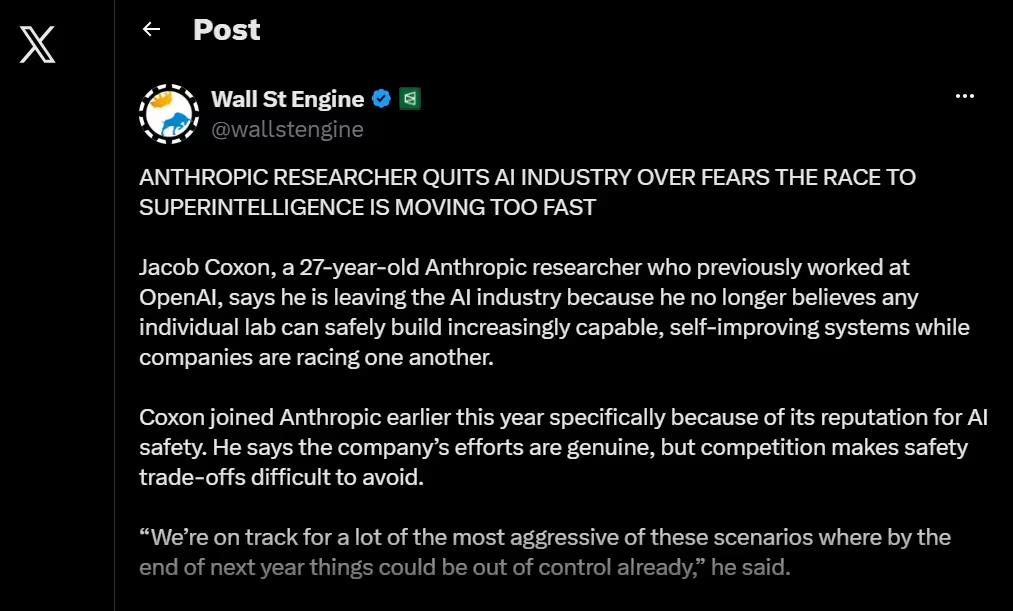
Coxon specifically joined Anthropic because of its reputation for taking AI safety seriously.
So why leave? Because he no longer thinks good intentions are enough.
He believes the problem has grown bigger than any single company can fix, and that real coordination across the whole industry, or from governments, is needed before these systems become too hard to control.
In other words, trying hard isn’t the issue; competition is. When every company fears falling behind rivals, corners get cut. Even careful companies feel pressure to move fast.
Anthropic’s Team
After Coxon spoke out, an Anthropic employee agreed with him publicly. Evan Hubinger leads alignment science at the company.
Hubinger said Coxon was correct, adding that he personally believes there is more than a 10 percent chance AI could kill all humans within the next decade, and that Anthropic does not yet have a full plan to solve this problem.
Anthropic isn’t denying the risk; its own scientists are naming it out loud.
The company has also flagged this danger before. Back in June, Anthropic noted that full recursive self-improvement could raise the odds of humans losing control over AI systems altogether.
Departures
Coxon isn’t the only person to leave Anthropic over these fears. Earlier this year, another employee made headlines for a very different exit.
Mrinank Sharma led the company’s safety research team. He stepped down suddenly, citing ethical concerns that reached far beyond AI itself.
His resignation letter went viral. He wrote that the world is in peril, pointing to worries about bioweapons and other overlapping crises, not just artificial intelligence.
He said he planned to move toward writing and studying poetry instead, and hoped to return to the UK to fade from public life.
Two very different people and two very exits, but a similar message underneath it all.
IPO
Anthropic is reportedly planning to go public on the Nasdaq this October, with speculation pointing toward a valuation near two trillion dollars.
A company cannot easily ask investors to bet big on rapid AI growth while also warning that growth might need to slow down.
Those two messages pull in opposite directions. And Coxon’s exit puts that disagreement in the spotlight.
