
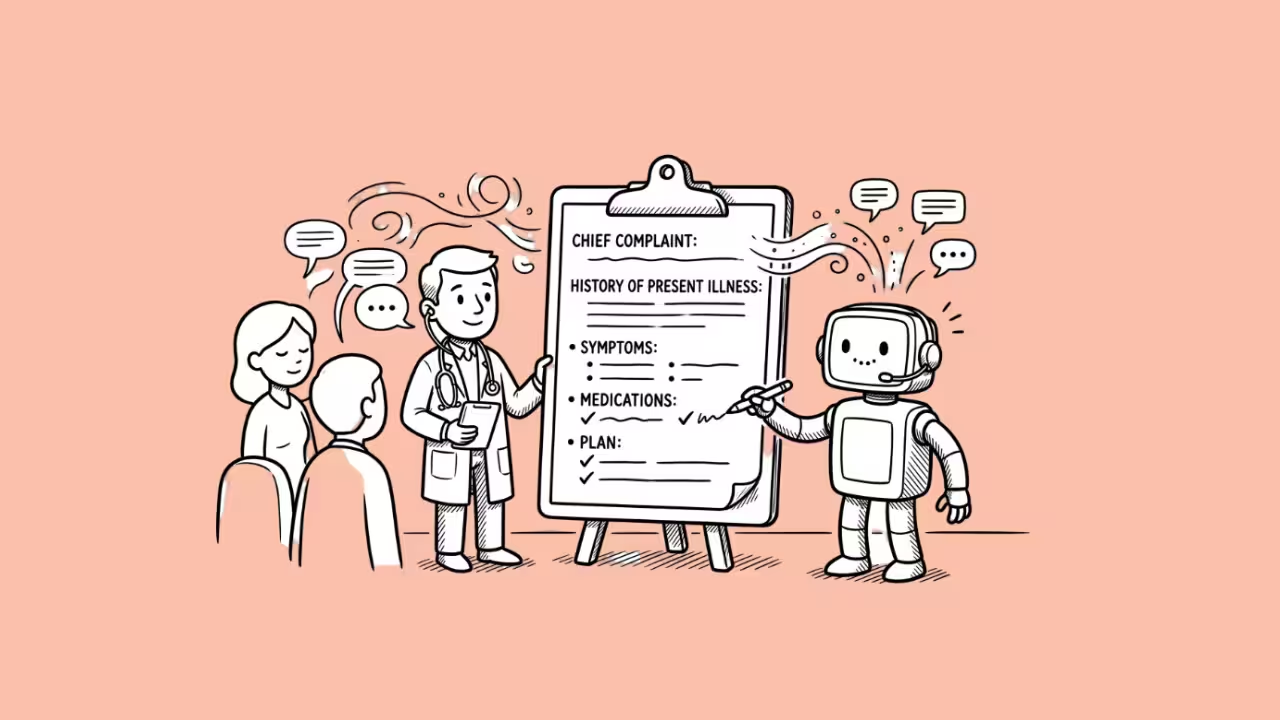

So, what is Abridge AI?
Abridge AI is an enterprise-grade artificial intelligence platform that listens to conversations between doctors and patients, then automatically turns those conversations into structured clinical notes, billing codes, and plain-language patient summaries.
It was founded in 2018 in Pittsburgh, Pennsylvania, by practicing cardiologist Dr. Shiv Rao and AI researcher Zachary Lipton, an associate professor at Carnegie Mellon University specializing in machine learning and healthcare applications.
In simpler terms: Abridge acts like an AI-powered medical scribe.
Instead of a doctor spending two hours after their shift typing up notes from patient visits, Abridge does it in real time while the doctor focuses on the person sitting in front of them.
That might sound like a small change. It is not. Physician burnout has been a crisis in American healthcare for over a decade, and documentation is a massive driver of it.
Abridge exists to fix that specific problem, and as of April 2026, it is being used in over 250 health systems across the United States, including Mayo Clinic, Kaiser Permanente, Johns Hopkins, Duke Health, and the Veterans Health Administration.
The company is projected to support over 80 million patient-clinician conversations this year alone.
Who Founded Abridge and Why Does That Matter?
The people behind a healthcare AI tool tell you a lot about whether you should trust it.
Dr. Shiv Rao still practices cardiology a few times per month. That is not a marketing line.
He built Abridge because he lived the problem firsthand. During long ICU shifts as a resident, he saw how much time clinicians wasted on documentation instead of patient care. That personal frustration became the company’s founding mission.
His co-founder, Zachary Lipton, serves as both Chief Technology Officer and Chief Science Officer. Lipton’s academic work at Carnegie Mellon focuses specifically on making machine learning reliable in healthcare settings, which is exactly the kind of background you want behind a tool that generates medical records.
The leadership team also includes Sagar Sanghvi (former CFO of Instacart and partner at Accel) as Chief Financial Officer, and Brian Wilson (formerly of NextGen Healthcare) as Chief Commercial Officer.
Why does this matter? In a field flooded with AI startups that have zero clinical expertise, Abridge was built by clinicians and AI scientists who understood both sides of the problem from day one. TIME named it one of the Best Inventions of 2024.
Forbes put it on the AI 50 list in 2025. Fast Company ranked it the #1 Most Innovative Company in Healthcare in 2026. KLAS Research, the most respected independent evaluator in health IT, named Abridge #1 Best in KLAS for Ambient AI in both 2025 and 2026.
How Does Abridge AI Actually Work?
The workflow is surprisingly straightforward for a tool running inside some of the most complex hospital systems in the country.
Here is how it works in practice:
Step 1: The clinician activates Abridge. This happens either through the Abridge app on a phone or computer, or directly within the Epic electronic health record (EHR) system. The patient is informed and gives consent before recording begins.
Step 2: Abridge listens to the conversation. The AI captures the full conversation using ambient listening. Nobody needs to dictate, press buttons, or issue voice commands. The doctor just talks to the patient like normal.
Step 3: The AI generates a structured clinical note. Within minutes, Abridge produces a complete note in SOAP format (Subjective, Objective, Assessment, and Plan), which is the standard charting method most clinicians use. The note is formatted to match each clinician’s template preferences.
Step 4: Linked Evidence lets the doctor verify. This is Abridge’s most distinctive feature. Every line in the generated note links back to the exact moment in the conversation transcript where that information was mentioned.
A doctor can click on any statement in the note and instantly see (or hear) the source. No other major competitor offers this level of traceability.
Step 5: The note flows into the EHR. For Epic users, the integration is deep. Notes go directly into the appropriate chart sections. The clinician reviews, edits if needed, and approves.
Step 6: A patient summary is generated automatically. Abridge creates a plain-language after-visit summary written at roughly an 8th-grade reading level. This gets delivered to the patient without the doctor needing to write it separately.
That entire process replaces what used to take clinicians hours of after-hours documentation.
Health systems using Abridge have reported that clinicians save up to 2 hours per day on documentation (according to Contrary Research’s analysis of 2023 deployment data), and Christus Health reported a 78% reduction in clinician burnout tied to documentation.
What Makes Abridge Different from Other AI Medical Scribes?
The AI medical scribe market has exploded. There are now dozens of tools competing for hospital contracts.
But they are not all built the same way, and the differences matter for accuracy, trust, and long-term value.
Here is how Abridge stacks up against its biggest competitors:
| Feature | Abridge | Nuance DAX Copilot (Microsoft) | Ambience Healthcare | Nabla |
| Primary market | Enterprise health systems | Enterprise health systems | Enterprise health systems | Small to mid-size practices |
| Epic integration depth | Deep (Haiku, Hyperdrive) | Deep (Haiku, Hyperdrive) | Moderate | Moderate (6 EHR systems) |
| Linked Evidence (note-to-source tracing) | Yes (unique feature) | No | No | No |
| Languages supported | 28 | Limited | Limited | Limited |
| Specialties covered | 55+ | 30+ | Deep in select specialties | General |
| Patient after-visit summary | Auto-generated | Not a core feature | Not a core feature | Not a core feature |
| Revenue cycle / billing intelligence | Yes (Contextual Reasoning Engine) | Limited | Yes (coding-aware) | No |
| Approximate cost per clinician | ~$2,500/year (enterprise contract) | ~$600/month (~$7,200/year) | Enterprise pricing (not public) | $119/month (~$1,428/year) |
| Available to individual clinicians? | No (enterprise only) | No (enterprise only) | No (enterprise only) | Yes |
| HIPAA compliant | Yes | Yes | Yes | Yes |
| Best in KLAS ranking (2026) | #1 Ambient AI | Strong presence | Not ranked #1 | Not ranked |
A few things stand out in that comparison. Abridge’s Linked Evidence feature is genuinely unique.
In a world where AI-generated clinical notes carry real legal and medical weight, being able to trace every line back to what was actually said in the conversation is a significant trust advantage. None of the other major competitors offer this.
In my assessment, Linked Evidence is the single most important differentiator in this entire market. Every AI model hallucinates sometimes. In most industries, that is an inconvenience. In healthcare, a hallucinated detail in a clinical note could lead to a wrong prescription, a missed diagnosis, or a billing audit.
Abridge is the only tool that gives doctors a one-click way to verify whether the AI got it right. That alone, in my view, justifies its position at the top of the KLAS rankings.
Abridge is also considerably cheaper than Nuance DAX Copilot on a per-clinician basis, while offering broader language support and more specialty coverage. That said, Nuance benefits from Microsoft’s infrastructure and has decades of history in medical speech recognition, so it remains the default choice in some deeply embedded Epic environments.
For individual doctors or small practices, Abridge is not an option. It sells exclusively to health systems through enterprise contracts. If you are a solo practitioner looking for an AI scribe, tools like Nabla, Freed, or Suki are more accessible.
This is the biggest gap I found while researching this tool. According to the American Medical Association, roughly 40% of US physicians work in practices with fewer than 10 doctors. Abridge’s enterprise-only model locks every single one of them out, no matter how badly they need documentation relief.
These are often the clinicians experiencing the worst burnout because they lack the administrative support that large hospital systems provide.
Until Abridge offers a self-serve tier or a small-practice plan, it is solving the burnout problem only for the half of American medicine that already has the most resources..
How Much Funding Has Abridge Raised?
The numbers tell their own story about where the market is headed.
Abridge has raised over $800 million in total funding across multiple rounds. The key milestones:
- Series C (February 2024): $150 million to invest in foundation model research
- Series D (February 2025): $250 million co-led by Elad Gil and IVP, valuing Abridge at $2.75 billion
- Series E (June 2025): $300 million led by Andreessen Horowitz, pushing the valuation to $5.3 billion
- Series E extension (April 2026): $316 million raise announced
Investors include NVIDIA’s venture arm (NVentures), CVS Health Ventures, Kaiser Permanente Ventures, Lightspeed Venture Partners, Bessemer Venture Partners, Redpoint Ventures, Spark Capital, and CapitalG (Alphabet’s investment fund).
Sacra, an independent research firm, estimates Abridge hit $100 million in annual recurring revenue (ARR) in May 2025, up from roughly $60 million at the end of 2024.
That kind of revenue growth in healthcare AI is rare and signals strong product-market fit with the large hospital systems that make up Abridge’s customer base.
What Is the Contextual Reasoning Engine?
In February 2025, Abridge launched what it calls the Contextual Reasoning Engine. This is worth understanding because it marks Abridge’s shift from a passive note-taking tool to an active clinical assistant.
The Contextual Reasoning Engine pulls information from multiple sources during a patient visit: the live conversation, the patient’s existing medical record, previous visits, and insurer guidelines.
It uses all of that context to generate notes that are not only clinically accurate but also properly coded for billing, helping close revenue cycle gaps at the point of care.
Then in April 2026, Abridge announced new partnerships with the New England Journal of Medicine (NEJM) and the JAMA Network.
These partnerships bring peer-reviewed medical evidence from those journals directly into Abridge’s clinical decision support tools, alongside existing integration with Wolters Kluwer’s UpToDate database (which covers over 13,000 clinical topics).
Dr. Rao described the vision to Fast Company in March 2026: the goal is to make clinicians “near-omniscient” by giving them real-time access to a patient’s full history, relevant research, and insurance requirements during the conversation itself.
That is an ambitious claim. But the infrastructure backing it (purpose-built models, NEJM/JAMA partnerships, deep Epic integration) is more concrete than what most AI healthcare startups bring to the table.
What Is AI in Healthcare Doing Beyond Medical Scribes?
Abridge is one piece of a much larger shift.
AI in healthcare is expanding rapidly across multiple areas: diagnostic imaging, drug discovery, clinical trial matching, remote patient monitoring, mental health chatbots, and administrative automation.
But ambient AI scribes like Abridge represent one of the fastest-adopted categories because the problem they solve (clinician burnout from documentation) is so immediate and so universal.
According to a 2024 study from the National Academy of Medicine, physicians spend roughly two hours on documentation for every one hour of direct patient care. That ratio is unsustainable. It drives burnout, shortens appointment times, and ultimately hurts patient outcomes.
AI in healthcare tools like Abridge attack that ratio directly. When documentation happens automatically in the background, doctors get those two hours back. They can see more patients, spend more time with each one, or simply go home at a reasonable hour.
That is not a marginal improvement. For healthcare systems struggling with clinician shortages and retention, it changes the math on how many patients a system can serve.
FAQs
1) Is Abridge AI HIPAA compliant?
Yes. Abridge is fully HIPAA compliant and provides a Business Associate Agreement (BAA) to covered entities.
All data is encrypted both in transit and at rest, and it is stored in US-based data centers. Kaiser Permanente confirmed compliance with state and federal privacy laws as part of their enterprise-wide deployment.
2) Can individual doctors sign up for Abridge?
No. Abridge operates exclusively through enterprise contracts with health systems. If you are an individual clinician or small practice, you cannot purchase Abridge directly.
Alternatives for solo practitioners include Nabla ($119/month), Freed ($99 to $149/month), and Suki.
3) Does Abridge work with EHR systems other than Epic?
Abridge’s deepest integration is with Epic, which is the EHR used by the majority of large US health systems.
The platform does support other care settings and workflows, but Epic integration is where Abridge has its strongest advantage and the most mature feature set.
4) Does Abridge record my conversation with my doctor?
Yes, with consent. Abridge uses ambient listening to capture patient-clinician conversations.
The patient must be informed and consent before the recording begins. Audio is stored temporarily (typically 90 days) for verification purposes and is handled under HIPAA protections.
5) How accurate are the notes Abridge generates?
Abridge does not publish a single accuracy percentage, but its Linked Evidence feature allows clinicians to verify every statement in a generated note against the source conversation.
This transparency mechanism is one of the reasons KLAS Research ranked it #1 for Ambient AI for two consecutive years. Clinicians always review and approve notes before they become part of the medical record.
6) What specialties does Abridge support?
Abridge supports over 55 medical specialties as of 2026, including cardiology, oncology, primary care, emergency medicine, psychiatry, and many others.
It also supports 28 languages for multilingual patient populations
