
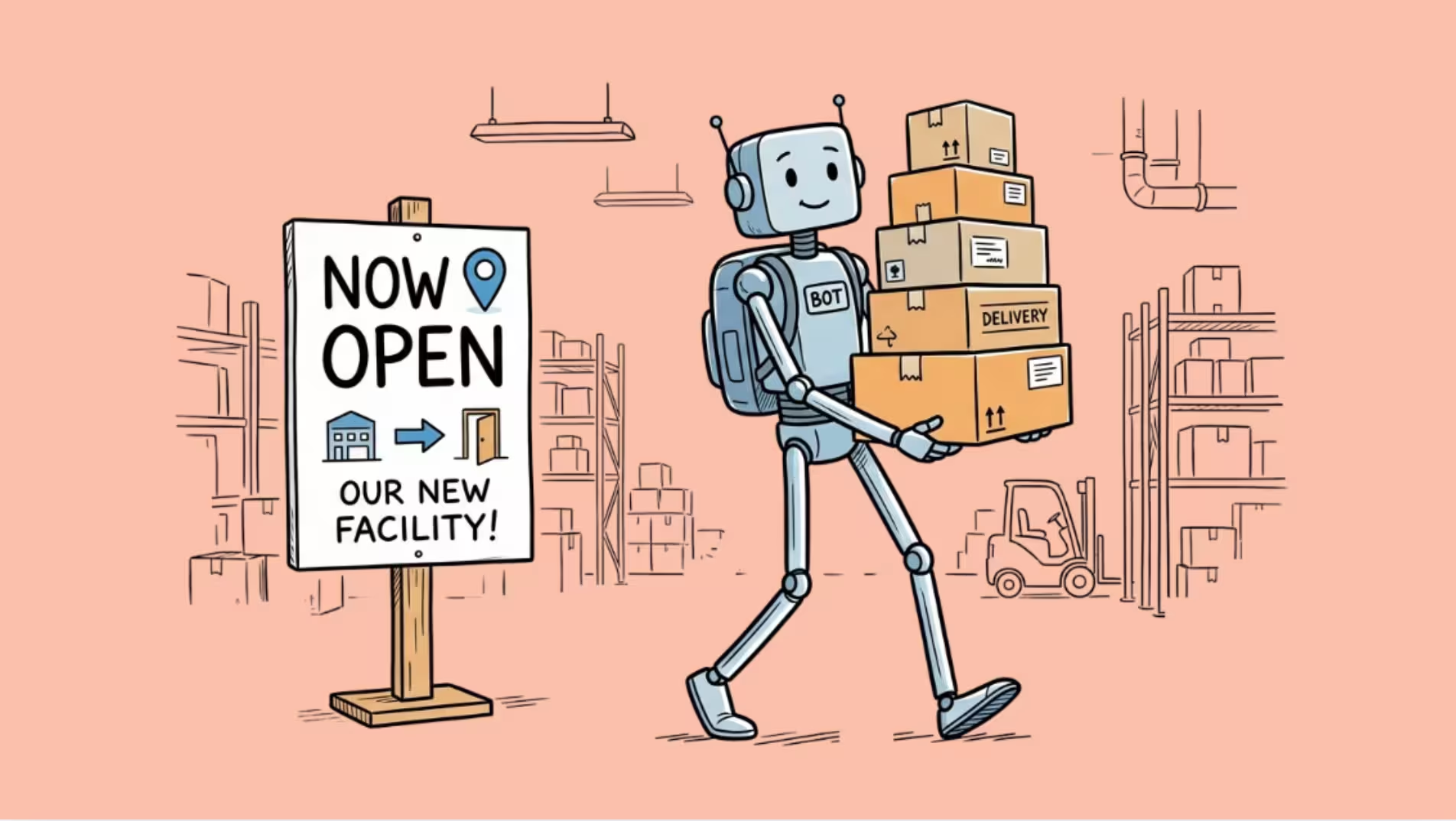

Tesla keeps promising its robots will change the world. Agility’s robots are already working. Now the company is setting up shop a few miles from Tesla’s factory, and daring anyone to compare notes.
On Wednesday, Agility Robotics announced the opening of a 60,000-square-foot facility in Fremont, California.
That’s the same city where Tesla is expected to begin manufacturing its Optimus humanoid robots later this year. The proximity is not lost on anyone.
“Fremont is where we build the mind of Digit, while Salem is where we build the body,” CEO Peggy Johnson told TechCrunch.
Salem, Oregon, is where Agility’s RoboFab manufacturing plant operates. Fremont is where Digit, the company’s six-foot humanoid, will learn new skills in environments that mirror real customer warehouses and factory floors.
The company plans to hire nearly 200 people at the new site across AI, machine learning, software engineering, and field operations. Fremont Mayor Raj Salwan welcomed the move, calling it “continued investment” in a city already home to advanced manufacturing and robotics companies.
Digit Is Already on the Clock
Here’s what separates Agility from most of the humanoid hype. Digit is generating revenue. Right now.
The robot carries totes and bins in manufacturing and warehouse settings for Amazon, GXO, Schaeffler, Toyota Motor Manufacturing Canada, and Mercado Libre. At a GXO logistics facility alone, Digits have moved 100,000 totes.
Agility says it has $300 million in multi-year contract orders for its next-generation Digit v5, with more than 30 additional customers in talks.
That’s not a prototype demo reel. That’s a business.
Tesla, by contrast, is still showing off Optimus at events and running pilot deployments inside its own factories. Elon Musk recently said he expects Optimus to be “the biggest product ever” once it’s useful outside of Tesla sometime next year. Johnson’s response was diplomatic:
“It’s great to have them in the same area as us, because really, for a long time Agility was out there alone.”
AI Does the Thinking. Physics Does the Walking.
Agility was founded in 2015 by researchers who developed new techniques for bipedal walking.
That’s a decade of engineering focused on one problem: getting a robot to move safely on two legs in messy, unpredictable environments.
The company’s approach to AI is pragmatic. Co-founder and chairman Damion Shelton put it bluntly: “You don’t want to get creative with your safety stack.”
Safety-critical systems like balance, collision avoidance, and joint control stay under classical robotics. AI handles higher-level planning, learning new tasks, and adapting to new environments.
That split is intentional. Shelton compared it to self-driving cars: you wouldn’t want a generative AI model controlling the anti-lock brakes. Same logic applies to a 140-pound robot walking through a warehouse full of people.
But AI is what makes the business scalable. Co-founder and chief robot officer Jonathan Hurst sees a clear path: start with bins and totes. Then picking and kitting. Then cardboard handling.
Then loading and unloading trailers. “Okay, now we’re at 100 million robots, you know? A trillion-dollar company.”
Going Public in a Crowd
Agility is in the middle of a reverse-merger with Churchill Capital Corp XI (NASDAQ: CCXI) that would make it the first publicly listed pure-play humanoid robot company. The listing is expected later this year.
That’s a bold move in a crowded field. Figure, 1X, the Bot Company, Sunday Robotics, and others are all raising enormous rounds to build humanoid systems. And Tesla has capital that none of them can match.
But Agility has something the others don’t: paying customers who’ve already integrated robots into production workflows.
The Fremont facility is designed to widen that lead, giving the company a Silicon Valley talent base to complement its Oregon manufacturing operation.
No Home Robots. Not Yet.
One thing Agility isn’t doing: selling robots for your living room.
Johnson and her team are clear that today’s humanoids aren’t safe enough for consumer environments.
Current Digits operate in human-free zones within warehouses. The upcoming Digit v5, expected this fall, will be able to sense and safely work around humans for the first time.
That’s a big step. But it’s still a warehouse step, not a kitchen step. Most independent robotics experts agree. Homes are harder. Factories pay.
For now, Agility is planting its flag in Fremont, hiring engineers, and betting that the company with working robots beats the company with the biggest promises. With Tesla right down the road, we’ll find out soon enough whether that bet pays off.
